

Yes, workplace bullying can seriously harm your mental health, causing anxiety, depression, panic attacks and, in severe cases, suicidal thoughts. If you're experiencing it, your first steps are to ensure your immediate safety, start a contemporaneous record of incidents, and contact your GP or a helpline if your health is suffering. Acas, the NHS and Mysafetherapy can all offer support from here.
TL;DR:
- Workplace bullying often builds over time through repeated undermine, exclusion, and criticism, with sleep disruption being the first warning sign.
- Victims face risks of anxiety, panic attacks, depression, burnout, and in severe cases, suicidal thoughts, with research linking bullying to higher odds of diagnosed mental disorders.
- Recording incidents with detailed logs and screenshots strengthens future HR or legal claims, especially when behavior involves personal attacks or covert harassment.
- Support options include direct conversations, escalating to HR or unions, formal grievances, and seeking legal advice if bullying ties to protected characteristics under the law.
- Therapy, workplace policies, and bystander intervention play crucial roles in long-term recovery and prevention, with early mental health support helping manage ongoing distress.
Table of Contents
- How does workplace bullying affect mental health?
- Is what you're experiencing actually bullying?
- What can you do at work right now?
- What are your legal rights under UK law?
- Where can you get support in the UK?
- How does accredited therapy help you recover?
- Why does bullying damage more than the individual?
- Can colleagues make a real difference by speaking up?
- How is bullying different from ordinary conflict or harassment?
- Can workplace policies actually prevent bullying?
- What does long-term recovery actually look like?
- A note from Mysafetherapy
- Start therapy that fits around a difficult working week
- Where to find further UK guidance
- Sources
How does workplace bullying affect mental health?
Bullying rarely announces itself with a single dramatic incident. It tends to build through repeated put downs, exclusion, unreasonable criticism or being deliberately undermined in front of colleagues, and the psychological toll accumulates the same way.
Sleep disruption is often the first sign something is wrong. Concentration slips next, followed by a creeping loss of confidence in your own judgement. Left unaddressed, these symptoms can progress into diagnosable conditions.
- Persistent anxiety and a sense of dread before work
- Panic attacks, particularly before meetings with the person involved
- Depressive symptoms, including low mood, hopelessness and withdrawal from colleagues or family
- Burnout, marked by exhaustion and cynicism that doesn't lift with a weekend off
- In severe or prolonged cases, suicidal thinking
Peer-reviewed UK research has found that people who report workplace bullying and harassment have significantly higher odds of clinically diagnosed common mental disorders than those who don't. This isn't a fringe finding. It reflects a consistent pattern across UK workplace studies, and it's why bullying deserves the same seriousness as any other occupational health risk.
The NHS is direct about the consequences: bullying can make working life miserable and lead to illness, depression and loss of motivation. The CIPD's harassment research frames bullying as a specific, damaging form of workplace incivility with measurable effects on wellbeing and retention, not simply a personality clash that resolves itself.
See a GP promptly if you notice sleep loss lasting more than two weeks, panic symptoms, or any thoughts of self-harm. These aren't signs to push through. They're signals that the situation has moved from stressful to clinically significant, and early intervention makes recovery considerably easier.
Is what you're experiencing actually bullying?
Bullying can look very different depending on where it happens. It might be a manager who consistently humiliates you in team meetings, a colleague who excludes you from group chats and social plans, or someone who sends curt, aggressive emails copying in your entire department. Social media harassment from colleagues, outside official channels but still tied to the workplace, counts too.
The line between firm management and bullying isn't always obvious, and that ambiguity is exactly what lets bullying persist unchallenged. Reasonable feedback on your work, even delivered bluntly, is management. Personal attacks, public humiliation, deliberately excluding you from information you need to do your job, or setting you up to fail are red flags.
Once you suspect a pattern, start recording it. A simple contemporaneous log, kept as events happen rather than reconstructed from memory, carries far more weight with HR, a mediator, or a tribunal than recollection alone.
- Date and time of the incident
- Exact words or actions used, as close to verbatim as possible
- Where it happened and who else was present
- Immediate impact on you, physically and emotionally
- Any follow-up, including how you responded and what happened next
Pro Tip: Screenshot emails, messages and calendar invites the moment they arrive, and store copies somewhere outside your work account, such as a personal cloud drive. If you're later locked out of work systems, you don't want your evidence locked out with you.
What can you do at work right now?
Start with the lowest-risk option that feels safe. If the person's behaviour seems unintentional or you feel able to raise it calmly, a direct conversation can sometimes resolve things quickly. Prepare specific examples beforehand rather than general complaints, and pick a moment when you're not already upset.
If a direct conversation feels unsafe, intimidating, or has already failed, escalate.
- Speak to your line manager or, if they're the problem, someone more senior
- Contact HR and ask what your organisation's bullying and harassment policy actually says
- Involve a trade union representative if you have one. They can attend meetings with you and know how these processes usually play out
- Ask about mediation, which brings in a neutral third party to help both sides reach a workable resolution without a formal investigation
Mediation works best when both people want the relationship to continue and the issue hasn't escalated into something more serious. A formal grievance is the next step when informal approaches haven't worked, or when the behaviour is severe enough that mediation feels inappropriate. Grievance investigations typically involve a written complaint, an investigation meeting, witness statements where relevant, and a written outcome, usually within a timeframe your employer's policy should specify.
If your employer drags this out or dismisses your complaint without proper investigation, that inaction itself becomes relevant. It strengthens any later claim and is worth noting in your own records. At this stage, contacting Acas for free, practical advice on next steps is worthwhile. Their helpline (0300 123 1100, Monday to Friday, 8am to 6pm) exists precisely for situations like this.
What are your legal rights under UK law?
There's no single UK law that makes "workplace bullying" a criminal offence in itself. That surprises a lot of people, and it's worth understanding because it shapes what any formal complaint can actually achieve. What the law does cover is harassment related to a protected characteristic under the Equality Act 2010, including age, disability, race, sex, sexual orientation, religion or belief, and gender reassignment. If the bullying you're experiencing ties to any of these, it becomes unlawful harassment, not just a policy breach.
Employers carry a legal duty of care to protect employees from harm, bullying included. Failing to take a complaint seriously can expose an employer to liability under the Equality Act, and in some cases can support a constructive dismissal claim if the working environment becomes intolerable enough that resignation is the only reasonable option.
- Legal claims almost always target the employer, not an individual colleague, because employers carry vicarious liability for what happens under their roof
- Naming a specific colleague personally in a claim is rarely advisable without proper legal advice first
- Acas early conciliation is a required step before most employment tribunal claims can proceed, and it often resolves matters without a hearing
If you're considering this route, a solicitor specialising in employment law can assess whether your situation meets the legal threshold before you commit time and stress to a formal claim.
Where can you get support in the UK?
You don't need a diagnosis or a completed grievance to justify getting help. Book a GP appointment as soon as bullying starts affecting your sleep, mood or concentration. A GP can issue a sick note if you need time away, and refer you to NHS talking therapies for structured psychological support, though waiting lists vary considerably by area.
- Samaritans offers free, confidential emotional support around the clock if things feel urgent
- Acas and Citizens Advice provide practical, non-clinical guidance on workplace processes and your options
- Employee Assistance Programmes (EAPs), if your employer offers one, typically include a set number of free confidential counselling sessions
- Private and online therapy, including platforms like Mysafetherapy, sidesteps NHS waiting times entirely and lets you start within days
Immediate coping strategies help bridge the gap while you arrange longer-term support. Slow, deliberate breathing before a difficult meeting genuinely lowers physiological stress response. Grounding techniques, naming five things you can see and hear, pull you out of panic spirals faster than trying to reason your way calm. It's also worth requesting practical workplace adjustments, such as changed meeting arrangements or a temporary change of reporting line, while matters are investigated.
Pro Tip: If NHS waiting lists feel discouraging, don't let that stop you starting somewhere. A structured mood check-in takes a minute and gives you and any future therapist a useful record of how things have progressed.
Coping techniques like these sit alongside broader stress management strategies for UK adults, which are worth building into your routine regardless of how the workplace situation resolves.
How does accredited therapy help you recover?
Therapy for bullying-related distress typically starts by stabilising acute symptoms, panic, sleeplessness, hypervigilance, before working on rebuilding the confidence bullying erodes. Trauma-informed approaches help when the experience has left you flinching at ordinary workplace interactions.
Mysafetherapy connects you with therapists accredited by BACP, UKCP or NCPS, offering one-to-one video, chat or avatar-based sessions for those who prefer anonymity, plus AI journaling and mood tracking between sessions. Evening and weekend slots suit those still working through a difficult situation, and employers can access workplace support too.
Why does bullying damage more than the individual?
A bullied employee doesn't just suffer quietly in a corner of the office. Performance drops as concentration and confidence erode, sickness absence rises, and staff turnover accelerates as talented people quietly start job hunting rather than raise a formal complaint.
The damage spreads through teams that witness it, not just the person targeted. Colleagues who see bullying go unchallenged often disengage themselves, reasoning that if management tolerates this behaviour, the organisation doesn't really value them either. Trust in leadership erodes, and that erosion tends to outlast the specific incident that caused it.
The CIPD's research on workplace harassment links unresolved bullying directly to weaker organisational culture and higher attrition, and recommends clear policies, manager training and independent mediation as the practical countermeasures. Organisations that treat bullying complaints as inconvenient administrative burdens, rather than genuine risk to the business, tend to see the cost show up later in recruitment spend and reputational damage that's much harder to reverse than the original problem would have been to fix.
For employers, this is where the business case and the ethical case converge entirely. Investing in employee mental health support isn't a soft add-on. It's a direct lever on retention, absence rates and the kind of culture that makes people want to stay.
Can colleagues make a real difference by speaking up?
Bystanders shape workplace bullying far more than most people realise. Research on conflict in professional settings consistently shows that bullying persists longest in environments where colleagues witness it and say nothing, because silence reads as tacit permission.
You don't need to confront the bully directly to make a difference. Simply checking in privately with the person being targeted, "I noticed that meeting was rough, are you alright?", breaks the isolation that makes bullying so corrosive. It tells the person their experience is visible and believed, which matters enormously when they're doubting their own judgement.

Documenting what you witness helps too, especially if the target is reluctant to raise it themselves. A colleague's independent, contemporaneous account carries real weight in any later investigation. Where you feel able, raising concerns with HR or a manager on someone else's behalf, with their knowledge and consent, can shift a stalled situation.
Structured conflict resolution training increasingly recognises this bystander effect, building it into workplace programmes rather than treating bullying as a purely two-person problem. Organisations that train staff to recognise and interrupt bullying early see it resolved faster and with less escalation to formal grievance procedures.
How is bullying different from ordinary conflict or harassment?
Not every difficult workplace relationship is bullying, and confusing the two can waste time and emotional energy pursuing the wrong remedy. Ordinary conflict, a disagreement over how a project should run, a personality clash, one blunt piece of feedback, tends to be isolated, mutual and resolvable through a single honest conversation.
Bullying is different in three specific ways. It's persistent rather than a one off, targeted at a specific person rather than a general management style, and it leaves the recipient feeling powerless rather than simply frustrated. A manager who gives tough feedback to everyone equally is managing firmly. A manager who singles out one person for humiliation while treating everyone else reasonably is bullying.
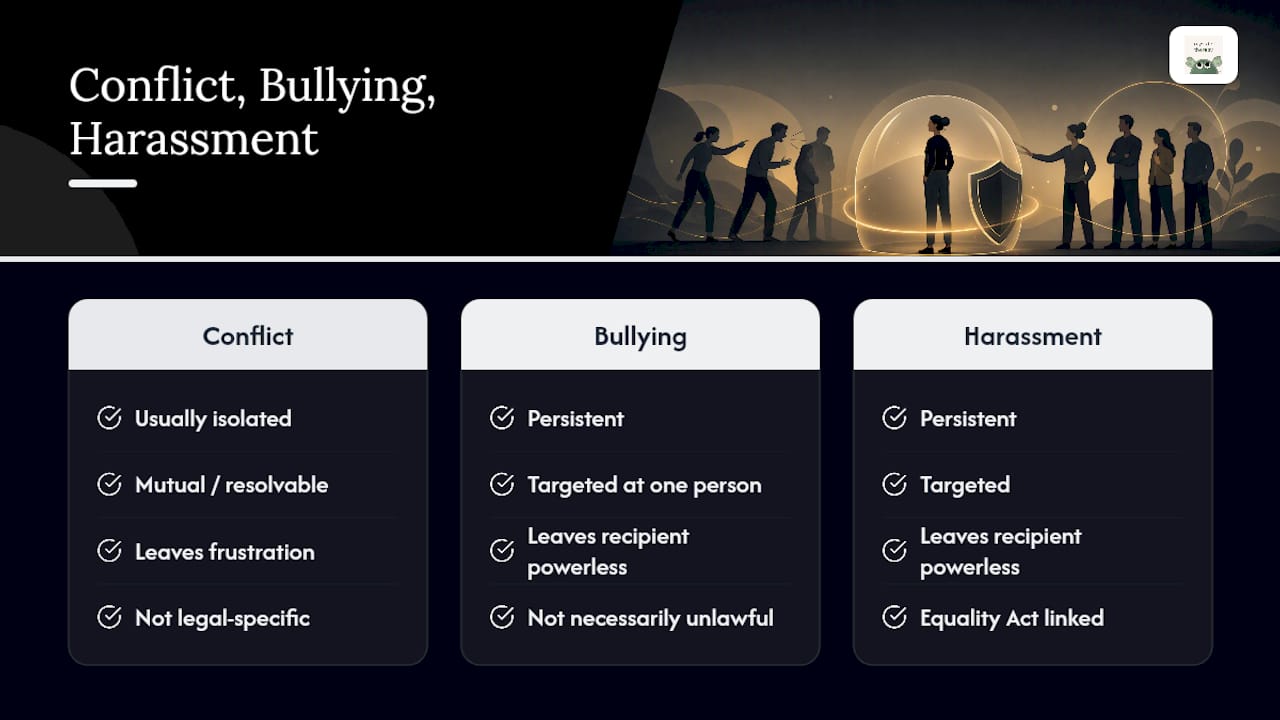
Harassment, legally speaking, is a narrower category still. It specifically involves unwanted conduct related to a protected characteristic under the Equality Act, sex, race, disability, age, and so on. Bullying can exist entirely without that legal element, which is precisely why not all bullying is unlawful even though all of it can be genuinely harmful. Knowing which category you're dealing with shapes which route, grievance, mediation, or a legal claim, actually fits your situation.
Can workplace policies actually prevent bullying?
Well-designed policies stop bullying before it starts more often than reactive complaints procedures fix it afterwards. The CIPD's guidance is specific on this: clear written policies, manager training, and access to independent mediation form the backbone of effective prevention, not vague statements about "respect in the workplace" that nobody reads.
Manager training matters more than most organisations invest in it. Many bullying situations involve a manager who genuinely doesn't recognise their own behaviour as bullying, mistaking it for robust management style. Training that helps managers distinguish firm feedback from personal attack closes that gap before it becomes a grievance.
Multiple, genuinely independent reporting channels matter just as much. If the only route to raise a concern is through the person doing the bullying, or someone closely allied to them, employees simply won't use it. Confidential reporting lines, a named independent adviser outside the immediate management chain, and anonymous survey mechanisms all lower the barrier to speaking up early, while problems are still small.
Regular, honest culture surveys, rather than the tick-box annual engagement survey, surface patterns before they calcify into entrenched behaviour. An organisation that reviews bullying and harassment data at board level treats the issue with the seriousness it deserves, and that visibility alone tends to change behaviour further down the chain.
What does long-term recovery actually look like?
Recovery from workplace bullying rarely follows a straight line, and expecting it to often makes people feel like they're failing when progress stalls. Confidence typically returns before trust does. You might feel capable again at work while still flinching at a raised voice in an unrelated meeting months later, and that's a normal part of the process rather than a sign something's gone wrong.
Rebuilding usually happens on several fronts simultaneously. Therapy addresses the psychological impact directly, whether through cognitive behavioural approaches for anxiety and panic, or trauma-focused work if the experience has left lasting hypervigilance. Practical changes, a new role, a different team, sometimes a new employer entirely, remove the ongoing trigger, which therapy alone can't always do while you're still working alongside the person involved.
Rebuilding professional confidence specifically, separate from general mental health, often needs its own attention. Career counselling can help here, particularly if bullying has left you doubting your competence or dreading your next role change. Give yourself permission for recovery to take months rather than weeks. The people who fare best tend to be the ones who kept seeking support consistently, rather than expecting one conversation or one grievance outcome to resolve everything at once.
A note from Mysafetherapy
If you're reading this because work has become genuinely hard to bear, that alone is reason enough to seek support, whether or not you ever raise a formal complaint. Confidentiality and proper accreditation matter here, which is why every therapist on our platform is registered with BACP, UKCP or NCPS.
Sessions run evenings and weekends, because bullying rarely waits for convenient hours. Whatever you decide about the workplace process, don't wait on that decision before getting clinical help.
— MySafeTherapy
Start therapy that fits around a difficult working week
Mysafetherapy exists for exactly the situation this article describes: needing proper mental-health support without waiting weeks for an NHS referral or navigating a rigid appointment system that doesn't fit around a job that's already draining you.
Sessions run as one-to-one video, chat, or avatar-based therapy, so you can choose whichever format feels safest if anonymity matters to you right now. Between sessions, mood check-ins and AI journaling help you track how things are shifting, useful evidence for you and for any therapist picking up your case. Pricing is transparent from the outset, with no hidden long-term contract, and you can switch therapists freely if the first match isn't right. Employers exploring workplace wellbeing support for their teams can also set up structured access for staff.
If bullying, anxiety, or panic before work is affecting you, start therapy today and get matched with an accredited therapist who understands what you're dealing with.
| Need | Where to go |
|---|---|
| Immediate mood tracking | Free check-in tool |
| Anonymous format preferred | Avatar therapy |
| Ready to begin therapy | Start therapy |
| Employer seeking staff support | Workplace wellbeing |
Where to find further UK guidance
- Acas: the clearest source for practical workplace steps, grievance processes, and its free helpline (0300 123 1100)
- NHS: guidance on recognising when bullying is affecting your health and when to see a GP
- GOV.UK and the Equality Act 2010: the legal framework around harassment and employer responsibilities
- CIPD: evidence-based research on prevalence, organisational impact, and prevention measures
- Citizens Advice: independent advice if you're unsure whether your situation meets the legal threshold for a claim
Each organisation covers a different part of the picture. Acas and Citizens Advice help with the practical workplace process, the NHS addresses your health directly, and CIPD's research grounds the wider organisational context in evidence rather than assumption.
This article is general information, not a substitute for advice from a qualified doctor. Consult a qualified healthcare professional about your own circumstances before acting on anything here.
Sources
- If you think you're being bullied - Acas
- Bullying at work - NHS
- Harassment factsheet - CIPD
- Prevalence and nature of workplace bullying and harassment and associations with mental health conditions in England