
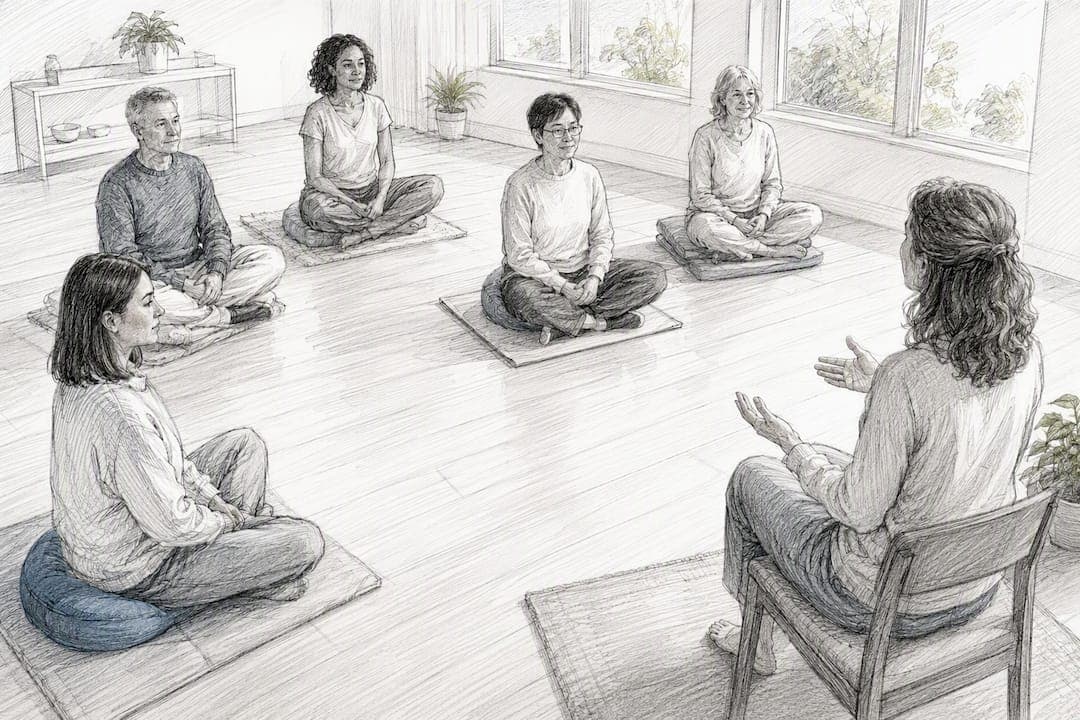
Mindfulness is an evidence-based therapeutic approach when delivered through structured programmes such as MBCT or MBSR, or embedded as a skill inside therapies like DBT and ACT. It typically involves an 8-week group course, roughly 20 to 40 minutes of daily home practice, and measurable benefits for anxiety and depressive relapse. It is not universally suitable, and a clinician should assess fit before you start.
TL;DR:
- MBCT typically involves eight weekly sessions of 1.5 to 2.25 hours, with group sizes of 8 to 12 participants and 20 to 40 minutes of daily home practice.
- Effective mindfulness courses require strict fidelity to protocols; skipping sessions or reducing practice time can diminish benefits and alter outcomes.
- Mindfulness-based approaches are not suitable for everyone, especially those with active psychosis, severe trauma, or suicidal crisis, and require careful clinical screening.
- Teachers should have relevant clinical qualifications, ongoing supervision, and a personal mindfulness practice, with membership in recognized professional bodies.
- Digital tools like apps support ongoing practice but do not replace the need for trained clinicians to tailor and safely deliver mindfulness interventions.
Table of Contents
- The evidence base: research, NHS guidance and clinical outcomes
- Main approaches: MBCT, MBSR and mindfulness inside DBT and ACT
- Common techniques you will practise in therapy
- What an MBCT or MBSR course looks like in practice
- Therapist training, competencies and how to judge a safe provider
- Limits and risks: when mindfulness may not be right
- Using apps, guided audio and self-practice alongside therapy
- MySafeTherapy's perspective: delivering mindfulness safely, not just conveniently
- Ready to try mindfulness-based therapy? Here's how to start
- Sources
The evidence base: research, NHS guidance and clinical outcomes
Systematic review evidence shows that mindfulness-based interventions reduce symptoms of anxiety and depression when delivered with fidelity to the original protocol. Mindfulness-Based Cognitive Therapy (MBCT) has the strongest track record specifically for preventing depressive relapse, which is why NICE and the NHS recommend it for people who have experienced recurrent depression.
That recommendation is not casual. It reflects the fact that MBCT was built directly on cognitive behavioural therapy, then layered with attention-training practices designed to interrupt the rumination cycle that pulls people back into low mood. The therapeutic target is what clinicians call decentering, learning to notice a thought as a passing mental event rather than a statement of fact. That reframing appears to be central to why MBCT reduces automatic reactivity in people prone to relapse.
Pro Tip: If a service advertises "mindfulness sessions" without naming a protocol (MBCT, MBSR) or citing NICE guidance, ask what evidence base the course follows before enrolling.
What does an actual programme look like in numbers? NICE and NHS guidance point to a fairly consistent structure across providers:
- Eight weekly sessions, each running roughly 1.5 to 2.25 hours.
- Group sizes of around 8 to 12 participants.
- Daily home practice of 20 to 40 minutes throughout the course.
- A pre-course assessment to check suitability before the group starts.
The limitation worth naming honestly: effect sizes in mindfulness trials are generally moderate, not dramatic, and outcomes depend heavily on whether the teacher and the curriculum stay close to the tested protocol. A course that trims sessions or skips home practice is not the same intervention the trials measured.
Main approaches: MBCT, MBSR and mindfulness inside DBT and ACT
Not all "mindfulness in therapy" means the same delivery model. Four distinct approaches dominate clinical practice, and mixing them up leads to mismatched expectations.
- MBCT targets depressive relapse prevention specifically. It's an 8-week group programme combining CBT principles with attention training, built for people who have recovered from depression but remain vulnerable to it returning.
- MBSR (Mindfulness-Based Stress Reduction) was designed for chronic stress and long-term physical conditions rather than diagnosed depression. It shares the 8-week group format but leans more heavily on body-based practice and less on cognitive restructuring.
- Dialectical Behaviour Therapy (DBT) treats mindfulness as one of four core skill modules, taught alongside emotion regulation, distress tolerance and interpersonal effectiveness. It's usually delivered as part of individual therapy plus skills group, tailored to the person rather than following a fixed 8-week arc.
- Acceptance and Commitment Therapy (ACT) uses mindfulness-style techniques (observing thoughts, present-moment awareness) in service of psychological flexibility and values-based action, integrated flexibly into individual sessions rather than as a standalone curriculum.
The practical difference for you as a client: MBCT and MBSR are standardised, manualised courses delivered to a group on a fixed schedule. DBT and ACT use mindfulness as one tool among several, woven into a therapy that's built around your specific goals and adjusted session by session. If your therapist mentions mindfulness during an individual therapy session rather than referring you to a group course, that's the DBT/ACT model at work, not a lesser version of MBCT.
Common techniques you will practise in therapy
Whichever programme you join, the exercises themselves tend to draw from a small, well-tested toolkit. Each one trains a slightly different skill.
- Breathing awareness. Attention rests on the breath's physical sensation, training the mind to notice when it has wandered and return without judgement. This is usually the first skill taught because it's the simplest anchor.
- The body scan. A guided, systematic attention sweep through different parts of the body, typically lying down. It builds somatic awareness and helps people who live largely "in their heads" reconnect with physical sensation, which matters for spotting early stress signals.
- Mindful movement. Slow, deliberate movement (often adapted from yoga) paired with attention to bodily sensation. It offers an alternative for people who find stillness difficult or triggering.
- The 3-minute breathing space. A compressed version of the longer practices, designed to be used in the middle of a stressful moment rather than during scheduled practice time. It's the technique most people end up using daily long after the course ends.
Home practice during a course typically runs 20 to 40 minutes a day, which is a genuine commitment, not a token add-on. It's the daily repetition, not the weekly session, that produces the attentional shift these programmes are built around.
A trauma-sensitive note matters here: body scans and prolonged stillness can occasionally increase distress for people with certain trauma histories, because sustained internal attention can surface unwanted memories or sensations. A competent teacher offers adaptations, eyes open instead of closed, shorter durations, movement instead of stillness, and checks in rather than assuming one script fits everyone.
What an MBCT or MBSR course looks like in practice
Before you sit in a group session, most reputable services run a one-to-one orientation and suitability assessment. This isn't bureaucracy for its own sake. It's the point where a clinician checks whether group mindfulness is the right fit, or whether individual therapy would serve you better first.
Once the course begins, expect this rhythm:
- Eight weekly group sessions, each 2 to 2.25 hours, following a set curriculum rather than an improvised structure.
- Guided audio recordings and written handouts to structure home practice between sessions.
- Daily home practice logged and discussed each week, since consistency between sessions drives most of the benefit.
- A follow-up or booster session sometimes offered weeks after the course ends, to reinforce practice.
Services that track outcomes formally often use standardised measures such as the PHQ-9 for depression symptoms, recorded before the course starts and again at completion, so progress is measured against a baseline rather than assumed. If a provider can't tell you how they track whether the course is working, that's a fair question to press on.
Therapist training, competencies and how to judge a safe provider
There is no single national certification that automatically qualifies someone to teach mindfulness in the UK. Instead, good practice expects a combination of a relevant clinical qualification, specific mindfulness teacher training, and an ongoing personal mindfulness practice, not just theoretical knowledge of the technique.
The British Psychological Society frames this clearly: mindfulness-based approaches are a way of working that depends on teacher embodiment, not a script that anyone trained for a weekend can deliver safely. Competency frameworks like the MBI-TAC (Mindfulness-Based Interventions Teaching Assessment Criteria) exist precisely to assess whether a teacher's actual delivery matches the standard, beyond just holding a certificate.
Practical signals worth checking before you commit to a course or a therapist:
- Professional registration with a recognised body (BPS, BACP, UKCP or NCPS) alongside specific mindfulness teacher training.
- Evidence of regular supervision and their own ongoing personal practice, not just a training certificate from several years ago.
- Membership or accreditation through a body such as BAMBA, which maintains standards for UK mindfulness teachers.
Pro Tip: Ask a prospective provider three direct questions: where did you train to teach mindfulness, how recently have you been supervised, and what happens if I find a technique distressing? A confident, specific answer to all three is a good sign.
Limits and risks: when mindfulness may not be right
Mindfulness is not risk-free for everyone, and reputable providers say so openly rather than glossing over it. People experiencing active psychosis, current suicidal crisis, or certain acute trauma presentations may find some practices, particularly prolonged silent stillness or body scans, unhelpful or destabilising rather than calming.
NHS guidance is explicit that mindfulness is not suitable for everyone and should be discussed with a clinician before starting, especially if you're managing a complex or severe mental health condition. This isn't a small print caveat, it's a genuine clinical screening step that a competent service will build into intake.
How well-run programmes manage this risk in practice:
- Pre-course suitability screening that flags anyone who might need one-to-one support instead of, or before, a group course.
- Access to a named clinician during the course who can adjust or pause practice if distress arises.
- Clear permission to skip or modify any exercise, rather than an expectation that everyone completes the full script identically.
Access to fully trained MBCT teachers is sometimes limited, and clinicians have flagged that adaptations drifting far from the tested protocol risk losing effectiveness or, in some cases, causing harm without proper safeguards. If a course feels rushed, under-resourced, or improvised, that's a legitimate reason to look elsewhere or raise it directly with the provider.
Using apps, guided audio and self-practice alongside therapy
Meditation apps and guided recordings have a real, useful role, but it's a supporting one. They help you keep up daily practice between sessions and reinforce what a teacher has already covered. They are not a substitute for teacher-led MBCT or MBSR, particularly for anyone with a significant mental health history, because an app cannot screen for risk or adjust in real time the way a trained clinician can.
When choosing digital tools to run alongside therapy, look for:
- Clinical oversight or input in how the content was designed, rather than generic wellness content repackaged as therapy.
- Content that reflects established therapeutic techniques rather than vague relaxation advice.
- Trauma-informed design, meaning options to shorten, modify or skip exercises without penalty.
Self-help tools, AI-guided journaling, mood tracking and structured guided resources can be used in a supporting role: reinforcing what happens in live sessions rather than replacing them. Curated self-help resources work best when they're chosen to complement, not compete with, whatever your therapist has actually recommended.
MySafeTherapy's perspective: delivering mindfulness safely, not just conveniently
Mindfulness gets marketed as a quick calm-down technique, and that undersells what makes it work clinically: structure, trained delivery and honest screening. Clients can be matched with BACP, UKCP and NCPS-registered therapists across video, chat and avatar-based formats, so mindfulness-informed support can fit around real schedules, including evenings and weekends, without cutting corners on assessment. We'd rather a client discover mindfulness isn't the right fit during assessment than midway through a course that isn't working for them.
— MySafeTherapy
Ready to try mindfulness-based therapy? Here's how to start
There are online services that connect clients with accredited therapists offering mindfulness-based support through flexible one-to-one video, chat or avatar sessions, avoiding months-long NHS referral queues.
Most clients start with an assessment to check whether a mindfulness-informed approach, or a different therapeutic route entirely, fits their situation. Sessions can be scheduled flexibly, including evenings and weekends; switching therapist may be possible if the first match isn't suitable. If anxiety, low mood or stress is what's brought you here, you can start therapy today and discuss mindfulness-based options directly with your assessing therapist.
Sources
- Mindfulness-based Cognitive Therapy (MBCT) for Depression
- Mindfulness Based Cognitive Therapy (MBCT) :: Avon and Wiltshire Mental Health Partnership NHS Trust
- Mindfulness-based approaches - a guide for psychologists (BPS)
- Mindfulness-Based Interventions for Anxiety and Depression (PMC review)