
TL;DR:
- Video therapy is clinically as effective as in-person treatment for anxiety and depression, with better attendance rates. It offers practical benefits such as increased accessibility, home comfort, and flexible scheduling but requires privacy, reliable technology, and appropriate clinical assessment. This format is most suitable for mild-to-moderate conditions, while severe disorders and crises may need face-to-face care.
One-to-one video therapy is defined as the delivery of personalised mental health support through secure, live video calls with a trained therapist, replicating the structure and effectiveness of traditional face-to-face sessions. This format, also referred to as teletherapy or remote psychotherapy, has moved firmly into mainstream UK mental health care. A meta-analysis of 65 studies confirms that video therapy is clinically non-inferior to in-person therapy for conditions including anxiety and depression. For adults in the UK weighing up their options, the evidence is clear: video therapy works, and understanding how it works is the first step to deciding whether it suits you.
How effective is one-to-one video therapy compared to in-person therapy?
Video therapy produces clinical outcomes that match those of face-to-face sessions for the most common mental health conditions. The 65-study meta-analysis published by the British Psychological Society found no significant difference in outcomes for depression and anxiety between video and in-person formats. That finding carries real weight: it means the medium itself is not the limiting factor in your recovery.
Engagement data reinforces this. Only 4% of video therapy sessions were missed, compared to 12% for face-to-face appointments in NHS data. Fewer missed sessions means more consistent treatment, which directly improves outcomes over time.
One area where video therapy clearly outperforms telephone therapy is the therapeutic alliance. Patient surveys show no significant difference in emotional engagement or goal alignment between video and in-person sessions. Telephone therapy, by contrast, often produces a weaker therapeutic connection because visual cues are absent. Seeing your therapist's face, and being seen, matters more than most people expect.
"The therapeutic alliance remains strong in video therapy due to visual engagement and real-time interaction, unlike phone therapy where emotional engagement suffers." — British Psychological Society research digest
There is one important exception to note. A large study of 106,153 psychiatric observations found that remote consultations increase hospitalisation risk by 6% for people with schizophrenia-related disorders. That figure signals a genuine clinical boundary. Video therapy is not appropriate for everyone, and a proper initial assessment is essential before starting.
Pro Tip: If you are unsure whether video therapy is right for your specific condition, ask your therapist directly about the evidence for your diagnosis before committing to a format.
| Format | Missed session rate | Therapeutic alliance | Best suited for |
|---|---|---|---|
| Video therapy | 4% | Strong (matches in-person) | Anxiety, depression, mild-to-moderate conditions |
| Face-to-face therapy | 12% | Strong | All conditions including complex presentations |
| Telephone therapy | Not specified | Weaker than video | Low-complexity support, accessibility barriers |
What are the benefits and limitations of one-on-one video therapy?
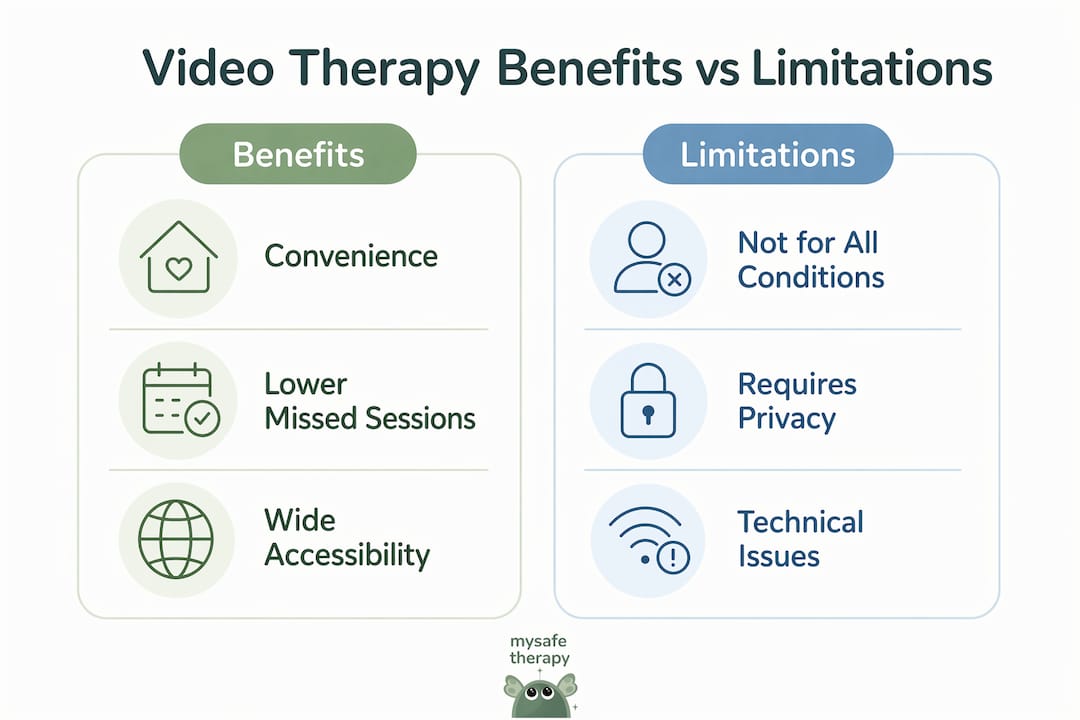
The practical advantages of video therapy are substantial, and they go beyond simple convenience. For adults in the UK with mobility difficulties, caring responsibilities, or those living in rural areas with limited local provision, video therapy removes barriers that would otherwise prevent access to support entirely.
Key benefits
- Wider therapist choice. You are not limited to practitioners within travelling distance. This matters significantly when you need a therapist with a specific specialism, such as trauma-focused CBT or EMDR.
- Reduced travel and time costs. A 50-minute session does not require an additional hour of commuting. That reduction in friction makes it easier to maintain regular attendance.
- Home comfort improves engagement. Clients report feeling more relaxed and able to be themselves in their own environment. That sense of safety can accelerate the therapeutic process.
- Privacy on your terms. You control your physical surroundings, which many people find less exposing than sitting in a waiting room.
- Flexibility of scheduling. Platforms like Mysafetherapy offer evening and weekend appointments, making therapy accessible around work and family commitments.
Limitations to consider honestly
- You need a genuinely private space. Thin walls, shared households, or open-plan offices make confidentiality difficult to maintain. This is a practical problem that requires a practical solution before you start.
- Technology can fail. Poor broadband, a frozen screen, or audio dropout disrupts the session. Having a backup plan, such as switching to a phone call, is worth agreeing with your therapist in advance.
- Emotional safety requires preparation. Difficult sessions can leave you feeling exposed. At home, you do not have the physical transition of a journey to decompress. Replicating that psychological container by setting up a dedicated, calm space before each session helps significantly.
- Not suitable for all presentations. Crisis situations, severe risk, and certain complex diagnoses require face-to-face assessment and intervention.
Pro Tip: Treat your video therapy space the way you would a work meeting: close unnecessary tabs, silence notifications, and let others in your household know you are unavailable for the session duration.
Blended approaches that combine video sessions with occasional in-person meetings offer a middle path for people who want flexibility without sacrificing the depth of face-to-face contact. Many therapists tailor the format over time as your needs change.
How does one-to-one video therapy work in practice?
Understanding the practical mechanics of a video therapy session removes much of the uncertainty that stops people from starting. The process is more straightforward than most people anticipate.
- Choose a registered therapist. Look for practitioners accredited by BACP, UKCP, or HCPC. Mysafetherapy lists only therapists who meet these standards, which you can verify on the therapist standards page.
- Complete an initial assessment. Before your first session, a clinical assessment determines whether video therapy is appropriate for your situation. This covers your diagnosis, risk level, privacy arrangements, and technology access. Initial assessments are vital to matching the right format to the right person.
- Set up your technology. A stable internet connection, a device with a working camera and microphone, and a private room are the core requirements. Most platforms use encrypted video software; your therapist will confirm the specific tool in advance.
- Agree on session structure and boundaries. Professional standards for video therapy are identical to those for in-person work. This includes confidentiality agreements, cancellation policies, fee structures, and a written crisis plan covering what to do if you feel unsafe between sessions.
- Prepare your space before each session. Sit at a comfortable height, ensure good lighting so your therapist can see your face clearly, and remove distractions. A consistent physical setup helps signal to your brain that the session is beginning.
- Review format regularly. Your therapist should check in periodically about whether video continues to suit your needs. Session frequency, format, and approach can all be adjusted as your circumstances or progress changes.
For a practical walkthrough of booking and preparing, the Mysafetherapy guide on scheduling therapy sessions online covers the UK-specific steps in detail.
Who is video therapy most suitable for, and when might other options be better?
Video therapy is not a universal solution, and knowing where it fits best helps you make a genuinely informed choice.
People who benefit most from video therapy
- Adults managing anxiety, depression, or mild-to-moderate mood difficulties, where clinical evidence is strongest for non-inferiority to in-person care.
- People with physical health conditions, mobility limitations, or caring responsibilities that make regular travel difficult.
- Adults who feel more comfortable opening up in a familiar environment, particularly those who find clinical settings anxiety-provoking.
- Those in rural or underserved areas where local therapist availability is limited.
- Professionals seeking confidential support outside office hours, where scheduling flexibility is a priority.
When to consider alternatives
- Schizophrenia-related disorders. The evidence indicates a meaningful increase in hospitalisation risk with remote care for this group. Face-to-face assessment and ongoing in-person contact is the safer default.
- Active crisis or high risk. Video therapy cannot replace the physical presence and immediate intervention capacity of in-person or crisis services.
- Severe technology anxiety or digital exclusion. If the technology itself becomes a source of distress, telephone therapy or face-to-face sessions are more appropriate starting points.
- Lack of a private space. Clinical judgement must account for privacy before recommending video therapy. A shared bedroom with no lock is not a suitable therapy environment.
The right format is always the one that fits your specific clinical needs, personal circumstances, and practical situation. A good therapist will assess all three before recommending video, telephone, or in-person work. For adults with anxiety or depression specifically, the evidence on video therapy is particularly well established and worth reading before your first session.
Key takeaways
One-to-one video therapy is clinically equivalent to in-person therapy for anxiety and depression, with lower missed-session rates and a strong therapeutic alliance, making it a reliable primary option for most UK adults with mild-to-moderate mental health needs.
| Point | Details |
|---|---|
| Clinical equivalence | A meta-analysis of 65 studies confirms video therapy matches in-person outcomes for anxiety and depression. |
| Higher attendance | Video sessions have a 4% missed-session rate versus 12% for face-to-face appointments. |
| Therapeutic alliance | Visual engagement in video therapy preserves the emotional connection that telephone therapy cannot replicate. |
| Suitability limits | People with schizophrenia-related disorders face increased hospitalisation risk with remote care and need face-to-face support. |
| Preparation matters | A private space, stable technology, and a written crisis plan are non-negotiable before starting video therapy. |
Video therapy is valuable, but it is not a shortcut
At Mysafetherapy, we have seen a consistent pattern: the people who get the most from video therapy are those who treat it with the same seriousness as an in-person appointment. They prepare their space, they show up consistently, and they communicate openly with their therapist when something is not working.
What concerns me about the broader conversation around teletherapy is the tendency to frame it as simply "easier" therapy. It is not easier. It is more accessible. Those are different things. Accessibility removes a barrier to entry. It does not reduce the emotional work required once you are in the session.
The blended model is where I see the most promising future. Starting with video, building the relationship, and then occasionally meeting in person when the work requires it. That combination respects both the evidence and the individual. No single format suits every person at every stage of their recovery.
My honest advice: do not choose video therapy because it feels less daunting. Choose it because it genuinely fits your life, your condition, and your readiness to engage. If you are uncertain, a good initial assessment will tell you more than any article can.
— Mysafetherapy
Starting video therapy with Mysafetherapy
Mysafetherapy connects UK adults with therapists accredited by BACP, UKCP, and NCPS, all delivering sessions through a secure, encrypted video platform. Every therapist on the platform meets verified professional standards, and sessions are available during evenings and weekends to fit around work and family commitments.
The process begins with a straightforward matching step that considers your presenting concerns, preferences, and availability. Confidentiality and safety protocols are built into every session from the outset. If video therapy is not the right fit after your initial assessment, Mysafetherapy also offers chat therapy and avatar-based sessions as alternatives. To begin, visit the start therapy page and take the first step towards consistent, professional mental health support.
FAQ
What is one-to-one video therapy?
One-to-one video therapy is a live, private session between a client and a trained therapist conducted over a secure video call. It follows the same professional standards as face-to-face therapy, including confidentiality, structured session times, and a written crisis plan.
Is video therapy as effective as in-person therapy?
A meta-analysis of 65 studies confirms that video therapy is clinically non-inferior to in-person therapy for depression and anxiety. Missed session rates are also lower for video appointments, at 4% compared to 12% for face-to-face.
Who should not use video therapy?
People with schizophrenia-related disorders face a statistically increased risk of hospitalisation with remote care and are generally better served by in-person support. Video therapy is also not appropriate in active crisis situations or where no private space is available.
How do I prepare for a video therapy session?
Choose a quiet, private room, test your camera and microphone in advance, and close any unnecessary applications on your device. Agree a backup communication method with your therapist in case of technical difficulties.
Do video therapists in the UK need to be registered?
Yes. Therapists offering video therapy in the UK should hold accreditation from a recognised professional body such as BACP, UKCP, or HCPC. Mysafetherapy lists only therapists who meet these verified standards.