

Phone therapy is an effective, evidence-backed treatment option for many adults with mild to moderate depression and anxiety. NICE recommends telephone delivery as part of the NHS Improving Access to Psychological Therapies (IAPT) programme, the British Association for Counselling and Psychotherapy (BACP) endorses it for a range of common mental health problems, and a large observational analysis of 39,227 adults found telephone low-intensity CBT non-inferior to face-to-face for most adults, with a per-session cost 36.2% lower. The evidence is not without limits, and phone therapy is not appropriate for every presentation, but for the majority of people seeking support for anxiety, stress, or low mood, it is a clinically credible and practically convenient route into care.
Core phone therapy benefits at a glance:
- No travel required, making it accessible to people in rural areas, those with mobility difficulties, and carers who cannot leave home
- Greater scheduling flexibility, including evenings and weekends
- Reduced social anxiety around attending a clinic in person
- Lower per-session cost to services, which can translate into shorter waiting times
- Higher initial assessment attendance compared with face-to-face appointments in some IAPT datasets
Primary caveat: Phone therapy is not suitable for active suicidal crisis, severe psychosis, or complex high-risk presentations where in-person containment is clinically necessary.
Pro Tip: Before your first phone appointment, find a private room, charge your phone fully, and let anyone in the household know you need uninterrupted time for at least an hour.
Key takeaways
Phone therapy is a clinically effective, NICE-recommended option for most adults with mild to moderate depression or anxiety, offering meaningful access, cost, and attendance advantages over face-to-face care, provided it is delivered by a trained and accredited therapist with clear safeguarding procedures in place.
| Point | Details |
|---|---|
| Clinical effectiveness | Telephone CBT is non-inferior to face-to-face for most adults with mild to moderate presentations, per IAPT observational data and systematic reviews. |
| Cost and attendance | Per-session telephone delivery costs 36.2% less than face-to-face in IAPT data; telephone assessments show higher initial attendance in some datasets. |
| Who it suits best | Adults with anxiety, depression, mobility barriers, caring responsibilities, or a preference for anonymity tend to benefit most from phone therapy. |
| When to seek alternatives | Active suicidal intent, severe psychosis, or complex high-risk presentations require face-to-face or emergency care, not telephone therapy. |
| Mysafetherapy | Offers verified BACP/UKCP/NCPS-registered therapists for phone and remote sessions, with transparent pricing, GDPR compliance, and documented escalation procedures. |
Table of Contents
- What does the research say about phone therapy effectiveness?
- What are the practical advantages of phone therapy?
- What are the drawbacks and risks of phone therapy?
- Who tends to benefit most from phone therapy?
- What does a phone therapy session actually look like?
- How do you choose a verified UK phone therapist?
- How should you weigh the evidence when making a decision?
- When phone therapy is not enough: immediate steps and UK resources
- Do the benefits of phone therapy last over time?
- How does phone therapy affect different populations?
- Why phone therapy deserves its place in mainstream mental health care
- Mysafetherapy: a vetted UK option for phone and remote therapy
- Sources
What does the research say about phone therapy effectiveness?
The evidence base for telephone-delivered psychological therapy is now substantial, drawing on systematic reviews, randomised controlled trials, and large-scale UK service analyses.
Systematic reviews of comparative studies report little or no meaningful difference between telephone and face-to-face therapy across key interactional features: therapeutic alliance, disclosure, and empathy. Telephone sessions do tend to run shorter than face-to-face appointments, a consistent finding across the literature, but shorter duration does not translate into poorer outcomes for most common presentations. That distinction matters for service planning more than for clinical effectiveness.
The largest UK dataset comes from an observational analysis of 39,227 IAPT patients, which found over-the-telephone low-intensity CBT was not inferior to face-to-face treatment for symptom severity in most adult cases. The per-session cost was 36.2% lower for telephone delivery. This is observational evidence, not a randomised trial, so selection effects cannot be ruled out entirely. Patients who chose telephone therapy may differ systematically from those who chose face-to-face. Read alongside the systematic review evidence, however, the picture is consistent: telephone therapy performs comparably for most adults with mild to moderate presentations.
One important caveat applies to RCT evidence specifically. Randomised trials often recruit therapists trained specifically for remote delivery, so their outcomes may reflect the benefit of bespoke telephone training rather than what happens in routine practice. UK service research confirms that implementation is shaped by workforce confidence, telephone-specific training, and service targets, all of which affect real-world uptake and quality.
Where face-to-face therapy tends to be superior: severe or complex presentations, active risk, and cases requiring close clinical observation. The evidence does not support telephone delivery as a universal replacement for in-person care.
| Evidence type | Key finding | Source context |
|---|---|---|
| Observational (39,227 adults) | OTT CBT non-inferior; per-session cost 36.2% lower | IAPT dataset; observational, not RCT |
| Systematic review | No meaningful difference in alliance, disclosure or empathy | Comparative interactional studies |
| RCT context | Trial outcomes may reflect telephone-specific therapist training | Implementation caveat |
| NICE / IAPT policy | Telephone recommended for mild to moderate depression and anxiety | UK national guidance |
What are the practical advantages of phone therapy?
The clinical evidence is one part of the picture. The practical advantages of phone therapy are what often determine whether someone accesses help at all.
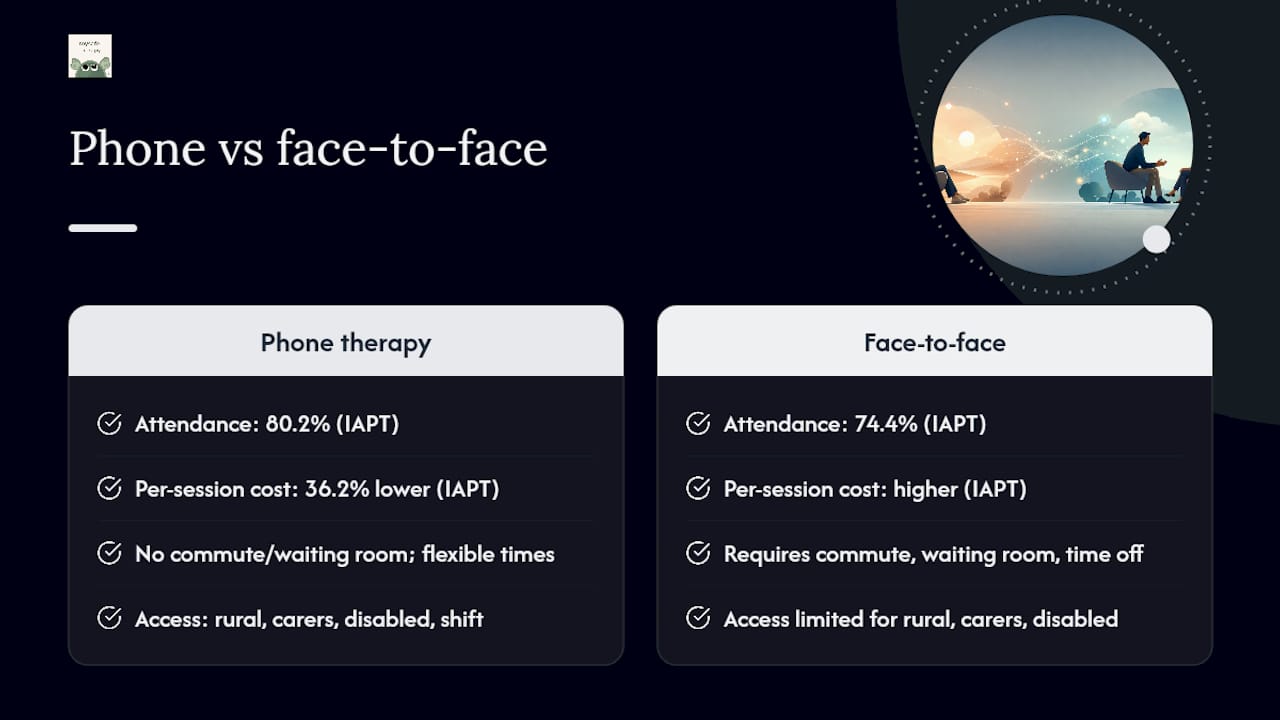
Accessibility and convenience are the most frequently cited benefits. There is no commute, no waiting room, and no need to take time off work for travel. For people living in rural or semi-rural areas of the UK, where specialist mental health services may be an hour's drive away, a phone appointment removes a genuine structural barrier. The same applies to carers who cannot easily leave the home, people with physical disabilities or chronic illness, and anyone whose work pattern makes fixed daytime clinic appointments difficult.
Anonymity and reduced social stigma play a meaningful role for many people. Attending a therapy clinic in person carries a visibility that some find prohibitive, particularly in smaller communities or workplaces where confidentiality feels less certain. On the phone, the client is in their own environment, which can lower the threshold for initial engagement. Some people disclose more readily without the pressure of face-to-face contact, a pattern noted in qualitative research on remote therapy.
Attendance rates tell a practical story. One IAPT dataset found telephone assessment attendance at 80.2% compared with 74.4% for face-to-face assessments, a difference that matters when services are managing long waiting lists. Higher attendance at the initial assessment stage means more people actually begin treatment. The accessibility benefits of remote therapy extend beyond individual convenience into system-level efficiency.
Cost advantages are real for both services and clients. The 36.2% lower per-session cost for telephone delivery in the IAPT analysis reflects reduced overhead and therapist time. For clients, there are no travel costs and no parking fees, which adds up across a course of treatment.
Consider a shift worker with anxiety who cannot attend a Thursday afternoon clinic appointment without losing pay. A phone session at 7pm on a Tuesday removes every logistical barrier that would otherwise prevent treatment from starting.
Pro Tip: Set up your phone therapy space in advance: a room with a door that closes, headphones if walls are thin, and a glass of water nearby. Treating it like a real appointment, not a phone call, helps you get more from the session.
What are the drawbacks and risks of phone therapy?
Phone therapy is not without genuine limitations, and understanding them is as important as knowing the benefits.
-
Absence of visual cues. Therapists cannot observe body language, facial expression, or physical presentation. This affects clinical judgement, particularly for risk assessment. Practitioners consistently report this as their primary concern, and qualitative research confirms it as a real attitudinal barrier even where empirical evidence does not show poorer outcomes on average.
-
Privacy and environment control. The client's home is not a controlled clinical space. Thin walls, shared housing, unexpected interruptions, and background noise all affect session quality. Unlike a therapy room, the therapist cannot guarantee the client's environment is private.
-
Technology-dependent problems. Signal drops, poor audio quality, and battery failure can interrupt a session at a clinically sensitive moment. These are not hypothetical risks; they occur in routine practice and require explicit contingency planning.
-
Variable service implementation. UK service research documents that telephone therapy is sometimes offered primarily to meet efficiency targets rather than because it is the best clinical fit for the individual. Practitioners have reported reluctance to advocate for telephone delivery when they feel it is being driven by performance metrics rather than patient need. That misalignment can affect the quality of what is offered.
-
Training gaps. Telephone-specific skills, including verbal pacing, explicit safety checking, and managing silence without visual feedback, are distinct competencies. Where therapists have not received dedicated training, the quality of telephone delivery may fall short of what RCTs demonstrate is achievable.
Clinical limits are the most important consideration. Severe presentations, active suicidal intent, complex trauma requiring careful in-person containment, and severe psychosis are not appropriate for telephone-only management. The phone is a capable medium for many presentations, but it is not a substitute for in-person care when risk is high.
Pro Tip: Before starting telephone therapy, ask your therapist directly: "What happens if the call drops during a difficult moment?" A clear reconnect plan, agreed in advance, removes uncertainty at exactly the point when you need clarity most.
Who tends to benefit most from phone therapy?
Phone therapy is not a universal fit, but for a defined set of presentations and life circumstances, it is often the most practical and clinically appropriate route.
Profiles that commonly do well:
- Adults with mild to moderate depression or anxiety, the population for whom NICE recommends telephone delivery and where the IAPT evidence is strongest
- People with mobility difficulties, chronic illness, or disabilities that make travel to a clinic difficult
- Carers who cannot reliably leave the home for a fixed appointment
- Those living in rural or remote areas with limited local service provision
- People who experience social anxiety around attending a clinic, for whom social anxiety treatment via phone removes a significant barrier to starting
- Individuals who prefer anonymity and find verbal-only communication less exposing than face-to-face contact
- Working professionals with irregular schedules who need evening or weekend appointments
Profiles for whom phone therapy is often less suitable:
- Anyone with active suicidal plans or intent requiring immediate risk management
- People with severe psychosis or complex presentations needing close clinical observation
- Those with complex trauma where the therapeutic relationship requires careful in-person attunement
- Clients who find verbal-only communication significantly more difficult than face-to-face interaction
- Situations where the home environment cannot be made private or safe for a session
BACP guidance is clear that people feeling particularly unwell or in an emergency should seek face-to-face support or contact their GP or emergency services rather than relying on telephone counselling.
Pro Tip: If you are unsure whether phone therapy is right for your situation, request a short telephone assessment first. Use it to ask the therapist directly how they would manage escalation if your needs changed during treatment. Their answer tells you a great deal about the quality of their safeguarding procedures.
What does a phone therapy session actually look like?
Knowing what to expect removes a significant source of pre-appointment anxiety. A standard telephone therapy session follows a clear structure, though the specifics vary by therapist and service.
Typical session length: Telephone sessions in IAPT services often run 30–45 minutes for low-intensity work, compared with the 50–60 minutes more typical of face-to-face therapy. High-intensity telephone sessions can match face-to-face duration. The systematic review evidence confirms that shorter session length is a consistent feature of telephone delivery, though it does not appear to reduce clinical effectiveness for most presentations.
What happens at the start of a session:
- The therapist confirms your identity and checks you are in a private, safe space before proceeding.
- Consent and confidentiality are reviewed, including the limits of confidentiality (for example, if risk to life is disclosed).
- Safety and risk are checked, typically through direct questions about current mood, self-harm, and suicidal ideation.
- Emergency contact details are confirmed or updated.
- The session agenda is agreed, and the therapist may ask what you want to focus on.
Preparing for your appointment:
- Find a private room and close the door
- Use headphones if you are concerned about being overheard
- Charge your phone to at least 80% before the call
- Have a glass of water and any notes or a journal nearby
- Silence other notifications so you are not interrupted
Record-keeping follows the same standards as face-to-face therapy. Your therapist documents the session, any risk factors identified, and agreed actions. GDPR applies in full; your data is held securely and not shared without your consent except in defined safety circumstances.
Pro Tip: Agree a reconnect protocol with your therapist at the very first session: if the call drops, who calls whom, on which number, and within how many minutes. Write it down. A dropped call during a difficult disclosure is disorienting; knowing the plan in advance keeps both parties calm.
How do you choose a verified UK phone therapist?
Choosing a phone therapist requires the same due diligence as choosing any mental health professional, with a few additional checks specific to remote delivery.
Credentials and registration to verify:
- BACP (British Association for Counselling and Psychotherapy) membership and accreditation, searchable on the BACP therapist directory
- UKCP (UK Council for Psychotherapy) registration for psychotherapists
- HCPC (Health and Care Professions Council) registration for clinical or counselling psychologists
- Ask specifically whether the therapist has received telephone-specific training and supervision, as this is not universal
Questions to ask before booking:
- How many clients do you currently see by phone, and for how long have you been working this way?
- What is your protocol if I disclose active suicidal intent during a session?
- How do you manage a dropped call?
- What are your cancellation and rescheduling terms?
- How is my data stored and who has access to it?
Trust signals to look for on a platform:
- Verified registration numbers for each therapist, not just a general statement of accreditation
- Clear data protection and GDPR statements
- Transparent pricing with no hidden fees
- Documented escalation and safeguarding procedures
- Easy therapist switching if the match is not right
Mysafetherapy meets these criteria as a vetted UK option. All therapists on the platform are registered with BACP, UKCP, or NCPS, registration is verified before listing, and the platform provides confidential online therapy with documented GDPR compliance and clear safety procedures. Transparent pricing and flexible booking, including evenings and weekends, are standard features.
Pro Tip: Check the therapist's registration number directly on the BACP or UKCP public register, not just on the platform's own page. It takes two minutes and confirms the credential is current.
How should you weigh the evidence when making a decision?
Understanding what the research actually shows, and where its limits lie, helps you make an informed choice rather than relying on either uncritical enthusiasm or unfounded scepticism.
The evidence hierarchy places systematic reviews and RCTs above observational studies. The systematic review finding that therapeutic alliance is not meaningfully worse on the phone is a strong signal, drawn from multiple comparative studies. The IAPT observational analysis is large and well-conducted, but it cannot rule out selection effects. Together, they point in the same direction: telephone therapy is clinically comparable for most common presentations.
Service-level factors shape real-world outcomes in ways that trial evidence does not always capture. Where telephone therapy is offered primarily to meet efficiency targets rather than as a considered clinical choice, practitioner ambivalence can affect the quality of what clients receive. This is not an argument against telephone therapy; it is an argument for choosing a provider where clinical rationale, not throughput pressure, drives the decision.
NICE's recommendation of telephone delivery for mild to moderate conditions, and its inclusion in the IAPT programme, provides a policy anchor that is worth noting. It means telephone therapy is not a fringe option; it is part of the mainstream UK mental health infrastructure.
Statistic to retain: In the IAPT observational dataset, telephone CBT was delivered at 36.2% lower per-session cost than face-to-face, with comparable outcomes for most adults. That cost difference has implications for service capacity and waiting times, not just individual affordability.
Pro Tip: When reading any study on phone therapy, check whether the therapists were specifically trained for telephone delivery. If they were, the results may not reflect what you would receive from a practitioner with no remote-specific training.
When phone therapy is not enough: immediate steps and UK resources
Phone therapy has clear clinical limits. Knowing when to step outside it, and what to do, is part of using it safely.
Red flags that require immediate in-person assessment or emergency help:
- Active suicidal plans with intent and means
- Severe self-harm requiring medical attention
- Severe psychotic episode with loss of contact with reality
- Any situation where you or someone else is in immediate danger
Steps to take in a crisis:
- Call 999 if there is immediate risk to life.
- Go to your nearest A&E department for urgent mental health assessment.
- Contact your GP for an emergency same-day appointment if the situation is serious but not immediately life-threatening.
- Call the Samaritans on 116 123 (free, 24 hours, seven days a week) for confidential emotional support.
- Contact your therapist's emergency procedure: most accredited therapists provide an out-of-hours contact or a named crisis service to call if a session ends with unresolved risk.
BACP guidance is explicit: if you are feeling particularly unwell or believe you are in an emergency, you should seek face-to-face support or contact your GP or emergency services rather than relying on telephone counselling alone.
For non-emergency situations where your needs have become more complex than telephone therapy can safely address, speak to your therapist directly. A responsible practitioner will discuss stepping up to face-to-face care or referring to a more intensive service. That conversation is part of good clinical practice, not a failure of the telephone format.
Do the benefits of phone therapy last over time?
The question of long-term outcomes is one the evidence addresses with reasonable, if not definitive, clarity. For mild to moderate depression and anxiety, the gains achieved through telephone-delivered CBT appear to be maintained at follow-up in the studies that have tracked them. The IAPT programme's own outcome data, collected across large patient populations, shows recovery rates for telephone-delivered treatment that are broadly consistent with face-to-face pathways for the same presentations.
What the evidence does not yet resolve with precision is whether long-term outcomes differ meaningfully between modalities for more complex presentations, or across extended follow-up periods beyond six to twelve months. The observational nature of most large-scale UK data means that patient selection, therapist quality, and service configuration all contribute to outcomes in ways that are difficult to isolate. What can be said with confidence is that there is no consistent signal of telephone therapy producing worse long-term results than face-to-face for the populations where it is recommended.
Sustained benefit also depends on factors that sit outside the modality itself: the quality of the therapeutic relationship, the client's engagement between sessions, and whether the presenting problem is one for which the evidence-based treatment is well-suited. A well-delivered telephone course of CBT for generalised anxiety disorder, completed with a trained and accredited therapist, produces durable gains for most people who complete it. The phone is the medium; the therapy is what drives the outcome.
How does phone therapy affect different populations?
Phone therapy does not perform uniformly across all groups, and the evidence is clearer for some populations than others.
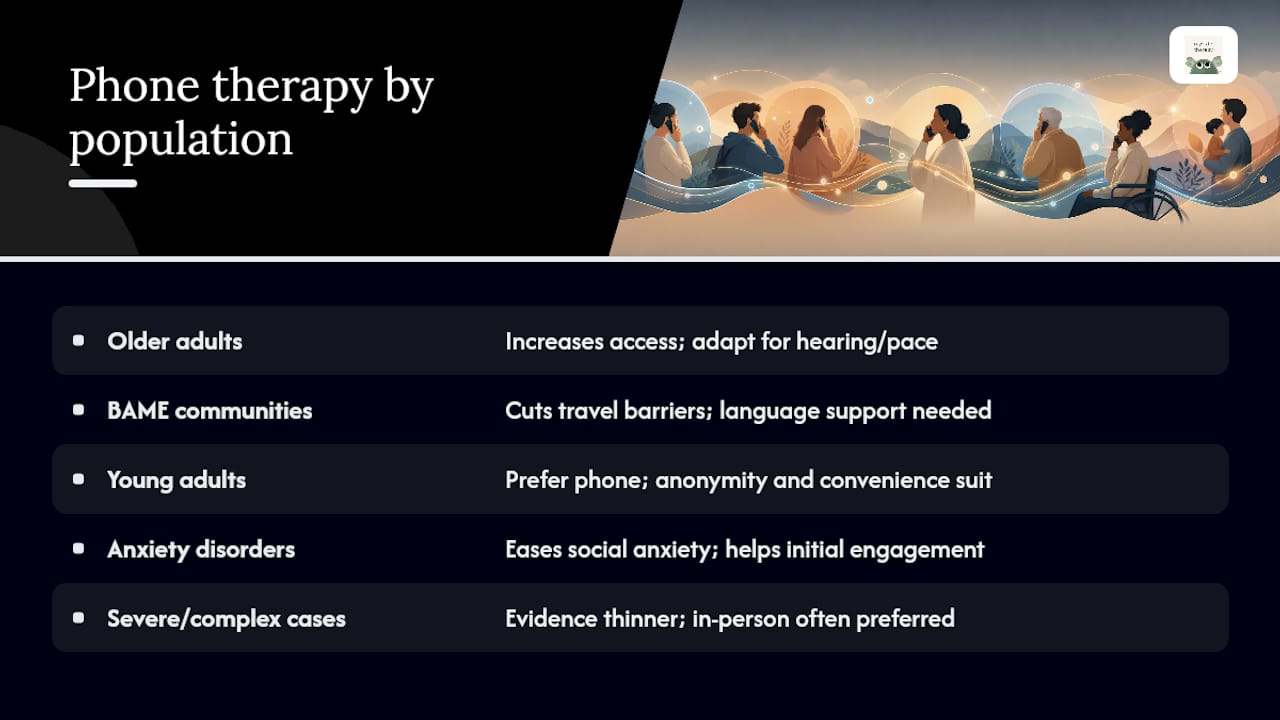
Older adults represent one area where telephone delivery has shown particular promise. Access barriers, including transport difficulties, reduced mobility, and reluctance to attend mental health services in person, are pronounced in this group. Service analyses suggest telephone delivery can increase engagement among older adults who would otherwise not access care, though therapists working with this group need to account for potential hearing difficulties and ensure the pace and format of sessions are adapted accordingly.
People from Black, Asian, and minority ethnic backgrounds face documented access barriers to mental health services in the UK, including stigma, cultural mistrust of services, and geographic concentration in areas where services are under-resourced. Telephone therapy can reduce some of these barriers by removing the need to attend a clinic, though it does not address the need for culturally competent therapists or therapy delivered in a client's first language. Mysafetherapy offers sessions in multiple languages, including Ukrainian, Turkish, and German, which extends accessibility for communities where language is a primary barrier.
Working professionals with demanding schedules represent a group for whom the flexibility of phone therapy is often decisive. The ability to book an evening or weekend appointment, without commuting to a clinic, removes the practical conflict between work commitments and mental health care. Therapy for professionals via phone or other remote formats is increasingly the norm rather than the exception.
Young adults and students tend to be comfortable with phone-based communication and often prefer it to in-person clinic attendance. For this group, the anonymity and convenience of telephone therapy align well with their existing communication habits.
People with anxiety disorders, including social anxiety and agoraphobia, may find the phone format particularly well-suited to initial engagement. The reduced social exposure of a phone call can make the first step into therapy feel manageable when a clinic visit would not. For those specifically managing social anxiety, starting treatment by phone can be a clinically appropriate entry point before transitioning to other formats if needed.
Where telephone therapy is less well-evidenced is in populations with severe mental illness, complex trauma histories, or significant communication difficulties. For these groups, the evidence base is thinner and the clinical case for in-person care is stronger.
Why phone therapy deserves its place in mainstream mental health care
The evidence for phone therapy has been available for over a decade, yet it still occupies an uncertain position in public perception. Many people assume it is a compromise, a lesser version of the real thing, offered when nothing better is available. The data does not support that assumption for the populations where telephone delivery is recommended.
What the evidence actually shows is that for mild to moderate anxiety and depression, the therapeutic relationship formed over the phone is not meaningfully weaker than one formed in person, outcomes are comparable, and the practical barriers to access are substantially lower. The 36.2% per-session cost saving in the IAPT dataset is not a minor footnote; it represents a real difference in how many people a service can reach with the same resource.
The more important question is not whether phone therapy works, but whether it is implemented well. Telephone-specific training, clear safeguarding procedures, and honest clinical matching, rather than efficiency-driven allocation, are what separate good telephone therapy from a cost-cutting measure dressed up as patient choice. When those conditions are met, phone therapy is not a compromise. It is a clinically sound, practically accessible option that reaches people who would otherwise not receive care at all.
Mysafetherapy: a vetted UK option for phone and remote therapy
Mysafetherapy connects adults in the UK with accredited therapists registered with BACP, UKCP, or NCPS, all verified before listing on the platform. Sessions are available by phone, video, chat, and avatar format, with flexible booking that includes evenings and weekends. Pricing is transparent, therapist switching is straightforward, and the platform's data protection and GDPR procedures are documented clearly.
For anyone ready to start, the platform's safety procedures cover consent, confidentiality, risk assessment, and escalation, the same trust signals outlined in this article. AI journaling, mood tracking, and self-help tools supplement live sessions for ongoing support between appointments. If you want a phone therapy option that meets the accreditation and safeguarding standards described here, book a session with a verified UK therapist or read the platform's full safety guidance at Mysafetherapy.
Sources
The sources below underpin the evidence presented in this article. Each is listed with a brief note on what it covers, so you can follow up on the areas most relevant to your situation.
- Comparative effectiveness of cognitive therapies delivered face-to-face or over the telephone: an observational study using propensity methods.
- Are there interactional differences between telephone and face-to-face psychological therapy? A systematic review of comparative studies
- Benefits and Challenges of Conducting Psychotherapy by ...
- Online and phone counselling About therapy
- Telephone treatments in Improving Access to Psychological Therapies services: an analysis of use and impact on treatment uptake