

Yes, for many focused problems, a single online therapy session can produce a written action plan that clarifies your next steps and reduces immediate distress. It works best for specific, present-day issues rather than long-standing or severe conditions. Evidence supports the approach, though with clear limits and safety caveats you should understand before booking.
TL;DR:
- Single-session therapy is most effective for clearly defined, present-day issues like decision-making or acute stress, not for complex or longstanding trauma.
- Beneficiaries should have a specific problem they can describe in one sentence and a clear idea of what "resolution" looks like.
- Preparing with a specific goal and measurable action plan before the session significantly improves outcomes and follow-up success.
- Safety screening is essential; therapy should stop and redirect if signs of severe mental health crises or safety concerns appear.
- Structured intake, goal setting, and follow-up tools are key to ensuring the session leads to real progress rather than superficial support.
Table of Contents
- What is single session therapy online?
- Who actually benefits from one session?
- What happens during an online single session?
- How do you find and book one, and what does it cost?
- Does single session therapy actually work?
- When is single session therapy not the right choice?
- How should you prepare, and what happens afterwards?
- Our take: stop treating one session as a lesser option
- Book a single online session with an accredited UK therapist
- Sources
What is single session therapy online?
Single-session therapy (SST) is one complete, self-contained appointment designed to resolve or make headway on a specific problem, not a taster session before a longer course of therapy. The distinction matters: multi-session approaches build a relationship over weeks and revisit progress gradually, while SST assumes this may be the only contact you and the therapist ever have, so every minute is used with intent.
That assumption shapes what practitioners call the single-session mindset. It borrows techniques from several established models rather than one fixed script:
- Solution-focused questions that identify what "better" looks like in concrete terms
- CBT-informed reframing to challenge unhelpful thought patterns quickly
- Method of levels, which helps you clarify which problem, among several, is actually worth solving today
Preparation drives outcomes here more than in ongoing therapy. An expert framework on the single-session mindset found that practitioners who use structured intake forms and encourage SMART goal-setting before the call see stronger, more measurable results. You are not just showing up. You are arriving with a defined target.
Who actually benefits from one session?
SST suits problems with a clear edge to them: a decision you cannot make, acute stress after a specific event, nerves before a job interview or difficult conversation, or a short-lived friction point in a relationship. If you can describe the issue in one sentence and picture what "resolved" would feel like, you are a strong candidate.
It is the wrong tool for some presentations. Watch for these red flags before booking a single session:
- Long-standing or complex trauma that has never been addressed
- Active suicidal ideation or a recent crisis involving self-harm
- Unmanaged psychosis or a severe, diagnosed mental illness
- Substance dependence needing structured, ongoing clinical support
The simplest heuristic: short timeline, focused goal, and a preference for an action plan over an ongoing relationship. If any of those three is missing, longer-term care is the safer route.
What happens during an online single session?
Sessions typically run 50 to 60 minutes over video, though many platforms also offer phone or chat formats for people who find talking on camera harder. A quiet room, a stable internet connection, and headphones make more difference to session quality than most people expect.
The flow generally follows four stages:
- Intake and goal setting. The therapist reviews your pre-session form and agrees the specific problem you are tackling.
- Focused intervention. A technique suited to your issue, solution-focused questioning or a CBT reframe, does the main work.
- Written action plan. You leave with concrete, measurable steps, not vague encouragement.
- Safety check and next steps. The therapist confirms you feel settled and discusses whether follow-up is needed.
Throughout, the therapist is also screening for risk and choosing techniques on the fly rather than following a rigid script.
Pro Tip: Write your one core question down before the session starts. Therapists working in the single-session mindset move fast, and having it in front of you stops the conversation drifting.
How do you find and book one, and what does it cost?
Access routes vary in cost and speed. Some UK charities and NHS-adjacent FAST (First Assessment and Screening Team) services offer single sessions free or at low cost, though waiting lists apply even for one-off appointments. Private clinicians who advertise standalone sessions, and therapy marketplaces like MySafeTherapy, give faster, more direct access.
Private single sessions in the UK commonly charge single-session fees, with prices varying depending on the therapist's experience, session length, and any platform booking fees. Treat any figure you see as a guide rather than a fixed rate, since qualifications and format both move the price.
Before booking, check a short list:
- Confirm the therapist's accreditation (BACP, UKCP, or NCPS)
- Ask directly how confidentiality is handled online
- Clarify the cancellation policy
- Ask whether follow-up contact is available if you need it
Understanding what affordable therapy actually looks like helps you compare offers sensibly rather than chasing the cheapest listing.
Does single session therapy actually work?
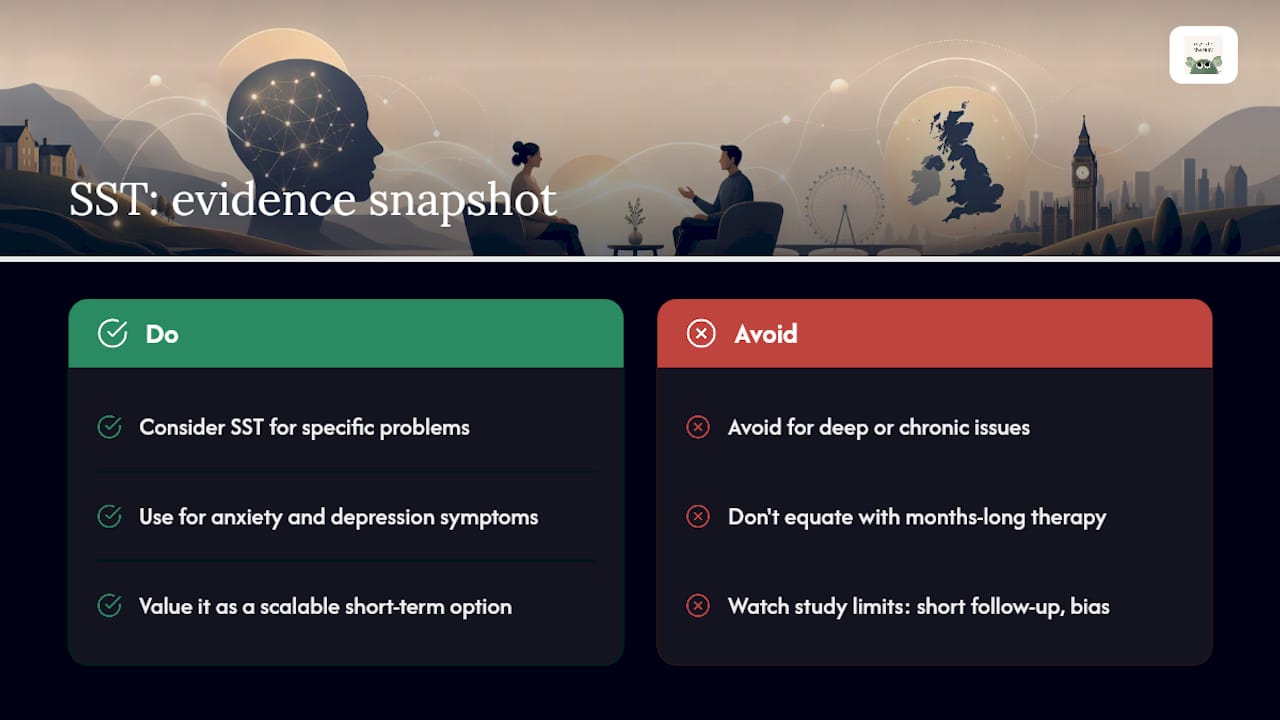
The research base is more substantial than most people assume for a format this brief. An umbrella review synthesising 24 systematic reviews and 415 trials found consistent positive effects across outcomes including anxiety, depression, and service engagement, with a pooled effect size in the small to moderate range (SMD around −0.25).
That figure sits below what you would expect from months of therapy, but it comes from a single hour, which changes the value calculation considerably.
A separate systematic review of SST for common mental disorders reported positive short-term outcomes for depression across several trials, though it flagged real limitations: short follow-up windows, inconsistent definitions of what counts as an "SST", and risk of bias in some of the included studies.
The honest takeaway is that SST is a genuinely useful, scalable option for specific problems, not a wholesale replacement for longer psychotherapy where deeper or chronic issues are involved.
When is single session therapy not the right choice?
Every reputable single-session service runs a risk screen at the start of the call, because a format built around one presenting issue can easily miss underlying severity if nobody checks. Reporting from clinicians working in the field confirms this screening is standard practice, not an optional extra.
Certain signs mean a single session should stop and redirect rather than proceed as planned:
- Active suicidal ideation or a disclosed plan to self-harm
- Severe, unmanaged substance dependence
- Signs of psychosis or a break from reality
- Disclosure of ongoing abuse or an unsafe living situation
When any of these appear, the therapist's job shifts from intervention to signposting: emergency services, a GP referral, or a structured multi-session pathway.
Pro Tip: If you are unsure whether your situation is "too severe" for one session, say so on the intake form. A good therapist would rather redirect you before the call than midway through it.
How should you prepare, and what happens afterwards?
Preparation is where most of the value gets created or lost. Before the call, narrow your issue to one clear goal, complete any intake forms honestly, find a private space, and gather relevant notes or dates.
- Before: Choose a single, specific goal rather than a general theme like "feeling stressed".
- During: Push for a written, measurable next step before the session ends, and ask plainly whether follow-up is available.
- After: Set a concrete date to check your own progress, and use a self-help tool like mood tracking to notice whether the plan is holding.
Know your urgent-help routes in advance. If your circumstances change after the session, a single appointment should not be the only safety net you have.
Pro Tip: Put the action plan somewhere you will actually see it. A phone note buried in a folder gets ignored by day three.
Our take: stop treating one session as a lesser option
Most guidance on this topic still frames single-session therapy as a consolation prize, something you settle for when you cannot access "proper" therapy. That framing gets the evidence backwards. For a genuinely bounded problem, one well-structured session with clear goal-setting beats several unfocused sessions that never quite land on what is actually wrong.
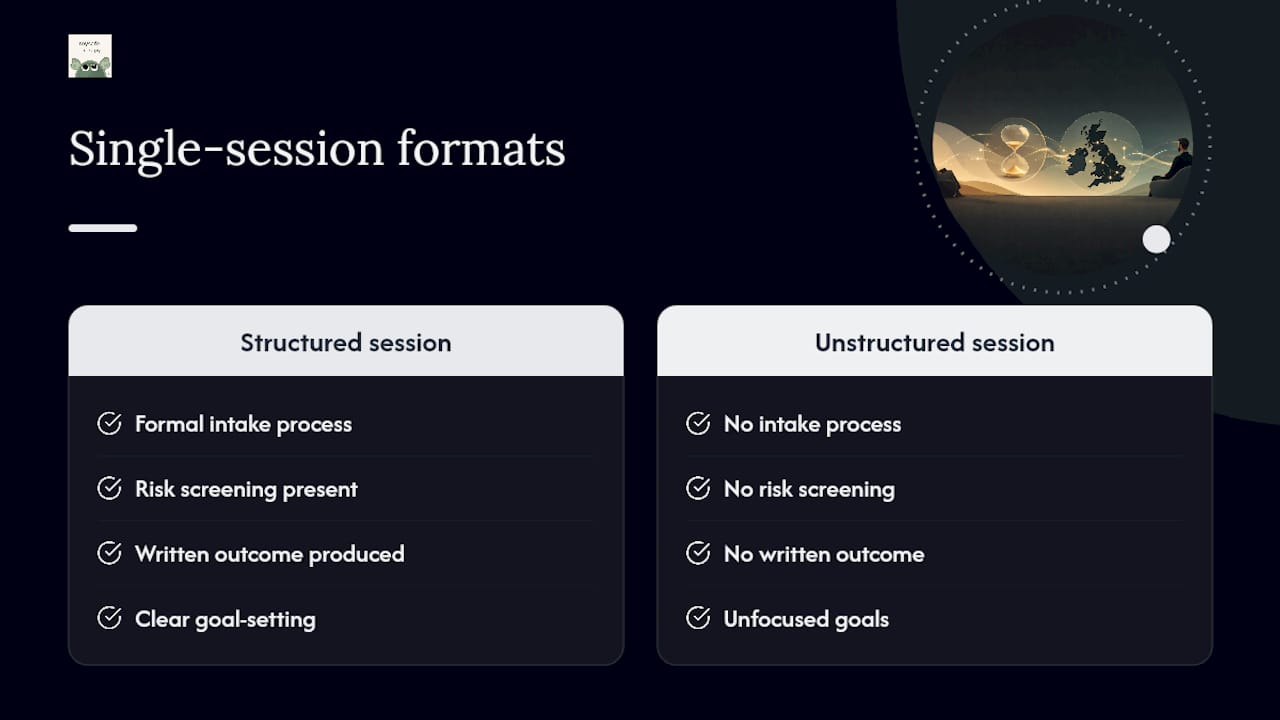
Where conventional advice falls short is in treating all single sessions as interchangeable. They are not. A session run without a real intake process, risk screening, or a written outcome is closer to a chat than to therapy. The research on the single-session mindset is consistent on this: structure before, during, and after the call is what separates a session that helps from one that just feels supportive for an hour.
Prioritise the therapist's process over their bio. Ask what happens if you are not a fit for one session. A practitioner working properly within this model will tell you plainly, and redirect you rather than force the format to fit.
— MySafeTherapy
Book a single online session with an accredited UK therapist
Mysafetherapy exists for exactly this moment: when you know what you need to talk through and want it resolved without committing to weeks of appointments. Therapists on the platform are accredited with recognized UK bodies, and you can choose video, chat, or avatar-based sessions depending on how comfortable you feel being seen.
Booking offers flexibility with evening and weekend slots and provides clear, upfront pricing before you commit. The intake process includes a pre-session form, goal setting, and a risk check at the start. If your first therapist is not the right match, switching is easy to do. Once your session ends, tools such as AI journaling and mood tracking can help you maintain the plan you leave with, rather than letting it fade quickly. If you know your issue and want it addressed properly in one sitting, start therapy today and get matched with a therapist who works this way as standard.
This article is general information, not a substitute for advice from a qualified doctor. Consult a qualified healthcare professional about your own circumstances before acting on anything here.
Sources
- Single-session therapy can help address gaps in mental health care | AP News
- Single-Session Interventions for Mental Health Problems and Service Engagement: Umbrella review | PubMed
- An expert understanding of the single-session mindset | Journal of Single Session Therapy (2024)