

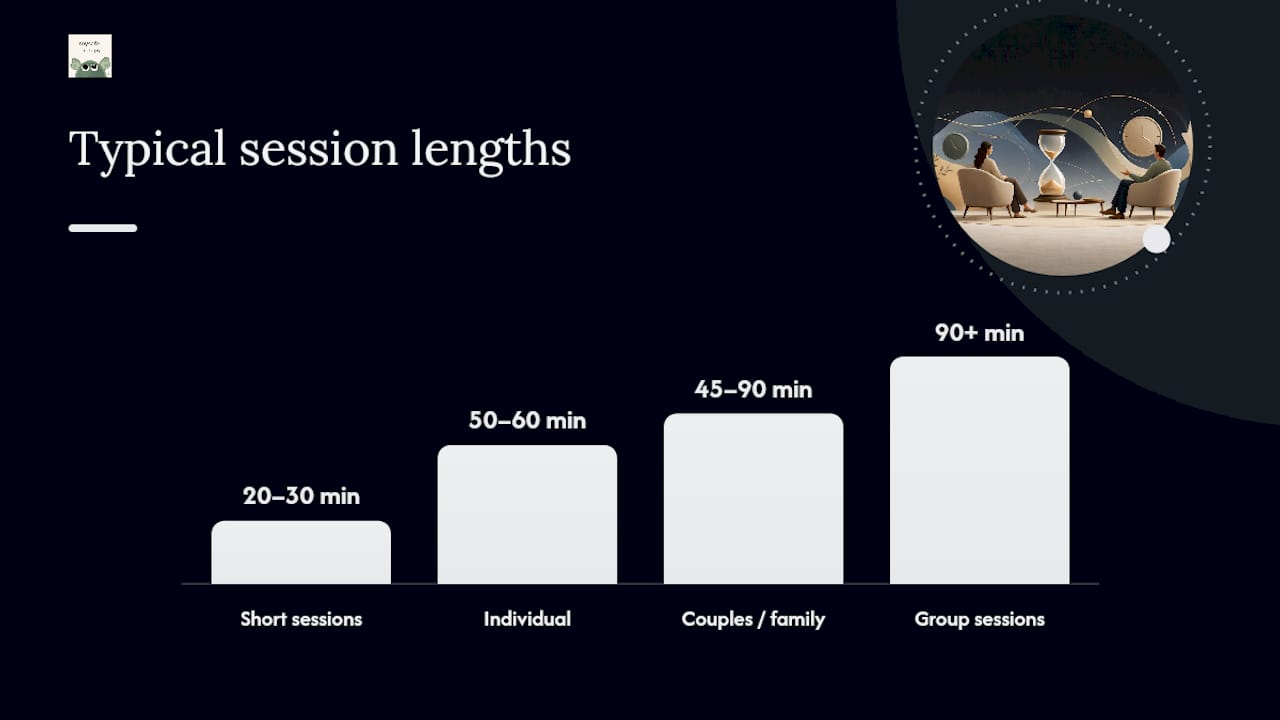
Most one-to-one therapy sessions last 50 minutes, sometimes stretching to a full hour. Couples and family sessions typically run for longer periods, often around an hour or more, and group therapy often lasts longer still, to give each participant time to speak. Shorter 20 to 30 minute check-ins exist too, usually for brief contact or crisis support.
The 50-minute slot is often called the "therapeutic hour", a long-standing convention in UK talking therapy rather than a fixed rule.
- Individual sessions: 30 to 60 minutes, commonly 50
- Couples and family sessions: 45 to 90 minutes
- Group sessions: often longer, to allow multiple people time to contribute
- Check-ins: 20 to 30 minutes for brief or crisis contact
Whatever length you're offered, it should be agreed upfront in your initial contract with your therapist, alongside frequency and total sessions. NHS-provided counselling is usually time-limited; private practice tends to be more open-ended.
Key Takeaways
Most UK therapy sessions last about 50 to 60 minutes for individuals and generally longer for couples, families, or groups, with length and frequency fixed in an upfront contract.
| Point | Details |
|---|---|
| Standard length | Individual sessions typically run 50 to 60 minutes, following the UK's therapeutic hour convention. |
| Format shapes duration | Couples and family sessions often run 45 to 90 minutes; group sessions frequently exceed 90 minutes. |
| Contracting matters | Length, frequency, fees, and whether therapy is time-limited should be agreed before your first full session. |
| NHS vs private differs | NHS counselling commonly offers 8 to 16 sessions, while private practice is usually more open-ended. |
| Mysafetherapy's approach | Offers video, chat, and avatar sessions mapped to standard UK durations, with transparent contracting and BACP, UKCP, or NCPS-accredited therapists at intake. |
This article is general information, not a substitute for advice from a qualified doctor. Consult a qualified healthcare professional about your own circumstances before acting on anything here.
Table of Contents
- Therapy session length by format: what to expect
- Why the 45 to 50-minute 'therapeutic hour' exists
- How session length and frequency get agreed
- Choosing the right session length for you
- How MySafeTherapy structures session length and format
- Book UK-accredited therapy with clear session terms
- Sources
Therapy session length by format: what to expect
The length you're offered usually depends on who's in the room, not just personal preference. One-to-one sessions typically run 50 minutes to a full hour, and that's the figure most UK therapists and professional bodies work to as standard practice, according to UKCP guidance. Fifty minutes has become the working default partly because it leaves therapists a short buffer between clients for notes and mental reset, something we'll unpack in the next section.
Shorter sessions of 20 to 30 minutes show up in specific contexts: brief welfare check-ins, medication reviews run alongside talking therapy, or crisis contact where the goal is stabilisation rather than deep exploratory work. They're not a lesser version of therapy, just a different tool for a different job.
At the other end, couples and family sessions commonly run 45 to 90 minutes. Two or more people need time to each have a voice, and unpicking relational dynamics rather than one person's internal world tends to take longer to unfold. Some practitioners offer extended 90-minute slots for intensive relationship work or the first assessment session, where there's more ground to cover.
Group therapy sessions frequently run 90 minutes or longer. With six to ten participants each needing space to speak, listen, and respond, compressing that into a standard hour rarely works. The maths is simple: more voices need more time.
- 50 to 60 minutes — standard for individual sessions
- 20 to 30 minutes — brief check-ins or crisis contact
- 45 to 90 minutes — couples and family work
- 90+ minutes — group therapy, to allow every participant airtime
Format matters here too. A video therapy session tends to mirror in-person timing closely, while chat-based sessions sometimes run on a different rhythm depending on how the exchange is structured.
Why the 45 to 50-minute 'therapeutic hour' exists
The therapeutic hour isn't arbitrary, though it can feel that way when you're mid-conversation and your therapist glances at the clock. Historical and clinical literature treats it as a professional convention that has evolved over time and varies by locality and setting, rather than a rule handed down by clinical science, according to research indexed on PubMed. The UK's roughly 50-minute norm sits alongside slightly different international habits, including 45-minute sessions in the US that were shaped partly by insurance billing structures rather than clinical necessity, as Therapy Today has noted.
There are practical reasons the convention has stuck:
- It gives therapists a short break between clients to write notes, decompress, and mentally reset before the next session
- It creates predictable transitions, which matters when a practice runs back-to-back appointments through the day
- It protects consistency of care across a caseload, so no single client's session bleeds into the next person's time
There's a clinical logic too. Sustained emotional or reflective work is tiring, and most people's capacity for focused introspection has a natural ceiling. Ending at a predictable point, often with a few minutes set aside to summarise and structure next steps, is a deliberate technique rather than an abrupt cutoff, as the BACP explains. Timing, in that sense, functions as a professional boundary that protects the quality of the work itself, a point Revive Health Therapy explores in more depth.
Pro Tip: If a session consistently leaves you feeling rushed just as you're getting to the difficult part, that's worth raising directly with your therapist. Some people do better with a slightly longer or more frequent slot, and it costs nothing to ask.

How session length and frequency get agreed
Before your first proper session, you and your therapist should agree what's known as a contract. This isn't a legal document in the way a tenancy agreement is, but professional guidance treats it as a cornerstone of safe practice, and it should be made explicit rather than assumed, according to the BACP.
A proper contract typically covers:
- Session length — usually 50 minutes, occasionally an hour, agreed from the outset
- Frequency — weekly is standard, though fortnightly or intensive schedules exist
- Fees and cancellation policy — including what happens if you're late or need to reschedule
- Whether the arrangement is time-limited or open-ended
That last point is where NHS and private provision diverge most sharply. NHS counselling commonly offers between 8 and 16 sessions as a defined package, according to NHS guidance, reflecting the realities of resourcing a free public service. Private practice, by contrast, is far more often open-ended, continuing for as long as client and therapist agree it's useful. Mind's guidance on what to expect from therapy draws the same distinction, and it's worth reading before you commit to either route. Our guide to NHS versus private therapy breaks down the practical trade-offs, including waiting times and cost.
Contracting isn't administrative box-ticking. It's what gives both client and therapist a shared understanding of the shape the work will take, and it's one of the clearest ways complaints and misunderstandings about timing or cost get avoided later on, according to UKCP's own analysis of therapy complaints.
If your circumstances change, whether you want longer sessions, more frequent contact, or a switch from open-ended to a defined block, say so at review. Most therapists are used to renegotiating the contract rather than treating the first agreement as fixed for good.
Choosing the right session length for you
Before booking, it helps to ask a few direct questions: How long is the standard session? What happens if we run over? Is there a fee for an extended session, and how is a cancellation or late arrival handled? A short, clear conversation at the first appointment saves confusion later, and booking a therapy appointment is usually the natural moment to raise it.
What suits you depends on a few practical factors: how complex or long-standing the issue is, your own concentration span, what fits your schedule, and the cost implications of a longer slot. Trauma-focused work, for instance, often benefits from the full standard hour to allow proper grounding before and after difficult material, while brief supportive check-ins can work well at 20 to 30 minutes.
- Ask about extension rules and fees before you need them, not mid-session
- Consider whether chat or video format suits your attention span better
- Occasional extended sessions can be arranged around assessments or intensive periods
- Late arrivals are usually absorbed into the existing end time, so the session simply runs shorter
Pro Tip: If cost is a factor, ask whether shorter or blended sessions are available rather than assuming the only option is the standard 50-minute slot at full price.
How MySafeTherapy structures session length and format
Mysafetherapy offers one-to-one sessions in video, chat, and avatar-based formats, each built around the standard 50 to 60-minute UK convention, with shorter check-in style contact available for those who need lighter, more frequent touchpoints, in line with the flexibility UKCP guidance describes as increasingly common across modern practice.
Every therapist on the platform is accredited with BACP, UKCP, or NCPS, and contracting, covering session length, fees, and whether your arrangement is time-limited or ongoing, is set out clearly at intake rather than left vague. Our guide on BACP's role in UK therapy explains what that accreditation actually guarantees.
- Video, chat, and avatar sessions, each mapped to standard or shorter durations
- Transparent contracting on length, fees, and cancellation terms from the first booking
- AI journaling and mood tracking to support progress between sessions, useful if you're on a blended or lower-frequency schedule
A note from Mysafetherapy
Worrying about session length and cost before you've even started is common, and understandable. We build our contracting process to make those choices visible from the outset, not buried in fine print. If you'd like tailored advice, book an assessment and we'll talk through what fits.
Book UK-accredited therapy with clear session terms
Unlike a lot of practices where session length only becomes clear once you're already in the chair, Mysafetherapy sets out length, format, and fees before you book anything. Every therapist is accredited with BACP, UKCP, or NCPS, and you can choose video, chat, or avatar-based sessions depending on what suits your schedule and comfort level, including evenings and weekends if daytime slots don't work for you.
If you're not sure what length or frequency fits your situation, that's exactly what the first assessment is for. Whether you're weighing up a standard 50-minute weekly slot or something shorter and more flexible, you can browse available therapists and book individual sessions and see real availability, formats, and pricing before committing to anything.
Sources
- What to expect from therapy and counselling | Mind
- Psychotherapy FAQs | UKCP
- Counselling - NHS
- PubMed article (historical/clinical context)