

TL;DR:
- Person-centred therapy is a humanistic, non-directive approach developed by Carl Rogers that emphasizes the innate capacity for growth and self-healing within individuals. It relies on three core conditions—congruence, unconditional positive regard, and empathic understanding—that create a safe environment for clients to explore their true selves and facilitate lasting change. This therapy prioritizes the therapeutic relationship over techniques, focusing on client-led sessions that foster self-trust, emotional clarity, and genuine self-acceptance.
Person-centred therapy is defined as a humanistic, non-directive psychotherapy developed by Carl Rogers in the 1950s, built on the belief that every individual possesses an innate capacity for growth and self-healing. Known formally as Rogerian therapy or client-centred therapy, this approach does not treat symptoms in isolation. It focuses on the whole person, trusting that clients can find their own answers when placed in a sufficiently supportive therapeutic relationship. Among the most widely practised talking therapies in the UK and globally, person-centred therapy prioritises the client's internal frame of reference over diagnosis or prescriptive advice. Understanding how it works, what it offers, and how it compares to other approaches helps you make an informed choice about your mental health care.
What is person-centred therapy and its core principles?
Person-centred therapy rests on three conditions that Rogers argued are both necessary and sufficient for therapeutic change. These are congruence, unconditional positive regard, and empathic understanding. Together, they create the environment in which a client can safely explore who they are and who they want to become.

Congruence means the therapist is genuine and self-aware within the session. Rather than performing a professional role, the therapist brings their authentic self to the work. Therapist congruence encourages clients to be equally authentic, which is often the first time many people feel truly seen in a conversation.
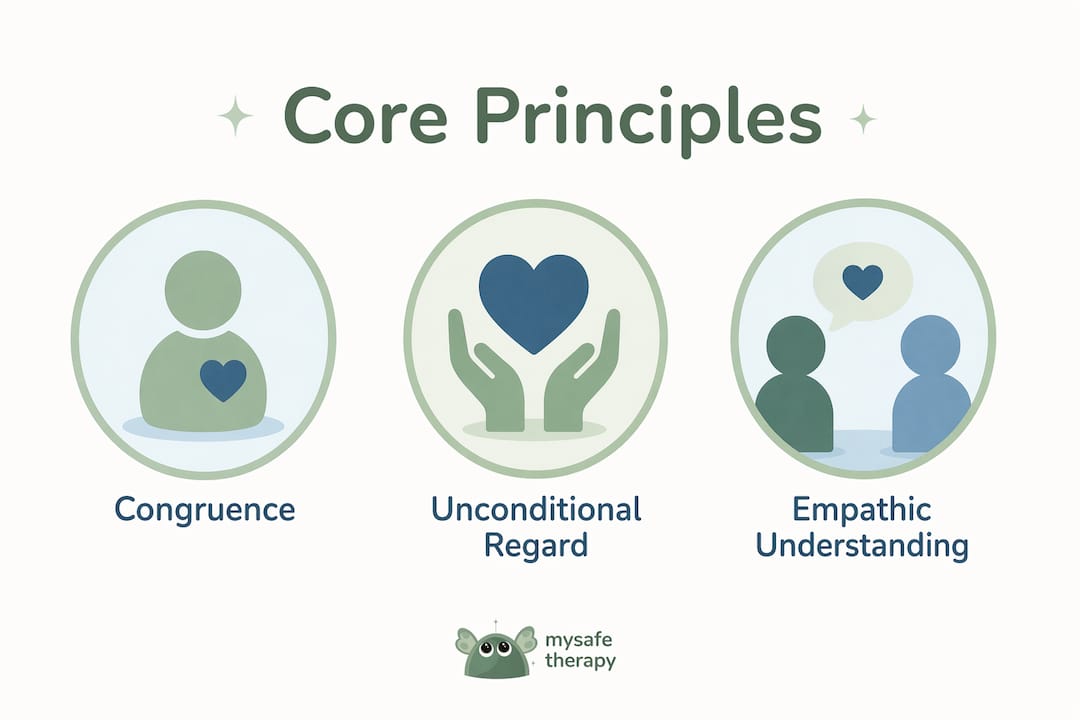
Unconditional positive regard is the therapist's complete, non-judgemental acceptance of the client. There are no conditions attached to this acceptance. The client does not need to behave, think, or feel in a particular way to receive warmth and respect. For many people, this is a radical departure from the conditional approval they have experienced in daily life.
Empathic understanding goes beyond listening. The therapist actively works to perceive the client's experience from the inside, reflecting back what they hear with precision and care. This is not sympathy. It is a disciplined effort to understand the client's world as they experience it.
The therapist's role in person-centred therapy is deliberately non-directive. Sessions have no fixed agenda, no homework, and no prescribed techniques. Clients lead sessions by setting the pace and choosing the topics, which places responsibility and authority firmly with the person seeking help. Sessions typically last 50 minutes and occur weekly, though the frequency can be adjusted to suit individual needs.
- The therapist does not interpret, diagnose, or advise
- The client is regarded as the expert on their own experience
- The relationship itself is the primary instrument of change
- Progress is measured by the client's own sense of growth, not external criteria
Pro Tip: If you are new to therapy and unsure what to expect, person-centred sessions can feel unfamiliar at first because there is no set structure. Give yourself three to four sessions before assessing whether the approach suits you.
How does person-centred therapy compare to other approaches?
Person-centred therapy differs from CBT and psychoanalysis in one fundamental way: the therapist acts as a facilitator and partner rather than an expert diagnostician or instructor. This distinction shapes every aspect of how sessions feel and what they aim to achieve.
Cognitive Behavioural Therapy (CBT) is directive and structured. It identifies specific thought patterns and behaviours, then uses techniques such as thought records, exposure hierarchies, and behavioural experiments to change them. The therapist sets tasks and guides the client through a defined programme. Person-centred therapy does none of this. It trusts that change emerges naturally from within the client when the right relational conditions are present.
Psychoanalysis, developed by Sigmund Freud, focuses on unconscious processes, early childhood experiences, and the interpretation of dreams and transference. The analyst holds interpretive authority. In person-centred work, the client holds all authority over the meaning of their own experience.
| Feature | Person-centred therapy | CBT | Psychoanalysis |
|---|---|---|---|
| Therapist role | Facilitator and partner | Expert instructor | Interpretive authority |
| Session structure | Client-led, no agenda | Structured with tasks | Structured with interpretation |
| Primary focus | Whole person and self-concept | Thoughts and behaviours | Unconscious processes |
| Use of techniques | None prescribed | Extensive | Extensive |
| Goal | Self-directed growth | Symptom reduction | Insight into unconscious |
| Homework | None | Regular | None |
This comparison is not a ranking. CBT has strong evidence for specific conditions such as panic disorder and OCD. Psychoanalysis offers depth for those seeking to understand long-standing patterns. Person-centred therapy is the approach of choice when the therapeutic relationship itself is what the client needs most, and when self-directed exploration is more valuable than structured intervention.
What are the benefits of person-centred therapy for mental health?
The benefits of person-centred therapy extend across a wide range of mental health challenges, including anxiety, depression, trauma, identity struggles, and low self-esteem. Its strength lies not in targeting specific symptoms but in building the internal resources that allow a person to manage all of these challenges more effectively over time.
Clients who engage with this approach often report a clearer sense of who they are and what they value. This is because the process of being heard without judgement, consistently and over time, allows people to hear themselves more clearly. Many arrive in therapy with a significant gap between how they see themselves and how they actually feel and behave. Therapy helps reduce this gap through safe, unhurried exploration.
The following benefits are consistently reported by clients and supported by clinical observation:
- Increased self-trust and confidence in personal decision-making
- Greater emotional clarity and the ability to name and process feelings
- Reduced anxiety stemming from self-criticism and the need for external approval
- Improved relationships, as clients become more authentic with others
- A stronger sense of personal identity and direction
- Lasting change rather than short-term symptom management
Person-centred therapy is particularly suitable for those who feel overwhelmed or constrained by directive approaches. If you have tried structured therapy and found the pace or prescriptive nature unhelpful, a client-led model may offer the space you need. It is also well-suited to people navigating significant life transitions, grief, or questions of identity and self-worth. For those working through self-esteem and identity, person-centred work provides a relational foundation that more technique-driven approaches do not.
Pro Tip: Person-centred therapy does not produce quick fixes. If you are in acute crisis or need immediate symptom relief, discuss with your therapist whether a short-term structured intervention might run alongside or precede person-centred work.
How does person-centred therapy work in the brain?
The neurobiological basis of person-centred therapy explains why the therapeutic relationship produces lasting change rather than temporary relief. Safety and non-judgement within the therapeutic relationship downregulate stress responses and reduce activation of the hypothalamic-pituitary-adrenal (HPA) axis. This is the body's primary stress regulation system. When it is chronically overactive, as it is in anxiety, depression, and trauma, the brain's capacity for learning, reflection, and emotional regulation is significantly reduced.
A low-stress, consistently safe environment facilitates neuroplasticity. This is the brain's ability to form new neural connections and reorganise existing ones. Person-centred therapy creates the precise conditions under which this reorganisation becomes possible. The therapeutic relationship influences both emotional and physical regulation in the client's brain, which is why the quality of the relationship matters as much as any technique.
Over time, clients gradually internalise the core conditions of the therapeutic relationship. They begin to offer themselves the same non-judgemental acceptance and compassionate attention that the therapist has modelled. This internalisation is what makes the changes durable. Clients become their own compassionate guides, reducing dependence on the therapist and building genuine self-regulation.
| Brain mechanism | How person-centred therapy engages it |
|---|---|
| HPA axis regulation | Safety and non-judgement reduce chronic stress activation |
| Neuroplasticity | Low-stress environment supports new neural pathway formation |
| Emotional regulation | Consistent empathic presence builds self-regulatory capacity |
| Internalisation | Core conditions are absorbed and self-applied over time |
This neurobiological perspective also explains why trauma recovery often benefits from person-centred principles. Trauma dysregulates the nervous system. Before any cognitive or behavioural work can take hold, the nervous system needs to experience sustained safety. Person-centred therapy provides exactly that.
Key takeaways
Person-centred therapy produces lasting change by creating the relational conditions under which clients can resolve incongruence, build self-trust, and internalise compassionate self-regard.
| Point | Details |
|---|---|
| Core conditions | Congruence, unconditional positive regard, and empathic understanding are the foundation of all therapeutic change in this model. |
| Non-directive structure | Clients lead every session with no agenda, homework, or prescribed techniques, placing authority with the individual. |
| Neurobiological basis | Safety and non-judgement downregulate the HPA axis and facilitate neuroplasticity, producing durable brain-level change. |
| Broad applications | Effective for anxiety, depression, trauma, identity struggles, and self-esteem, particularly where directive approaches have felt constraining. |
| Long-term self-sufficiency | Clients internalise the core conditions over time, becoming their own compassionate guides well beyond formal therapy. |
The active discipline behind apparent simplicity
From where we stand at Mysafetherapy, the most persistent misconception about person-centred therapy is that it is passive. Sitting with someone and listening sounds simple. It is not. Maintaining unconditional positive regard is a disciplined, skilled practice that requires the therapist to set aside their own judgements, reactions, and assumptions continuously throughout every session. That is demanding work.
What strikes us most, having seen this approach applied across a wide range of clients and presenting issues, is how often people underestimate the power of being genuinely heard. Many clients have spent years in environments where their feelings were minimised, redirected, or met with advice. The experience of a therapist who simply stays present, reflects accurately, and accepts without condition can be genuinely disorienting at first. Then it becomes transformative.
We also want to be honest about the challenge. Person-centred therapy asks clients to sit with uncertainty and explore feelings without the scaffolding of tasks or techniques. For those accustomed to structured approaches, this can feel unproductive in the early stages. The flexible, client-led pace is not a weakness of the model. It is the model. The absence of a prescribed path is precisely what allows the client's own path to emerge.
Person-centred therapy is not the right fit for every person or every moment. But for those who need to rebuild trust in themselves and their own perceptions, it offers something that no structured technique can replicate: a relationship in which they are consistently treated as the authority on their own life.
— MySafeTherapy
Explore person-centred therapy with a qualified online therapist
Mysafetherapy connects you with UK-accredited therapists registered with professional bodies including BACP, UKCP, and NCPS, many of whom are trained in person-centred and humanistic approaches.
Sessions are available via video, chat, or avatar-based formats, with evening and weekend availability to suit your schedule. Every session is confidential, client-led, and conducted at a pace that works for you. If you are ready to explore what person-centred therapy can offer, you can start therapy today through a straightforward, secure booking process. For those seeking support tailored to professional life, Mysafetherapy also offers therapy for professionals with the same commitment to confidentiality and client-centred care.
FAQ
What is the person-centred therapy definition?
Person-centred therapy is a humanistic, non-directive psychotherapy developed by Carl Rogers, based on the belief that individuals have an innate capacity for growth when provided with congruence, unconditional positive regard, and empathic understanding from a therapist.
How does person-centred therapy work in practice?
Sessions are client-led with no fixed agenda or homework. The therapist maintains a non-judgemental, empathic presence, and the therapeutic relationship itself is the primary mechanism through which change occurs.
What are the main benefits of person-centred therapy?
Person-centred therapy supports anxiety, depression, trauma, low self-esteem, and identity struggles by building self-trust, emotional clarity, and lasting personal growth rather than targeting specific symptoms with techniques.
How is person-centred therapy different from CBT?
CBT is structured and directive, using specific techniques to change thought patterns and behaviours. Person-centred therapy is non-directive and relationship-based, trusting the client to find their own answers through a safe, accepting therapeutic environment.
Is person-centred therapy suitable for everyone?
It is particularly well-suited to those who feel constrained by directive approaches or who need to rebuild self-trust. It may be less suitable as a standalone approach for those in acute crisis who require immediate, structured symptom management.