

Cognitive behavioural therapy is a recommended, evidence-based treatment for many forms of anxiety, and for generalised anxiety disorder specifically. NICE guidance sets out a typical course of weekly one-hour sessions, completed within a few months. That is the high-intensity route. Many people start somewhere lighter first.
Under the stepped-care model used across NHS Talking Therapies services, guided self-help or digital CBT often comes before a referral to a full course with a therapist. Whether you need the full 12 to 15 sessions or a shorter guided programme depends on how severe and persistent your symptoms are.
Before booking anything, it helps to know:
- CBT works by changing the link between anxious thoughts, feelings, and avoidance behaviours, not by "positive thinking".
- A full course is time-limited and structured, with homework between sessions.
- Lower-intensity options (guided self-help, digital CBT) exist for milder presentations and can be accessed without a lengthy wait.
Key Takeaways
CBT works for anxiety because it replaces avoidance with structured, repeated tests of the thoughts driving it, and NICE recommends 12 to 15 weekly sessions as the standard high-intensity course.
| Point | Details |
|---|---|
| Course length is defined | NICE recommends 12 to 15 weekly one-hour CBT sessions for GAD, completed within four months. |
| Stepped care comes first | Guided self-help or digital CBT is often offered before a full course, matching intensity to symptom severity. |
| Homework drives the change | Between-session practice, not insight alone, is what makes cognitive and behavioural shifts stick. |
| Know when to escalate | If low-intensity support stalls, ask to be stepped up to individual CBT rather than repeating it. |
| Mysafetherapy offers an accredited route | BACP, UKCP, and NCPS-registered therapists deliver CBT-style support via video, chat, or anonymous avatar sessions. |
Table of Contents
- How does CBT help anxiety?
- What does the evidence say about CBT for anxiety?
- Practical CBT techniques for anxiety you can use now
- How do you access CBT for anxiety in the UK?
- What actually happens in a CBT session?
- When CBT isn't enough on its own
- How Mysafetherapy approaches CBT for anxiety
- Getting started with CBT-style support that fits your life
- Frequently asked questions
- Sources
How does CBT help anxiety?
CBT treats anxiety as a loop rather than a fixed trait. A thought ("something bad is about to happen") triggers a feeling (dread, a racing heart), which triggers a behaviour (avoidance, checking, reassurance seeking). That behaviour then reinforces the original thought, because avoiding a feared situation never gives you the chance to disprove it. Cognitive behavioural therapy for anxiety works by interrupting that loop at multiple points, using specific, teachable skills rather than vague reassurance.
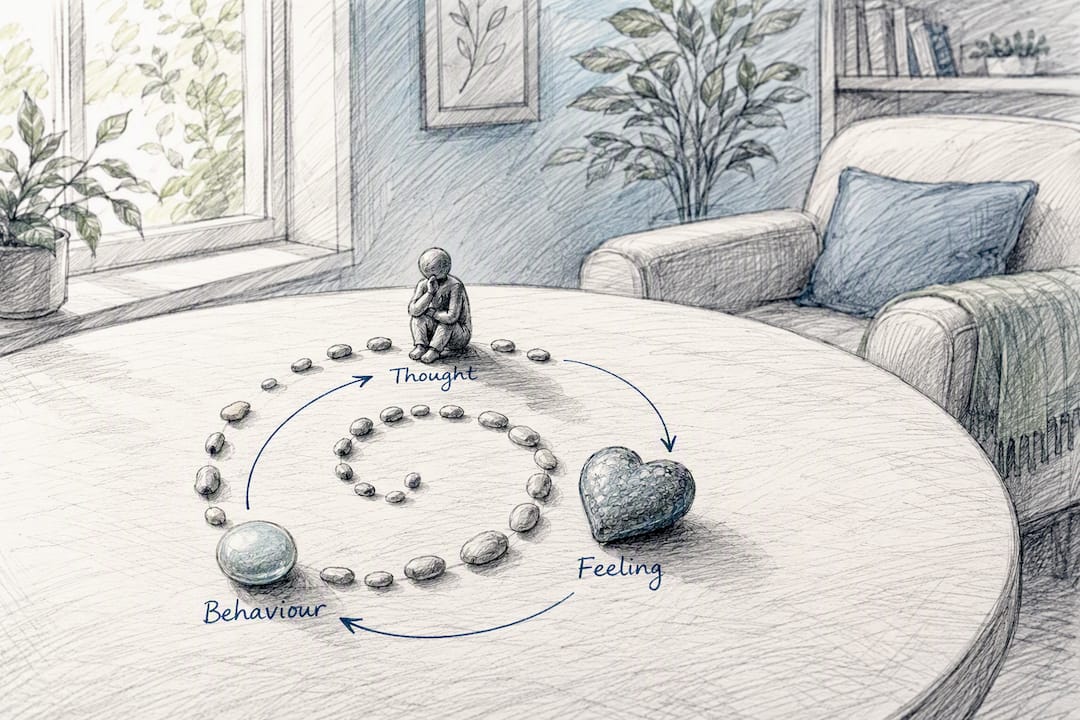
The therapist's role looks less like a traditional talking-cure and more like coaching. Sessions are structured and collaborative: the therapist helps you identify the exact thought or behaviour driving distress, then teaches a technique to test or change it. Therapeutic collaboration and skills transfer are central to how CBT is delivered, since the goal is for you to eventually run these techniques yourself, without the therapist in the room.
In practice, this splits into two connected targets:
- Cognitive targets: the content of worry itself, catastrophic predictions, and the tendency to overestimate danger while underestimating your ability to cope.
- Behavioural targets: avoidance (skipping social events, refusing to fly), and safety behaviours (over-preparing, seeking constant reassurance, carrying medication "just in case").
Safety behaviours are worth pausing on, because they are easy to miss. Carrying anti-anxiety medication you never take, always sitting near an exit, or rehearsing conversations obsessively before they happen all feel like sensible precautions. CBT treats them as maintaining factors, because they stop you learning that you can tolerate the anxious feeling without the crutch.
Pro Tip: Keep a simple log for a week of moments your anxiety spikes, what you were thinking right before it, and what you did next. That pattern, thought then behaviour, is exactly what a CBT therapist will ask you to map in your first session.
What does the evidence say about CBT for anxiety?
The case for cognitive behavioural therapy for anxiety is not built on one flattering trial. A peer-reviewed review of the empirical evidence concludes that CBT is efficacious and effective across anxiety disorders, drawing on a substantial base of randomised controlled trials, though the review is honest that further dismantling studies are needed to isolate exactly which components (exposure versus cognitive restructuring versus relaxation) do the most work.
12 to 15: the number of weekly one-hour sessions NICE recommends for a full course of high-intensity CBT for generalised anxiety disorder, completed within a four-month window.
That figure comes from NICE's clinical guideline CG113, the standard reference UK clinicians use when planning treatment for GAD. It is not an arbitrary number. NICE builds it from trial data on how long it typically takes for cognitive and behavioural change to become durable, rather than just noticeable.
What NICE and NHS Talking Therapies both describe is a stepped-care model, and it matters because not everyone needs the full course on day one:
- Step one (low intensity): guided self-help, psychoeducation groups, or digital CBT programmes, often with minimal therapist contact.
- Step two (high intensity): individual CBT with a trained therapist, delivered over the 12 to 15 sessions described above, for people whose symptoms persist or are more severe.
The NHS Talking Therapies manual frames this escalation as deliberate resource-matching, not a hurdle you have to clear before "real" therapy starts. Guided self-help genuinely resolves milder anxiety for a meaningful number of people, which is part of why the stepped model exists at all rather than routing everyone straight to a therapist.
Practical CBT techniques for anxiety you can use now
You don't need to be mid-course to start using CBT techniques for anxiety. Several are designed as self-help tools, and NHS guidance on self-help CBT techniques confirms that many of the same ideas therapists teach in session translate directly into daily practice. Here's how the core techniques break down, roughly in the order a therapist would introduce them.
- Cognitive restructuring. Catch the automatic thought ("I'm going to make a fool of myself"), write it down exactly as it occurred, then interrogate it like evidence in a trial. What actually supports this thought? What contradicts it? What would you say to a friend who had it? The output is not blind positivity but a more balanced, evidence-weighted version of the thought.
- Graded exposure. Rather than confronting your biggest fear immediately, you build a ladder of situations from mildly uncomfortable to genuinely frightening, and work up it in stages, staying in each situation long enough for anxiety to peak and fall on its own. This is the mechanism behind most lasting change in anxiety treatment: repeated, planned tests of a feared prediction that let your brain update the belief rather than just avoid the evidence.
- Behavioural experiments. Closely related to exposure but framed as a test: "If I speak up in the meeting, I predict my colleagues will look annoyed." You do it, then compare the prediction against what actually happened. Over several experiments, the gap between fear and reality becomes hard to ignore.
- Worry management. For generalised, free-floating worry, scheduling a fixed "worry time" each day, rather than letting it intrude constantly, combined with structured problem-solving for the worries that are actually actionable, reduces the sense that anxiety is running the whole day.
- Relaxation and breathing retraining. Slow, diaphragmatic breathing and progressive muscle relaxation won't resolve the underlying thought patterns alone, but they lower physical arousal enough to make the other techniques usable in the moment.
- Grounding. Simple sensory techniques (naming five things you can see, four you can hear) interrupt panic spirals quickly, useful as a bridge until you can apply a more substantial technique.
These rarely work in isolation. A typical session might combine cognitive restructuring on the drive to a social event with a graded exposure plan for the event itself, and a grounding technique on standby if anxiety spikes once you arrive.
Pro Tip: Start your exposure ladder with something that produces noticeable but manageable anxiety, not the top of the list. If the first step feels unbearable, you've picked the wrong rung, not the wrong technique.
A genuine safety note belongs here. Graded exposure for straightforward social or situational anxiety is generally safe to attempt gradually and cautiously on your own, and the NHS is explicit that self-help CBT works for many milder presentations. But if you experience panic attacks with physical symptoms you haven't had assessed, intrusive thoughts that feel dangerous or violent, or anxiety tied to trauma, work with a therapist before attempting exposure alone. Unsupervised exposure done badly, too fast or without an exit strategy, can reinforce fear rather than reduce it.
How do you access CBT for anxiety in the UK?
Most people in the UK reach CBT through one of three doors, and knowing which one fits your situation saves time.
NHS Talking Therapies (formerly IAPT) accepts self-referral in most areas, meaning you can refer yourself online without seeing a GP first, though a GP referral remains an option too. After an initial assessment, you're typically placed at the step that matches your symptom severity: guided self-help with a trained practitioner offering brief check-ins, or a full course of individual CBT if symptoms are more entrenched.
Guided self-help and digital CBT sit at the low-intensity end of the stepped-care model. NICE's clinical knowledge summary describes this format as interactive, based on CBT principles, usually running for at least six weeks, and involving only minimal therapist contact, sometimes five to seven short check-in sessions rather than a full weekly course. It suits people whose anxiety is affecting them but not severely disrupting daily function, and it works well for readers who want a self-help guide with practical UK strategies to try before committing to a longer course.
Private therapy removes the stepped-care queue but shifts the responsibility for vetting quality onto you. Before booking, check the therapist:
- Holds accreditation with the BACP, UKCP, or NCPS, the three main UK bodies for psychological therapists.
- States clearly which model they practise (CBT specifically, not a general "talking therapy" label).
- Offers a format that suits your schedule and comfort level, whether that's video, phone, chat, or in person.
A GP remains a sensible first stop even if you plan to go private, since they can flag anything that needs medical attention alongside talking therapy and can also connect you with faith-based and community mental health resources, such as those outlined in this practical guide for Australian churches, which can complement clinical care and support recovery if cost is a barrier. It's also worth reading about the different types of therapy for anxiety before you commit, since CBT is not automatically the right fit for every presentation.
What actually happens in a CBT session?
A CBT session follows a recognisable shape almost every time, which is part of what makes it different from open-ended talking therapy. Knowing the structure in advance takes some of the anxiety out of the anxiety treatment itself.
- Check-in and review. The therapist asks how the week went, reviews any homework you completed, and checks in on symptom measures, often a short questionnaire tracking anxiety or worry scores week to week.
- Agenda setting. You and the therapist agree what today's session will focus on, usually one or two specific problems rather than an open discussion of everything that happened that week.
- Skill work. This is the bulk of the session: practising cognitive restructuring on a real recent example, planning the next step of an exposure ladder, or working through a behavioural experiment together before you try it independently.
- Homework planning. Nearly every session ends with a specific task for the week ahead. This is not optional padding. Planned, repeated practice between sessions is the mechanism through which change actually happens, because insight gained in the room only becomes belief once it's tested in real life.
Progress gets tracked, not just felt. Most services use standardised symptom scales session to session, alongside functional goals you set yourself, being able to attend a meeting, travel on the tube, or leave the house without checking the door six times. Meaningful movement on these measures often starts appearing by session four to six, though full resolution typically takes the whole course. If you want a fuller walkthrough of session structure and how homework fits together, the complete guide to therapy sessions for anxiety covers it in more depth.
When CBT isn't enough on its own
CBT is not a universal fix, and a good therapist will tell you that directly rather than push a course that isn't working. A few situations call for something more than standard CBT:
- Complex comorbidity. Anxiety alongside psychosis, severe personality disorder presentations, or active suicidality needs multi-professional input, not a standalone CBT referral, and should be flagged to a GP or crisis service immediately.
- Limited response after a full course. If 12 to 15 sessions haven't shifted symptoms meaningfully, that's a signal to review the formulation, not necessarily to abandon CBT, sometimes a different technique mix or a longer course helps.
- Medication alongside therapy. For moderate to severe generalised anxiety disorder, a GP may discuss combining CBT with medication. This is a conversation to have directly with a prescriber, since it depends on your history and symptom severity.
- Escalation within stepped care. If low-intensity guided self-help isn't shifting things after the expected timeframe, ask explicitly to be stepped up to high-intensity, individual CBT rather than repeating the same low-intensity programme.
How Mysafetherapy approaches CBT for anxiety
Mysafetherapy connects people with UK-accredited therapists registered with BACP, UKCP, or NCPS, and structures sessions around the same evidence-based principles NICE and NHS Talking Therapies describe: clear goals, measurable progress, and skills you keep using after the course ends.
What sits underneath the sessions matters too. AI journaling and mood tracking give you a way to log the thought-feeling-behaviour patterns that come up between appointments, so the work doesn't stop when the session ends. Pricing is stated upfront, and switching therapists is straightforward if the fit isn't right, which matters more in CBT than people expect, since the collaborative relationship is part of how the technique actually works.
Getting started with CBT-style support that fits your life
If reading about exposure ladders and worry scheduling has you wanting to try this properly rather than piecing it together from articles, that's exactly the gap a structured platform is built to close. Mysafetherapy offers avatar therapy from £49, an anonymous online counselling format that suits people who want CBT-style structure without the exposure of a video call, alongside standard video and chat sessions for those who prefer a more familiar setup.
Signing up starts with a short questionnaire matching you to an accredited therapist based on your presentation, whether that's generalised worry, panic, or something more specific like social anxiety. Every therapist on the platform is registered with BACP, UKCP, or NCPS, the same bodies you'd check credentials against if you were vetting a private therapist yourself, and sessions run in confidence with clear, upfront pricing and no lock-in to a fixed number of weeks. If you're ready to move from reading about CBT to actually starting it, you can book your first session and be matched with a therapist within days rather than months.
Frequently asked questions
How many CBT sessions does it take to see results for anxiety? Noticeable movement on symptom scores often starts by session four to six, but NICE's recommended full course runs 12 to 15 sessions for lasting change in generalised anxiety disorder.
Can I do CBT for anxiety without seeing a therapist? Guided self-help and digital CBT programmes work for many milder presentations, and the NHS confirms several core techniques translate well into self-help, though more severe or trauma-linked anxiety usually needs a therapist.
Is CBT better than medication for anxiety? They're not competitors. For moderate to severe generalised anxiety disorder, a GP may recommend combining CBT with medication rather than choosing one over the other.
Does CBT work differently for panic disorder versus social anxiety? The core model stays the same, but the exposure targets differ: panic disorder work often focuses on physical sensations and catastrophic misinterpretation of them, while social anxiety work targets specific social situations and safety behaviours like avoiding eye contact.
How do I know if my CBT therapist is properly accredited? Check they're registered with BACP, UKCP, or NCPS, the main UK accrediting bodies, and ask directly which therapy model they practise before booking.
This article is general information, not a substitute for advice from a qualified doctor. Consult a qualified healthcare professional about your own circumstances before acting on anything here.
Sources
NICE CG113, NHS self-help CBT, PMC evidence review, and evidence-based therapy explained.
- NICE guidance: Generalised anxiety disorder and panic disorder in adults: management (CG113)
- Online self-help CBT techniques - Every Mind Matters
- Cognitive-behavioral therapy for anxiety disorders: an update on the empirical evidence — PMC
- NHS Talking Therapies for anxiety and depression manual (IAPT) — Royal College of Psychiatrists