

TL;DR:
- Inclusive mental health care offers culturally competent, equitable services tailored to diverse social needs. Addressing systemic barriers and redefining family structures are essential to improve access and recovery for marginalized communities. Implementing sustained community partnerships and diverse workforce development enhances service inclusivity and effectiveness.
Inclusive mental health care is defined as the provision of accessible, culturally competent, and equitable mental health services tailored to the diverse needs of all individuals, particularly those facing social exclusion. The term aligns with the recognised industry concept of equity-oriented care, which addresses not just clinical symptoms but the social conditions shaping mental distress. In the UK, frameworks such as the NHS Patient and Carer Race Equality Framework (PCREF) and the Workforce Race Equality Standard (WRES) set the structural baseline for this approach. Researchers in 2026 identified 18 specific socially marginalised groups requiring tailored integrated mental health care. That figure signals how far beyond a one-size-fits-all model genuine inclusivity must reach.
What does defining inclusive mental health care actually mean?
Inclusive mental health care means designing services around the person, not the system. It requires cultural competence, person-centred practice, and structural awareness of how race, class, disability, gender identity, and economic status shape mental health. The goal is equitable access and equitable outcomes, not simply equal provision.

Person-centred care, as defined by the British Association for Counselling and Psychotherapy (BACP), places the individual's values, preferences, and lived experience at the centre of every clinical decision. Cultural competence extends this further by requiring practitioners to understand and respond to the cultural context of each person they support. Together, these principles form the foundation of inclusive mental health access in practice.
Integrated care models that prioritise person-centred practice and cultural competence address significant gaps in both access and quality. This matters because gaps in access are not random. They follow predictable patterns tied to ethnicity, socioeconomic status, and geography.
Why does inclusive mental health care matter for diverse UK communities?
Social inclusion is a critical recovery goal in mental health, not a secondary concern. Participation in community activities such as education and employment correlates directly with better recovery outcomes for people with severe mental illness. People with severe mental illness face much higher rates of social isolation than the general population. That isolation compounds clinical symptoms and reduces the effectiveness of treatment.
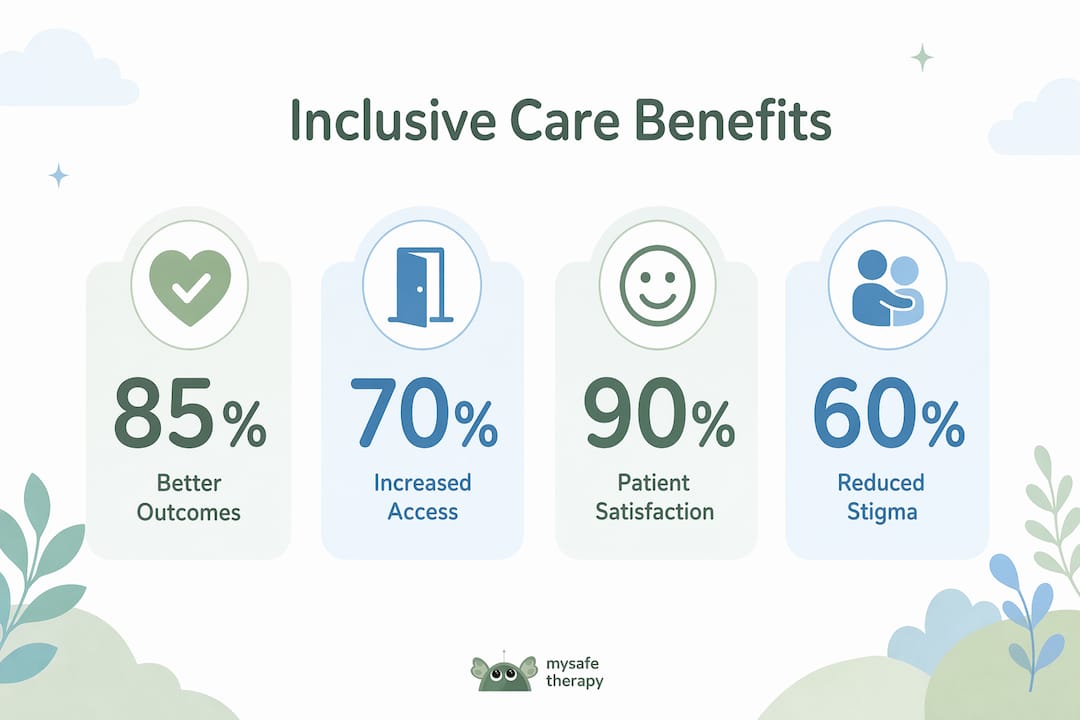
The importance of inclusive mental health extends beyond individual wellbeing. Systemic exclusion, shaped by factors such as institutional racism and economic deprivation, produces measurable disparities in mental health outcomes across ethnic minority communities in the UK. Traditional Eurocentric and biomedical models of care tend to isolate clinical risk factors while ignoring these structural causes. A social determination framework offers a more complete picture by addressing the societal power structures that generate mental distress in the first place.
Individuals with multiple marginalised identities face cumulative barriers that services often treat as isolated issues. A Black woman with a disability and low income, for example, does not experience three separate disadvantages. She experiences them simultaneously, and services that fail to account for this intersection reduce their own effectiveness.
"Inclusion in mental health is a protective factor as well as a human rights imperative. Community participation, employment, and belonging are not rewards for recovery. They are conditions that make recovery possible."
This framing shifts the question from "how do we treat this person?" to "what does this person need to thrive?" That shift is the core of the importance of inclusive mental health in practice.
What barriers prevent truly inclusive mental health access in the UK?
Systemic barriers to inclusive mental health access in the UK are well documented and persistent. They operate at every level, from national policy to individual clinical encounters.
Structural and organisational barriers:
- Fragmented services with poor continuity of care leave people from marginalised groups navigating multiple providers without coordination.
- Under-representation of ethnic minorities in NHS mental health clinical and administrative roles reduces cultural resonance and trust.
- Insufficient cultural competency training within NHS services, compounded by historical prioritisation of Eurocentric treatment models, limits practitioner effectiveness.
- Narrow definitions of family in care planning exclude kinship networks, chosen families, and blended arrangements that are central to many communities.
- Stigma around mental health, particularly in communities where psychological distress is expressed somatically or through spiritual frameworks, reduces help-seeking behaviour.
Pro Tip: If you are supporting someone from a community where mental health stigma is high, therapy that reduces stigma through anonymity and flexible formats can lower the threshold for first contact significantly.
One-off cultural competency training is a particularly common failure point. Services that deliver a single workshop and consider the obligation met do not produce lasting change. System-level commitments to interpreter support, community partnerships, and continuity of care are what actually shift outcomes. Training is a starting point, not a solution.
The gap between policy intent and lived experience remains wide. PCREF exists as a framework, but uneven implementation across NHS trusts means its impact varies considerably depending on where a person lives and which service they access.
How can mental health services achieve inclusivity?
Achieving genuinely inclusive mental health care requires changes at the system level, not just the practitioner level. The following approaches reflect current evidence on what works.
-
Adopt a social determination framework. Address structural causes of mental distress, including institutional racism, housing insecurity, and economic exclusion, rather than treating symptoms in isolation. Shifting from biomedical to social determination models enables services to target root causes.
-
Redefine family in care planning. Services must explicitly account for kinship networks, chosen families, and blended arrangements. Diverse family structures are central to person-centred care for many communities, and ignoring them limits the quality of support.
-
Build sustained community partnerships. Consistent relationships with community organisations, faith groups, and cultural networks create trust over time. One-off outreach events do not.
-
Invest in workforce diversity and ongoing development. Representation of minority communities in clinical and leadership roles is not a diversity target. It is a clinical quality measure. Practitioners from shared backgrounds improve engagement and reduce dropout.
-
Integrate care across services. Mental health, housing, employment, and social care must work together. Integrated, community-based models produce better outcomes than siloed clinical services.
The table below compares two broad service models on key inclusivity criteria.
| Criteria | Traditional clinical model | Integrated inclusive model |
|---|---|---|
| Focus | Symptom reduction | Recovery and social participation |
| Family definition | Nuclear family assumed | Kinship, chosen, and blended families included |
| Cultural training | One-off workshops | Ongoing, system-wide development |
| Community links | Minimal | Sustained partnerships |
| Care coordination | Single provider | Cross-sector integration |
Pro Tip: When evaluating a mental health service, ask whether it has formal community partnerships and whether its workforce reflects the communities it serves. These are stronger indicators of genuine inclusivity than any policy statement.
Person-centred therapy is one of the most evidence-supported approaches for delivering culturally aware care. It avoids imposing a single framework on the person and instead works from their own values and goals.
What are the benefits of inclusive mental health services?
The benefits of inclusive mental health services extend well beyond clinical symptom reduction. Inclusion functions as a protective factor that builds resilience and sustains recovery over time.
Key benefits supported by evidence:
- Inclusion promotes resilience and self-esteem, with community and employment participation correlating with better recovery outcomes. This is not a soft outcome. It is a measurable clinical result.
- Psychological distress decreases when people feel seen, understood, and supported within their cultural context. Services that achieve this reduce both symptom severity and relapse rates.
- Patients and carers become more engaged when care reflects their actual lives. Engagement drives adherence, and adherence drives outcomes.
- Inclusive services reduce the stigma that prevents help-seeking in the first place. When a community sees people like themselves working in and benefiting from mental health services, the barrier to access lowers.
- Community cohesion improves when mental health services actively support social participation rather than treating it as outside their remit.
The global inclusion report confirms that inclusion is both a human rights imperative and a practical clinical strategy. Services that treat it as optional are not delivering best practice. They are delivering a reduced standard of care for the people who need the most support.
For people researching mental health support in 2026, understanding these benefits clarifies why the structure of a service matters as much as the qualifications of its practitioners.
Key takeaways
Inclusive mental health care requires structural reform, cultural competence, and sustained community engagement, not just good intentions at the practitioner level.
| Point | Details |
|---|---|
| Core definition | Inclusive care combines equitable access, cultural competence, and person-centred practice for all groups. |
| Systemic barriers persist | Fragmented services, poor workforce diversity, and one-off training undermine genuine inclusivity. |
| Social inclusion drives recovery | Community participation and employment are clinical recovery factors, not optional add-ons. |
| System-level change is required | Effective cultural competence is a property of whole service systems, not individual practitioners. |
| Diverse families must be recognised | Services that assume nuclear family structures exclude many communities from person-centred care. |
Mysafetherapy's view on advancing inclusive care in the UK
The gap between policy and practice in UK mental health services is the most consequential problem in this field right now. PCREF and WRES exist. The evidence base for inclusive care is strong. Yet the people most likely to benefit from these frameworks are still the least likely to receive consistent, culturally competent support.
What I observe at Mysafetherapy is that the demand for flexible, anonymous, and culturally aware therapy is not a niche preference. It is a signal that traditional service models have failed to earn the trust of significant portions of the population. People do not avoid mental health services because they do not need them. They avoid services that do not feel safe, relevant, or accessible to them.
The most promising direction is not another policy document. It is sustained investment in community relationships, diverse workforces, and flexible access models that meet people where they are. Online therapy, avatar-based sessions, and text-based counselling are not technological novelties. They are practical responses to real barriers that in-person services have not resolved. Cultural humility, meaning the ongoing practice of examining one's own assumptions, matters more than any single training programme. Services that build this into their culture, rather than treating it as a box to tick, are the ones that will close the gap between policy intent and lived experience.
— Mysafetherapy
Mysafetherapy: accessible therapy for every background
Mysafetherapy connects people across the UK with BACP, UKCP, and NCPS-registered therapists who are trained in person-centred and culturally aware practice. Every session is confidential, and formats include video, chat, and avatar-based therapy, so you can choose what feels right for you.
Appointments are available evenings and weekends, with clear pricing from £49 per session. If you want to start therapy online without waiting lists or lengthy referral processes, Mysafetherapy offers a straightforward route. For those who prefer greater anonymity, avatar therapy provides fully anonymous counselling from £49. You can also book with a therapist directly to get started at a time that suits you. Mysafetherapy also works with culturally competent services to support diverse communities.
FAQ
What is inclusive mental health care?
Inclusive mental health care is the delivery of equitable, culturally competent, and person-centred mental health services that address the diverse social, cultural, and economic needs of all individuals. It is grounded in frameworks such as PCREF and WRES in the UK context.
Who benefits most from inclusive mental health services?
People from the 18 socially marginalised groups identified in 2026 research benefit most, including ethnic minorities, people with disabilities, those experiencing economic exclusion, and individuals with multiple intersecting disadvantages.
What are the main barriers to inclusive mental health access in the UK?
The main barriers include fragmented services, insufficient cultural competency training, under-representation of minorities in NHS roles, narrow definitions of family in care planning, and stigma that reduces help-seeking in certain communities.
How does social inclusion support mental health recovery?
Social inclusion, defined as participation in education, employment, and community life, correlates directly with better recovery outcomes for people with severe mental illness. It builds resilience and self-esteem alongside clinical treatment.
How can online therapy support inclusive mental health care?
Online therapy removes geographical, physical, and social barriers to access. Formats such as avatar-based and text-based counselling offer anonymity that lowers the threshold for help-seeking, particularly in communities where mental health stigma remains high.