

TL;DR:
- A safe space in therapy is an evolving, trust-based environment built on confidentiality, empathy, and client autonomy. Safety develops gradually through repeated positive interactions, enabling emotional processing and healing, especially for trauma survivors. Assessing safety involves clear communication, professional standards, and ensuring the client feels heard and in control during sessions.
A safe space in therapy is defined as an emotionally secure, judgement-free environment built on confidentiality, empathy, and consistency, where clients can explore thoughts, feelings, and vulnerabilities without fear of criticism or harm. The clinical term for this concept is psychological safety, and it forms the foundation of every effective therapeutic relationship. Without it, meaningful healing cannot begin. For adults in the UK navigating anxiety, trauma, depression, or relationship difficulties, understanding what a safe space actually means in practice, and how to recognise one, is the first step toward getting the most from therapy.
What does explaining safe space in therapy actually mean?
A safe space in therapy is not simply a comfortable room with soft lighting. It is a relational condition, created between therapist and client over time, through repeated experiences of trust, respect, and transparency. The Tavistock and Portman NHS Foundation Trust describes safety as starting with transparent communication, not physical settings, and requiring deliberate trust-building across multiple sessions.
This distinction matters because many people enter therapy expecting to feel at ease immediately. The reality is more nuanced. Psychological safety is built on three pillars: confidentiality, empathy, and consistency. Each requires time and repeated positive interactions to solidify. A therapist who explains their confidentiality policy clearly, checks in regularly, and responds to distress without judgement is actively constructing that safety, session by session.
The concept also extends beyond the therapy room itself. Non-clinical factors such as the warmth of a receptionist's greeting, the clarity of appointment reminders, and the comfort of a waiting area all influence a client's nervous system before the session begins. Safety, in this sense, is a whole-system experience, not a single moment.
How do therapists create and maintain safe spaces in sessions?
Therapists use a combination of environmental design, relational behaviours, and clinical interventions to build psychological safety. Each element serves a specific function, and together they create the conditions for genuine therapeutic work.
Environmental and relational foundations:
- Welcoming physical space: neutral colours, comfortable seating at equal height, and minimal clinical equipment reduce the power imbalance between therapist and client.
- Transparent communication: therapists explain their approach, fees, cancellation policies, and confidentiality limits before the first session begins. This reduces uncertainty, which is a primary source of anxiety.
- Consistent check-ins: asking "How are you finding this pace?" or "Is there anything you'd like to slow down on?" signals that the client's comfort governs the session.
- Respecting client pace: therapists who validate limits and consent continuously, rather than pushing toward disclosure, build trust that is particularly critical for trauma survivors.
- Clear professional standards: registration with bodies such as BACP, UKCP, or NCPS provides clients with a formal framework of accountability. You can review therapist accreditation standards to understand what these credentials mean in practice.
Beyond these relational behaviours, therapists trained in trauma-informed care use specific clinical tools. Grounding techniques and the EMDR safe place exercise help clients move from states of high distress to greater calm by using sensory anchors, such as imagining a safe location in vivid detail, to regulate the nervous system during sessions. These are not relaxation exercises. They are structured interventions that give clients a reliable internal resource to return to when emotional intensity rises.
Pro Tip: Before your first session, ask your therapist directly: "What does confidentiality mean in your practice, and are there any limits to it?" A therapist who answers clearly and without defensiveness is already demonstrating the transparency that underpins a safe space.
Why are safe spaces vital for psychological healing?
Safety is not a comfort feature in therapy. It is a clinical prerequisite. When a person feels unsafe, the nervous system activates the fight, flight, or freeze response, and the brain's capacity for reflection, emotional processing, and learning is significantly reduced. Shifting a client out of fight-or-flight into a regulated state is the precondition for any psychological processing to occur.
"Safety is about resetting the nervous system, not avoiding reality, enabling clients to engage in deeper healing work." — CalmPsy
This has direct implications for what happens in the room. When clients feel safe, they can express painful emotions without needing to manage the therapist's reaction. They can sit with grief, anger, or shame without those feelings being minimised or prematurely resolved. A genuine safe space acts as a container for discomfort, allowing clients to feel fully without the therapist rushing to "fix" what they are experiencing. This is where real therapeutic progress lives.
The long-term benefits are equally significant. Clients who repeatedly experience psychological safety in therapy develop a felt sense of security that becomes a template for life outside the therapy room. They build emotional resilience, improve their capacity to regulate distress, and become better equipped to manage difficult situations independently. Safety in therapy, in other words, teaches safety as a skill.
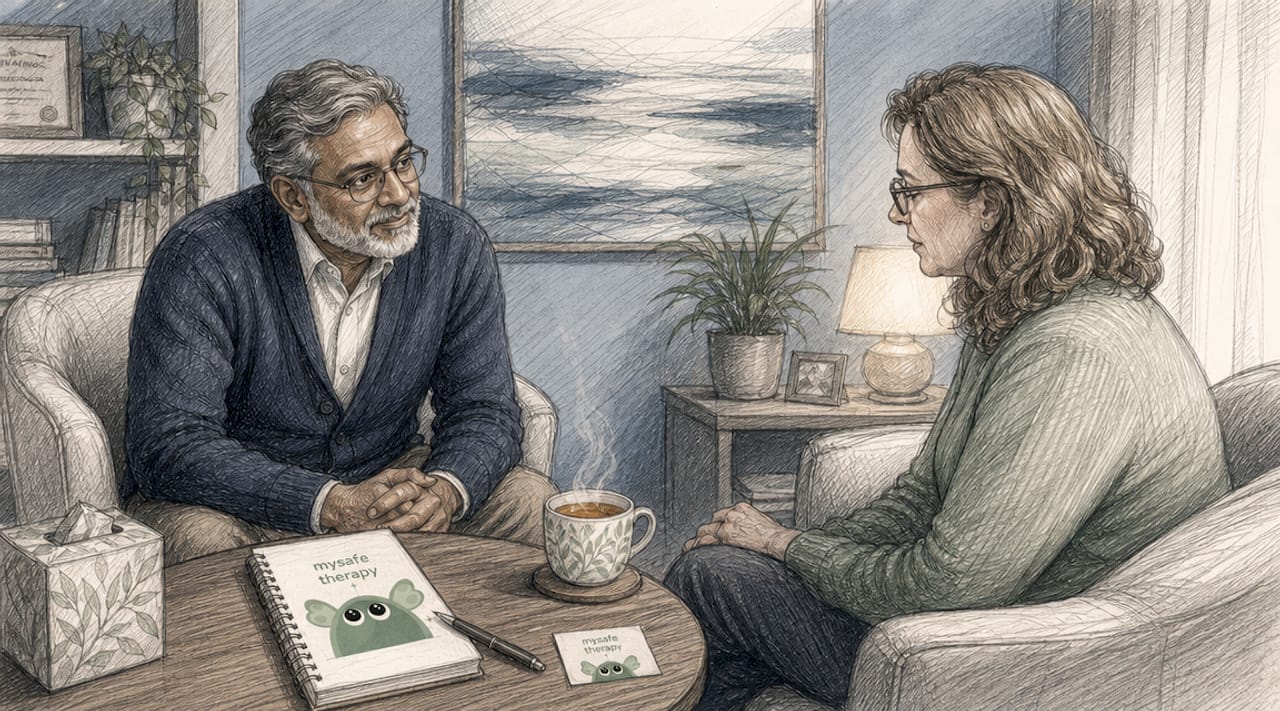
For those working through trauma specifically, this process is not optional. Trauma disrupts the nervous system's baseline. Without a reliably safe therapeutic environment, trauma processing cannot proceed without risk of retraumatisation. This is why trauma-informed counselling places the establishment of safety as the first and most critical phase of treatment.
Common misconceptions about safe spaces in therapy
Several widely held assumptions about what a safe space should feel like can actually interfere with the therapeutic process. Understanding the difference between myth and reality helps clients engage more effectively from the start.
| Misconception | What safe spaces actually involve |
|---|---|
| You should feel comfortable immediately | Feeling vulnerable early on is normal; safety builds gradually as defences are tested and trust forms |
| A safe space means avoiding difficult topics | Safe spaces contain discomfort rather than eliminate it; difficult emotions are expected and welcomed |
| Safety depends entirely on the therapist | Safety is co-constructed; clients contribute by voicing concerns and setting the pace |
| Online therapy is less safe than in-person | Confidential digital platforms with regulated therapists can provide equivalent psychological safety |
The most consequential misconception is the expectation of instant comfort. Clients often feel more distressed in early sessions precisely because they are beginning to lower their usual defences. This is not a sign that therapy is failing. It is a sign that the process has begun. Safety develops across sessions, not within the first hour, and clients who understand this are far better positioned to persist through the initial discomfort.
Client autonomy is also a defining feature of genuine safety. A therapist who allows you to steer the pace, decline to discuss certain topics, or change direction mid-session is not being passive. They are actively reinforcing your sense of control, which is particularly restorative for anyone whose history includes experiences of powerlessness.
Pro Tip: If you leave a session feeling unsettled, that is not automatically a red flag. Reflect on whether the discomfort came from the work itself or from feeling unheard or pressured. The former is therapeutic; the latter warrants a direct conversation with your therapist.
How to assess whether a therapy space feels safe for you
Finding a genuinely safe therapeutic environment requires active evaluation, not passive acceptance. The following steps give you a structured way to assess safety before committing to ongoing sessions.
- Use the initial consultation. Most therapists offer a free or low-cost first session. This is your opportunity to assess rapport, ask direct questions, and notice how your body responds to the interaction. Initial consultations are specifically designed for this kind of safety assessment.
- Check professional registration. Verify that your therapist is registered with BACP, UKCP, or NCPS. Registration means they are bound by a code of ethics that includes confidentiality, client welfare, and professional accountability. The Mysafetherapy guide to therapist professional registration explains what each body requires.
- Ask about confidentiality explicitly. You have a right to know the limits of confidentiality before disclosing anything sensitive. A clear, confident answer from your therapist is itself a safety signal.
- Notice the full environment. Pay attention to how you are treated from first contact onwards. Is the booking process clear? Is communication prompt and respectful? Administrative interactions shape your nervous system's response before the session begins.
- Assess your sense of control. After one or two sessions, ask yourself: do you feel able to say "I'd rather not discuss that today"? If the answer is no, that is worth addressing directly with your therapist or reconsidering the fit. Guidance on choosing the right therapist can help you identify what to look for.
Clients who feel empowered to voice concerns maintain a safer therapeutic space throughout treatment. Safety is not something that happens to you. It is something you and your therapist build together, and your ability to speak up is part of that construction.
Key takeaways
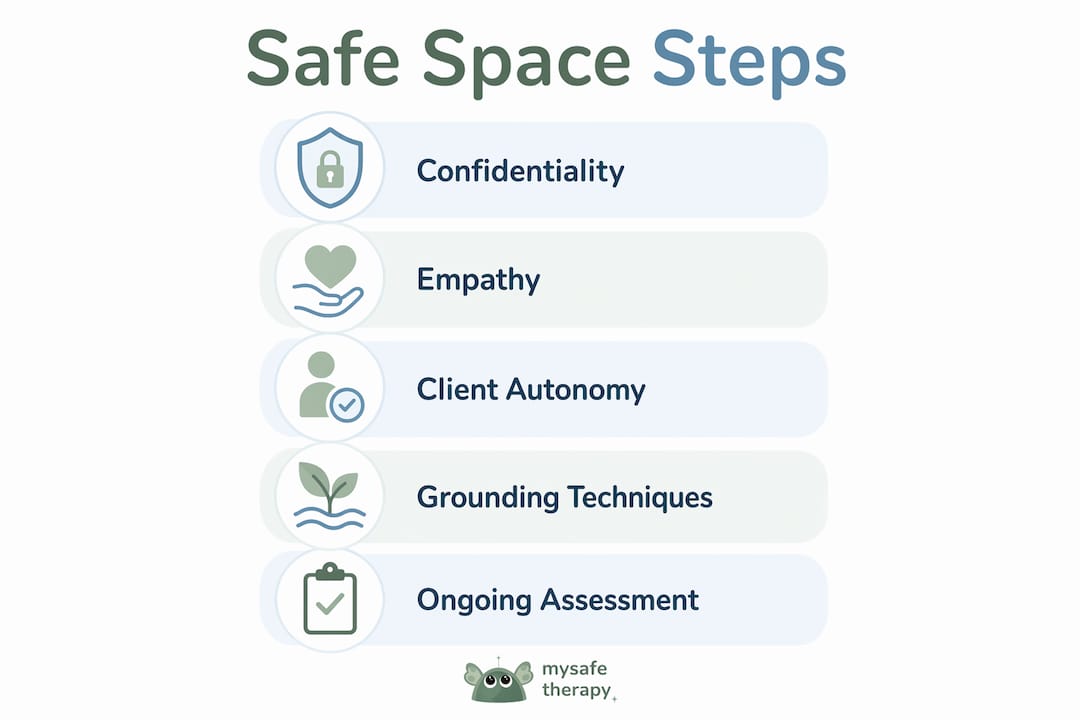
A safe space in therapy is a co-constructed, evolving condition built on confidentiality, empathy, and client autonomy, and it is the clinical prerequisite for any meaningful psychological healing.
| Point | Details |
|---|---|
| Safety is relational, not physical | Psychological safety depends on trust and transparency, not room décor or comfort features. |
| It develops gradually | Feeling vulnerable early in therapy is normal; safety solidifies through repeated positive interactions. |
| Safe spaces contain discomfort | Effective therapy holds difficult emotions rather than avoiding them; this is where healing occurs. |
| Client autonomy is central | The ability to set pace, decline topics, and voice concerns is a defining feature of genuine safety. |
| Assessment starts before session one | Initial consultations, therapist credentials, and administrative communication all signal safety levels. |
Mysafetherapy's view on safety as an ongoing process
Safety in therapy is not a box ticked at the start of treatment. From working with clients across the UK, what becomes clear is that safety is continuously renegotiated. A client who felt safe in month one may need that safety rebuilt after a particularly difficult session, a change in life circumstances, or a shift in what they are ready to disclose. The therapists who handle this best are those who treat safety as a live question, not a settled one.
There is also a dimension to safe spaces that rarely gets discussed: the way they model something clients often lack in their daily lives. For many people, therapy is the first relationship in which their pace is genuinely respected, their discomfort is not minimised, and their autonomy is treated as non-negotiable. That experience does not stay in the therapy room. It changes how clients relate to others, set limits, and understand what they deserve from relationships more broadly.
The practical implication for anyone starting therapy is this: do not wait to feel safe before engaging. Engage in order to build safety. Ask the questions. Name the discomfort. Tell your therapist when something does not feel right. That is not a disruption to the process. It is the process.
— MySafeTherapy
Start your safe therapy experience with Mysafetherapy
Mysafetherapy connects UK adults with accredited therapists registered with BACP, UKCP, and NCPS, all of whom are trained to build the kind of psychological safety this article describes. Sessions are available via video, chat, and anonymous avatar therapy, with evening and weekend appointments to fit your schedule. Confidentiality is built into every format. Pricing is transparent, therapist switching is straightforward, and your comfort governs the pace throughout. If you are ready to find a space where you can speak honestly and be heard without judgement, start therapy today with a therapist matched to your specific needs.
FAQ
What is the safe space definition in therapy?
A safe space in therapy is an emotionally secure, judgement-free environment built on confidentiality, empathy, and consistency, where clients can explore thoughts and feelings at their own pace. It is a relational condition created between therapist and client over time, not simply a comfortable physical setting.
How long does it take to feel safe in therapy?
Safety develops gradually across multiple sessions rather than immediately. Feeling vulnerable or more distressed in early sessions is normal, as clients begin to lower their usual defences and trust forms through repeated positive interactions.
What questions should I ask a therapist to assess safety?
Ask directly about confidentiality limits, how they handle distress in sessions, and whether you can adjust the pace or decline topics at any point. A therapist who answers clearly and without defensiveness is already demonstrating the transparency that defines a safe therapeutic space.
Can online therapy provide the same safe space as in-person sessions?
Yes. Confidential digital platforms with regulated, accredited therapists can provide equivalent psychological safety to in-person therapy. The relational conditions of trust, transparency, and client autonomy apply equally across video, chat, and avatar-based formats.
What is the role of confidentiality in creating a safe space?
Confidentiality is one of the three core pillars of a safe space in therapy, alongside empathy and consistency. Clients who have clear expectations about what is kept private, and who feel empowered to voice concerns, maintain a more secure therapeutic environment throughout treatment.