
If you're a UK healthcare worker struggling right now, self-refer to NHS Practitioner Health if you're a doctor or dentist, contact your trust's staff mental health and wellbeing hub, or speak to your GP or occupational health team. If you're in crisis, text SHOUT to 85258 for 24/7 support, call Samaritans, or dial 999. Every one of these routes can be arranged quickly and confidentially, and reaching out does not have to affect your career.
TL;DR:
- Younger NHS staff, those feeling unsupported, and workers exposed to morally distressing situations are at the highest risk of long-term mental health problems.
- Repeated exposure to violence, inadequate PPE, and lack of managerial support are key systemic factors driving staff distress during the pandemic.
- Confidential support options like NHS Practitioner Health, online therapy, and 24/7 helplines are available, but trust and perceived privacy remain significant barriers to seeking help.
- Shift work complicates appointment scheduling, making online therapy with flexible hours a vital resource for healthcare workers balancing night shifts.
- Managers should proactively foster supportive environments, offer reliable signposting, and measure wellbeing initiatives’ impact to reduce workplace mental health risks.
Table of Contents
- Healthcare worker mental health UK: how big is the problem?
- What causes distress among UK healthcare staff?
- Where can you get help in the UK right now?
- How do you get confidential mental health support at work?
- What should managers and employers do to support staff?
- What can staff do immediately and over the coming weeks?
- Can online therapy work for NHS shift patterns and confidentiality needs?
- Our view on how UK healthcare workers should actually approach this
- Start confidential therapy that fits around your shifts
- Sources
Healthcare worker mental health UK: how big is the problem?
Roughly half of NHS staff surveyed across the NHS CHECK cohort study reported probable common mental disorders at repeated points between April 2020 and March 2023. This wasn't a single bad month during the worst of the pandemic. It was a sustained pattern across 22,092 participants from 17 English trusts, tracked over three years.
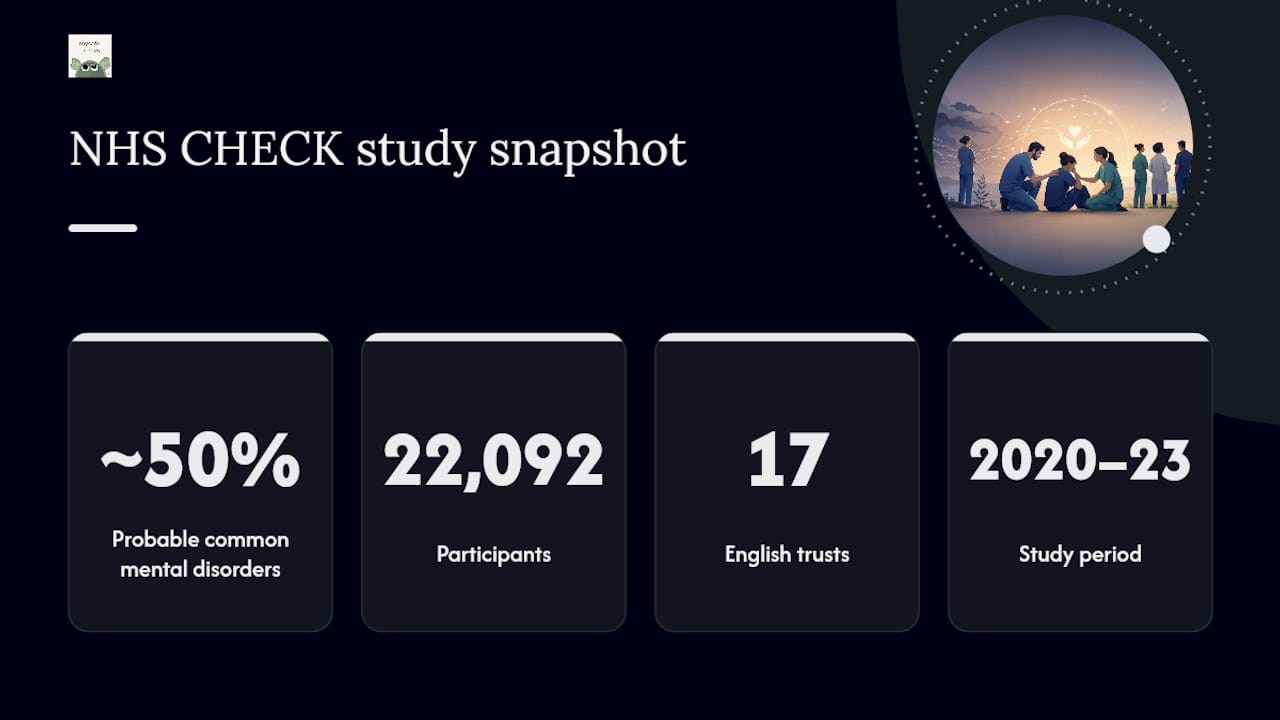
That figure matters because it shows distress among healthcare workers didn't spike and fade with COVID-19 waves. It settled in. The same NHS CHECK data identifies who fared worst: younger staff, those who felt unsupported by managers, and those exposed to morally injurious events, situations where they were forced to act against their own values because the system gave them no better option.
The pandemic left specific fingerprints on mental health outcomes. Earlier UK research into frontline health and social care workers found clinically significant PTSD, anxiety and depression were strongly predicted by redeployment to unfamiliar roles, worry about infecting family members, and unreliable access to PPE. These weren't abstract stressors. They were daily, concrete threats that many staff carried home with them.
The scale, in context: Around half of NHS staff in the NHS CHECK study reported probable common mental disorders across multiple survey waves between 2020 and 2023, with younger staff and those lacking managerial support faring worst.
Social care tells a related but distinct story. The Department of Health and Social Care's adult social care workforce survey wave 2 found higher rates of physical violence and harassment among care staff compared with the NHS workforce, and linked these experiences directly to poorer work-related quality of life. Social care workers face many of the same pressures as NHS colleagues, plus a distinct layer of physical risk that gets far less public attention.
NHS sickness absence data has long flagged psychiatric illness, including anxiety, stress, depression and other mental health conditions, as one of the leading causes of staff time off work. That's not a footnote. It's a workforce planning problem, and it's one reason NHS England has shifted from crisis-era emergency measures toward a more permanent staff mental health and wellbeing offer.
What causes distress among UK healthcare staff?
Not every difficult day at work amounts to a mental health crisis, but certain patterns of exposure reliably push people from coping into struggling. Understanding which ones apply to you helps you judge how urgently to act and which support route fits best.
Moral injury deserves its own explanation, because it's often confused with burnout. Burnout comes from chronic overwork and depletion. Moral injury comes from being forced to act, or forced to stand by, in ways that violate your own ethical code, for example, rationing care during a crisis, or discharging a patient you knew wasn't ready to go home. The NHS CHECK research treats moral injury as a distinct predictor of long-term distress, separate from workload alone. Recognising it as a systemic failure, not a personal one, is often the first step toward recovery.
Several workplace exposures show up repeatedly in the evidence as risk multipliers:
- Redeployment to unfamiliar clinical areas without adequate preparation or support
- Direct exposure to violence, aggression or harassment from patients or the public
- Inadequate or absent managerial support during high-pressure periods
- Repeated exposure to morally injurious decisions with no debrief or acknowledgement
- Uncertainty over safety equipment or protective measures during outbreaks or emergencies
Demographic patterns matter too. NHS CHECK found younger staff at higher risk, likely reflecting less clinical experience and fewer coping resources built up over a career. Lower-paid grades and those in caring roles outside clinical settings, including unpaid carers balancing work and home responsibilities, also show elevated risk, often because they have less flexibility to step back when things get difficult.
Pro Tip: If you keep replaying a specific decision or incident rather than feeling generally exhausted, that's often a sign of moral injury rather than straightforward burnout, and it usually responds better to structured reflective support than to rest alone.
Where can you get help in the UK right now?
The right route depends on your role, how urgent things feel, and how much confidentiality you need. Here's how to work through the options in order of relevance.
- Check if you're eligible for NHS Practitioner Health. This confidential NHS primary care service supports doctors and dentists with mental health and addiction problems, and it operates a self-referral system, meaning you don't need permission from your employer or a GP referral to access it.
- Find your local staff mental health and wellbeing hub. NHS England coordinates a national network of hubs offering rapid access to psychological support, and most trusts and integrated care boards (ICBs) publish local contact details on their intranet or HR pages.
- Speak to your GP if you're not eligible for a practitioner-specific service. GPs can refer you into NHS talking therapies (previously known as IAPT) for structured psychological treatment, typically CBT-based, without a long wait in most areas.
- Contact your occupational health department. This is particularly useful if workplace factors, such as a specific incident, are contributing to how you feel, and occupational health can advise on adjustments as well as treatment routes.
- Use your employer's Employee Assistance Programme (EAP) if one is available. Many NHS trusts and larger care providers contract external EAPs offering short-term counselling, usually accessed by phone or online booking.
- Text SHOUT on 85258 if you need to talk to someone right now. This free, confidential, 24/7 text support service doesn't require an appointment and is designed for exactly the moment when you can't wait for a referral to come through.
Each route suits a different situation. A quick way to think about it:
- Need total confidentiality and you're a doctor or dentist? Go straight to NHS Practitioner Health.
- Not sure where to start, and you work for the NHS? Your local staff wellbeing hub is the fastest general entry point.
- In crisis, right now, today? SHOUT 85258, Samaritans, or 999 for emergencies.
- Dealing with a specific incident or ongoing workplace issue? Occupational health should be part of the conversation.
Charities also play a supporting role. Alongside SHOUT and Samaritans, several sector-specific organisations offer peer support and helplines aimed at healthcare and care staff, though national NHS services remain the most consistently funded and widely available first stop for most readers.
How do you get confidential mental health support at work?
Confidentiality fear is the single biggest reason healthcare workers delay seeking help, and services like NHS Practitioner Health exist specifically because staff perceive local occupational health routes as insufficiently private. That perception, rightly or wrongly, keeps people quiet until they're in crisis rather than when a problem first appears.
Some services are built around anonymity in a way general routes aren't. NHS Practitioner Health, for instance, is configured to preserve confidentiality from local management and from regulatory bodies where appropriate, which is precisely what makes it different from going through your own trust. Text services like SHOUT don't require you to give your name or employer at all.
If you're self-referring, expect to be asked for straightforward information, nothing intrusive beyond what any GP appointment would ask. Typically that's your name, contact details, your role and employer (for eligibility checks), and a brief description of what's troubling you. You won't need a letter from anyone else to start.
A few practical points worth knowing before you make contact:
- Occupational health confidentiality is different from medical confidentiality. Occupational health may share fitness-for-work information with your employer if it affects patient safety, whereas a therapist or Practitioner Health clinician generally won't.
- You are not obliged to tell your line manager the details of a mental health referral, only that you need time or flexibility, if that's what you're comfortable disclosing.
- Involving occupational health becomes more relevant when you need formal adjustments at work, such as changed hours or duties, rather than when you simply want to talk to someone.
Pro Tip: If you're anxious about your employer finding out, start with a service that doesn't require employer sign-off, such as NHS Practitioner Health or a text-based helpline, before deciding whether occupational health needs to be involved at all.
For a fuller picture of how confidential therapy records are handled in UK settings generally, this guide to the confidential therapy process explains what you can expect before you commit to a first session.
What should managers and employers do to support staff?
Individual coping strategies only go so far if the workplace itself keeps generating the same pressures. Managers and organisations have a direct role in reducing risk, not just reacting to it once someone's already struggling.
- Train managers to hold supportive, non-judgemental check-ins, not just performance reviews, so staff have a natural opening to mention pressure before it escalates.
- Signpost actively rather than passively. Posting a poster in a staffroom isn't the same as a manager saying, directly, "Here's the hub number, and here's how to self-refer."
- Protect rest properly, including ensuring redeployed or short-staffed teams get genuine breaks, not just scheduled ones that get skipped under pressure.
- Offer wellbeing apps and self-check tools as part of a standing, year-round programme rather than a one-off pandemic response. NHS England's own direction has been to move preventative, local-level support into permanent structures rather than emergency measures.
- Escalate to occupational health or specialist hubs early, when a team member shows sustained signs of distress, rather than waiting for a crisis or a sickness absence to trigger action.
- Measure impact, using absence data, exit interviews and staff survey results to track whether wellbeing initiatives are actually changing outcomes, not just being used.
Practical conversation scripts help here too. Managers who feel unsure what to say can lean on structured guidance, such as this practical UK guide to talking about mental health, rather than improvising and risking a conversation that feels intrusive or dismissive.
What can staff do immediately and over the coming weeks?
Formal treatment matters, but it isn't the only lever. Several practical techniques work alongside therapy, or while you're waiting for an appointment.
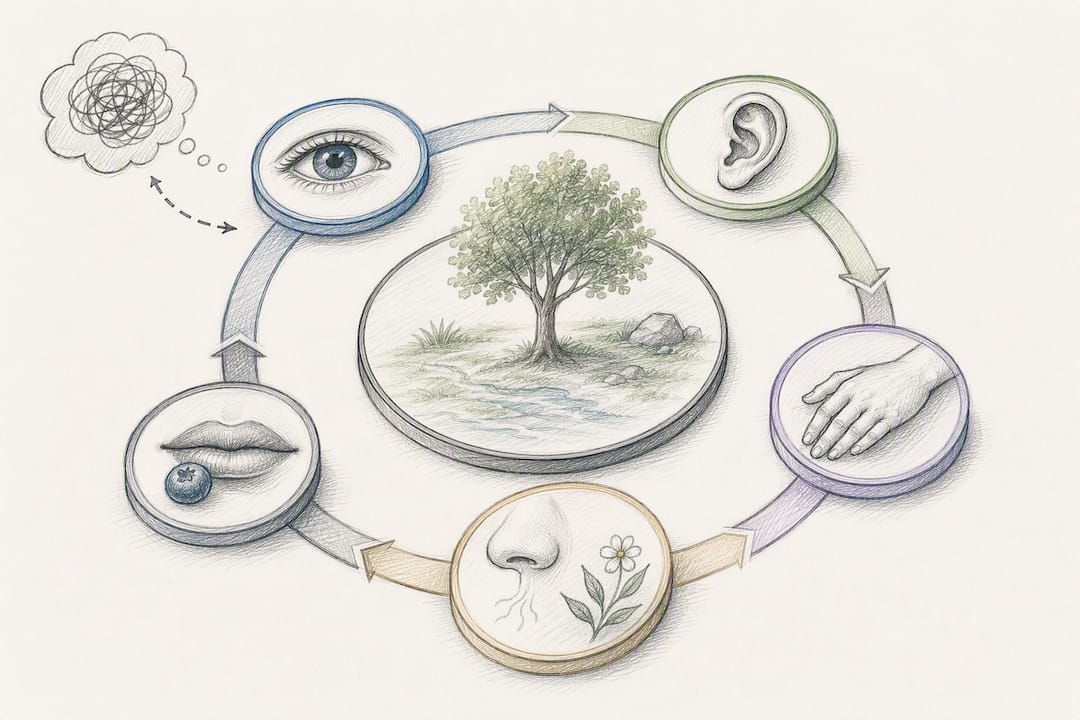
In the moment, grounding techniques help interrupt acute distress. A simple approach: name five things you can see, four you can hear, three you can touch, two you can smell, one you can taste. It sounds basic. It works because it pulls your attention out of a spiralling thought and back into your physical surroundings, which is often enough to get through a shift.
A short, written safety plan is worth having before you need it, not after. Note down who you'd call in a crisis (a colleague, SHOUT 85258, Samaritans), what usually helps you calm down, and what you'll avoid doing (working an extra shift on no sleep, for instance) if things feel bad.
Over the following weeks, several evidence-based habits build resilience without requiring a full course of therapy:
- Sleep hygiene changes, particularly around shift transitions, matter more than most staff assume, since disrupted circadian rhythm compounds every other stressor.
- Pacing, deliberately not overcommitting to extra shifts during a rough patch, protects recovery time that would otherwise get eaten up.
- Booking a first therapy session, even if you're unsure you "need" it, gives you a structured space that daily work rarely allows.
- CBT-style thought records, writing down a triggering thought and testing it against evidence, can reduce rumination between sessions. Several UK-focused mental health support tools build this into guided digital journaling.
Team-level approaches matter as much as individual ones. Brief, structured debriefs after difficult shifts, buddy systems pairing newer staff with experienced colleagues, and regular reflective practice sessions all show up repeatedly in NHS wellbeing guidance as low-cost, high-value interventions.
Pro Tip: A five-minute debrief straight after a hard shift, even just naming what happened out loud to a colleague, does more to prevent long-term distress than a single wellness day months later.
Can online therapy work for NHS shift patterns and confidentiality needs?
Shift work makes fixed weekly appointments genuinely difficult, and confidentiality concerns make some staff avoid workplace-linked support altogether. An accredited online platform can solve both problems at once, provided the therapists are properly registered.
Mysafetherapy connects UK healthcare workers with therapists accredited by bodies including the BACP, UKCP and NCPS, offering evening and weekend sessions across video, chat and avatar-based formats, so a session doesn't have to compete with a shift pattern that no employer scheme was built around.
Online therapy isn't a replacement for NHS Practitioner Health or your local wellbeing hub if you're eligible for them. It's a genuinely useful complement, particularly when you want a session that fits around night shifts, or when you'd rather your care sit entirely outside any workplace-linked system.
Confidential online formats, including avatar-based sessions, can suit staff who want distance from anything resembling a clinical assessment during their working day.
Our view on how UK healthcare workers should actually approach this
The evidence points somewhere the standard advice usually avoids: confidentiality fear, not access, is the primary reason healthcare workers wait until crisis point. The NHS CHECK data and the ASC workforce survey both confirm distress is widespread, sustained and predictable by known risk factors. Yet most public health messaging still frames the problem as awareness, telling people that support exists, when the real barrier is trust in how that support handles their information.
We think the conventional advice, "just talk to someone", undersells how much the choice of which someone matters. A conversation with your line manager and a conversation with a service that guarantees anonymity from your employer are not interchangeable options, and treating them as such is why so many staff delay.
Prioritise, in order: identify whether a genuinely confidential route applies to you (Practitioner Health if eligible, a text service if not), use it before things escalate rather than after, and treat online formats with flexible scheduling as a legitimate primary route, not a backup. Shift patterns shouldn't be the reason someone goes untreated.
— MySafeTherapy
Start confidential therapy that fits around your shifts
Mysafetherapy gives NHS and healthcare staff something most workplace schemes can't: therapy booked entirely outside your employer's systems, with evening and weekend slots that work around night shifts rather than office hours. Every therapist is accredited with BACP, UKCP or NCPS, and you choose video, chat, phone or avatar-based sessions depending on how much distance you want from a traditional format.
Sign-up is straightforward: browse therapist profiles, pick a format and time that suits your rota, and book your first session without needing a referral from anyone. If confidentiality is your main concern, this confidential online therapy guide explains exactly how records and privacy are handled before you commit. Many staff also use it alongside NHS Practitioner Health or a local wellbeing hub rather than instead of them.
Ready to book a first session? Start therapy today and choose a time that actually fits your week.
This article is general information, not a substitute for advice from a qualified doctor. Consult a qualified healthcare professional about your own circumstances before acting on anything here.
Sources
- Predictors of clinically significant PTSD, depression and anxiety in UK frontline health and social care workers during COVID-19
- Support now — NHS England
- NHS Practitioner Health
- The work-related quality of life of the adult social care workforce in England in 2025: findings from the wave 2 survey