

Non-directive therapy, more formally known as person-centred or Rogerian therapy, is a humanistic approach in which the therapist creates a safe, non-judgemental space and trusts the client to direct their own exploration. The therapist does not set an agenda, offer diagnoses, or prescribe solutions. Instead, they offer consistent empathy, unconditional positive regard, and genuine presence, allowing the client's own capacity for growth to guide the work. The NCBI Bookshelf overview of person-centred therapy situates this approach firmly within humanistic psychology, where the person, not the problem, is the focus.
Three things to know before reading further:
- What you experience in sessions: You set the agenda. The therapist listens closely, reflects your words and feelings back to you, and avoids directing you towards any particular conclusion or course of action.
- What the approach aims to achieve: Greater self-awareness, improved self-acceptance, and the confidence to make decisions that feel genuinely your own, rather than solutions handed down by a professional.
- What the evidence shows: A pragmatic UK trial involving 464 patients found that non-directive counselling produced symptom reductions comparable to CBT for anxiety and depression, with some measures showing higher patient satisfaction with non-directive counselling at 12 months.
The sections below cover the historical roots of the approach, its three core conditions, what a session actually looks like, the evidence base, who it suits, how to verify a UK therapist's credentials, and practical routes to access, including online options.
Key takeaways
Non-directive therapy, grounded in Carl Rogers' person-centred model, produces symptom outcomes comparable to CBT in UK trials while placing the client's autonomy and self-directed growth at the centre of every session.
| Point | Details |
|---|---|
| Core definition | Person-centred therapy trusts the client to lead; the therapist offers empathy, unconditional positive regard, and congruence. |
| UK trial evidence | A pragmatic trial of 464 UK patients found non-directive counselling matched CBT for symptom reduction at 4 and 12 months. |
| Checking credentials | Verify BACP, UKCP, or NCPS registration before booking; confirm supervision and insurance directly with the therapist. |
| Who it suits | Best for self-exploration, relational issues, and low-to-moderate depression or anxiety; specialist approaches are advisable for acute risk or complex trauma. |
| Mysafetherapy | Connects UK adults with BACP/UKCP/NCPS-registered person-centred therapists via video, chat, or avatar, with flexible scheduling and easy therapist switching. |
Table of Contents
- How did non-directive therapy begin?
- What are the three core conditions in person-centred practice?
- What actually happens in a non-directive therapy session?
- What does the evidence say about effectiveness?
- Who is most likely to benefit, and when is another approach advisable?
- How does UK accreditation work for person-centred therapists?
- How do you access non-directive therapy in the UK?
- A session in practice: what non-directive therapy looks like
- Further reading and how to evaluate sources
- Mysafetherapy's perspective on non-directive therapy
- Trying non-directive therapy in the UK through Mysafetherapy
- Sources
How did non-directive therapy begin?
The approach was pioneered by the American psychologist Carl Rogers in the 1940s. Rogers broke sharply from the psychoanalytic and behavioural traditions dominant at the time, both of which positioned the therapist as the expert who interprets, diagnoses, or conditions the client. Rogers argued instead that people possess an innate drive towards growth and self-fulfilment, a capacity he called the actualising tendency. Given the right relational conditions, that tendency unfolds naturally. The therapist's job is to provide those conditions, not to steer the outcome.
The archival PMC paper from 1950 documents how early practitioners used the term "non-directive" to distinguish this stance from directive, advice-giving models. The label was precise: the therapist deliberately withholds direction so the client retains full authority over meaning and decision.
Key developments in the model's history:
- 1940s: Rogers publishes Counseling and Psychotherapy (1942), introducing the non-directive method and its emphasis on the client's frame of reference.
- 1950s–1960s: The label shifts from "non-directive" to "client-centred" as Rogers refines the theory, emphasising the relational conditions rather than the absence of direction alone.
- 1970s onwards: The term "person-centred" becomes standard, reflecting a broader application beyond clinical settings to education, organisations, and conflict resolution.
- Ongoing scholarly debate: Some authors later questioned whether "non-directive" was ever fully achievable, since any therapist response, however minimal, shapes the conversation. The scholarly chapter by Stephen reframes non-directivity not as a technique to be applied but as a principled therapeutic attitude, a way of being with a client rather than a set of rules about what not to do.
The actualising tendency is worth pausing on, because it underpins everything else. Rogers did not view psychological distress as a defect to be corrected. He viewed it as what happens when a person's natural growth is blocked, usually by conditions of worth imposed by others ("I am only acceptable if I achieve / conform / agree"). Therapy removes those blocks by offering a relationship free of such conditions.
What are the three core conditions in person-centred practice?
BACP describes three conditions the therapist must offer consistently for person-centred work to be effective. Rogers considered all three necessary and, together, sufficient for therapeutic change.
-
Empathic understanding: The therapist works to grasp the client's inner world as accurately as possible and communicates that understanding back. This goes beyond nodding along. A therapist demonstrating empathy might say: "It sounds as though the anger you felt wasn't really about the argument itself, but about feeling invisible for a long time." The client then corrects, confirms, or deepens that reflection, and the process moves forward.
-
Unconditional positive regard: The therapist accepts the client fully, without evaluation or approval conditions. This does not mean agreeing with everything the client says or does. It means the client's worth as a person is never in question, regardless of what they disclose. For someone who has spent years editing themselves to gain approval, this can be a genuinely novel experience.
-
Congruence (genuineness): The therapist is authentic rather than performing a professional role. If something the client says moves the therapist, that can be acknowledged. If the therapist notices a discrepancy between what the client says and how they appear, they may name it carefully. Congruence prevents the therapeutic relationship from becoming a one-way performance.
These three conditions work together to create what Rogers described as a climate of psychological safety. The Stephen chapter makes the important point that non-directivity is not a passive stance. It requires active, sustained presence. A therapist who simply stays quiet is not being non-directive; they are being absent. The conditions must be genuinely felt and consistently communicated, not performed as a technique.
What actually happens in a non-directive therapy session?
Sessions typically run for 50 minutes, once a week, though frequency can vary. There is no fixed structure imposed by the therapist. The session belongs to the client.
What the therapist does:
- Opens with an open invitation: "Where would you like to start today?"
- Listens without interrupting, taking notes, or redirecting
- Reflects content and feeling back to the client, checking accuracy
- Asks questions that deepen the client's own exploration rather than gather information for the therapist's assessment
- Notices and names emotional shifts when it seems useful
- Stays present with silence rather than filling it
What the therapist deliberately avoids:
- Offering advice, solutions, or recommendations
- Interpreting the client's experience through a diagnostic lens
- Setting homework or structured tasks
- Steering the conversation towards topics the therapist considers important
- Reassuring the client in ways that close down exploration ("I'm sure it will be fine")
Therapy Today's practitioner commentary makes a point that surprises many new clients: non-directivity is an active stance, not passive silence. The therapist is fully engaged, tracking the client's language, tone, and emotional shifts in real time. The absence of direction is itself a deliberate, skilled choice.
Many clients arrive expecting the therapist to tell them what to do. When that does not happen, the initial sessions can feel unfamiliar. That discomfort is worth tolerating. The ISPC guidance on counselling notes that supporting clients to find internal solutions, rather than supplying answers, is central to the model's purpose.
Pro Tip: Before your first session, write down two or three things you want to explore. You do not need to arrive with a clear problem statement. Even a vague feeling ("I'm not sure why I feel stuck") is a valid starting point. Bringing a rough list helps you use the space confidently from the outset. A therapy checklist for beginners can help you prepare.
What does the evidence say about effectiveness?
The evidence base for person-centred and non-directive counselling is substantial, though not without limits.
The most directly relevant UK data comes from a pragmatic controlled trial of 464 patients with anxiety and depression. The trial compared non-directive counselling with CBT and usual GP care. At both 4-month and 12-month follow-up, non-directive counselling and CBT produced comparable reductions in symptoms. Some measures showed greater patient satisfaction with non-directive counselling at the 12-month point.
Key finding: In a UK trial of 464 patients, non-directive counselling matched CBT for symptom reduction at 4 and 12 months, with some satisfaction measures favouring non-directive counselling at the later follow-up.
Research from the White Rose eprints archive suggests that the quality of the therapeutic relationship often mediates outcomes across different therapy modalities. Person-centred approaches aim to maximise that relational quality through the core conditions, rather than through specific technical interventions. This may partly explain why satisfaction tends to hold or improve at longer follow-up: the relational experience itself sustains change beyond the immediate reduction of symptoms.
| Evidence dimension | What the research shows |
|---|---|
| Symptom reduction (depression/anxiety) | Comparable to CBT at 4 and 12 months in UK pragmatic trial |
| Patient satisfaction | Some measures favoured non-directive counselling at 12-month follow-up |
| Mechanism | Therapeutic relationship quality identified as a key mediating factor |
| Evidence quality | Pragmatic trial design; real-world conditions, not highly controlled laboratory setting |
| Evidence limits | Heterogeneity of "non-directive" practice across studies; variable follow-up periods |
Honest appraisal of the limits: the term "non-directive counselling" covers a range of practice styles, and studies do not always define the approach consistently. Most trials focus on depression and anxiety; evidence for other presentations is thinner. The NCBI Bookshelf overview notes that person-centred therapy sits within a broader humanistic tradition where outcome measurement is complicated by the approach's emphasis on subjective, self-defined goals rather than standardised symptom scales.
Therapeutic relationship quality is consistently one of the strongest predictors of therapy outcomes across all modalities, and person-centred practice is specifically designed to optimise it.
Who is most likely to benefit, and when is another approach advisable?
Non-directive therapy tends to suit people who want space for self-exploration rather than a structured programme of change. It is not the right fit for every situation.
Presentations where person-centred work typically helps:
- Longer-term self-exploration: understanding patterns in relationships, identity, or self-worth
- Low to moderate depression and anxiety, particularly where the person wants to understand the roots rather than manage symptoms alone
- Grief, loss, and life transitions
- Self-esteem and confidence difficulties
- Relational issues, including difficulties in close relationships or at work
- Adjustment to chronic illness or significant life change
- Situations where previous directive approaches have felt alienating or unhelpful
Situations where more directive or specialist interventions may be warranted:
- Acute risk: active suicidal ideation, self-harm, or risk to others requires a structured safety plan and may need crisis services or psychiatric input alongside or instead of counselling
- Complex trauma with dissociation: structured trauma-focused approaches such as EMDR or trauma-focused CBT have a stronger evidence base for complex PTSD presentations
- Obsessive-compulsive disorder: exposure and response prevention (ERP) has considerably stronger evidence than non-directive approaches for OCD
- Psychosis or bipolar disorder in an acute phase: these require medical management; counselling may be a useful adjunct but not a primary intervention
- Cognitive difficulties requiring remediation: structured cognitive rehabilitation is more appropriate than open-ended exploration
- Eating disorders at clinical severity: specialist multi-disciplinary treatment is the recommended pathway
A short safety checklist to discuss with any prospective therapist:
- Do you have a clear crisis plan for clients who become acutely distressed between sessions?
- Are you in regular clinical supervision with an accredited supervisor?
- Do you carry professional indemnity insurance?
- What is your safeguarding protocol if a client discloses risk to themselves or others?
- How do you handle referrals when a client's needs exceed what counselling alone can address?
A therapist who answers these questions clearly and without defensiveness is demonstrating good professional practice.
How does UK accreditation work for person-centred therapists?
The ethical foundation of non-directive therapy rests on respect for client autonomy and a clear awareness of the power differential in the therapeutic relationship. The Stephen chapter frames non-directivity as a principled stance precisely because it takes that power differential seriously: the therapist deliberately refrains from using their position to steer the client's choices.
In the UK, therapy is not a legally protected profession in the same way as medicine. Anyone can call themselves a therapist. Professional registration with a recognised body is therefore the primary safeguard for clients.
How to verify a UK therapist's credentials:
- Check BACP registration: Visit the BACP therapist directory and search by name or location. BACP-registered practitioners have met training standards and are bound by the BACP Ethical Framework.
- Check UKCP registration: The UK Council for Psychotherapy maintains its own register. UKCP registration typically indicates a higher-level qualification (often to Masters level or equivalent). Search at ukcp.org.uk.
- Check NCPS registration: The National Counselling and Psychotherapy Society is another recognised professional body; its register is searchable online.
- Confirm supervision arrangements: Ask the therapist directly whether they are in regular clinical supervision. Supervision is an ethical requirement, not optional, for registered practitioners.
- Confirm insurance: Professional indemnity insurance protects both the therapist and the client. Ask whether it is current.
- Check DBS status where relevant: If the therapist works with children or vulnerable adults, a current Disclosure and Barring Service (DBS) check is expected.
- Review their training background: Ask where they trained, at what level, and whether their qualification included a supervised clinical placement. A reputable person-centred training programme will include substantial supervised practice hours alongside academic study.
For a detailed comparison of what BACP and UKCP registration each signify, the Mysafetherapy guide to BACP and UKCP differences sets out the distinctions clearly.
Ethical red flags to watch for:
- A therapist who offers unsolicited advice in early sessions without discussing this as a deliberate departure from the non-directive stance
- Dual relationships (the therapist is also a friend, employer, or social contact)
- Lack of clarity about fees, cancellation policy, or confidentiality limits
- Resistance to discussing their supervision or training background
- Any suggestion that the client should not seek a second opinion or switch therapists
Contemporary guidance from the HGI on advice-giving notes that modern practice accepts measured guidance in specific circumstances, but the ethical requirement is transparency: if a therapist departs from a non-directive stance, they should name that explicitly and explain why, rather than slipping into advice-giving without acknowledgement.
How do you access non-directive therapy in the UK?
There are three main routes: NHS, private, and online. Each has different trade-offs on cost, waiting time, and flexibility.
NHS provision:
- Referral through your GP is the standard route; your GP can refer to Improving Access to Psychological Therapies (IAPT) services, now rebranded as NHS Talking Therapies
- NHS Talking Therapies offers counselling for depression and anxiety, and some services include person-centred counselling
- Waiting times vary significantly by area; waits of several months are common for counselling specifically
- Cost: free at the point of use
- Limitation: the number of sessions is often limited (typically 6–12), and the approach offered may be determined by service capacity rather than client preference
Private provision:
- Direct referral to a BACP- or UKCP-registered therapist in private practice
- Typical session fees in the UK range from around £50 to £120 per session, depending on location and the therapist's experience level
- Waiting times are generally shorter than NHS
- Greater flexibility on session frequency, format, and approach
- Some therapists offer a sliding scale for clients on lower incomes; it is reasonable to ask
Online provision:
- Online therapy platforms connect clients with accredited therapists via video, telephone, or chat
- Removes geographical barriers and suits people with limited mobility, irregular schedules, or a preference for accessing support from home
- Evening and weekend appointments are more readily available than in traditional face-to-face settings
- A step-by-step guide to accessible online therapy covers what to expect from the format and how to prepare
Questions to ask before booking:
- What is your training in person-centred or non-directive approaches specifically?
- How many sessions do you typically work with clients, and how is progress reviewed?
- What session formats do you offer (video, telephone, chat)?
- What is your cancellation policy and how much notice is required?
- How do you handle confidentiality, and what are the limits of it?
- Are you currently in clinical supervision?
On session frequency and duration: Most person-centred work begins with weekly sessions. After an initial period, some clients move to fortnightly sessions as the work consolidates. There is no fixed endpoint; progress is reviewed collaboratively, often at agreed intervals (for example, after six sessions). The client retains the right to end at any point. Preparation tips specific to anxiety and depression are covered in the Mysafetherapy guide on preparing for therapy.
A session in practice: what non-directive therapy looks like
The following is an anonymised illustrative vignette showing how the approach works in a real conversation. No identifying details are included; the focus is on process.
A client, referred to here as M, came to therapy after a period of prolonged work stress. M described feeling "numb" and unable to explain why, despite having no obvious external crisis. In the first few sessions, M waited for the therapist to ask structured questions or suggest a plan. The therapist instead reflected back what M was saying: "You're describing a kind of flatness that doesn't seem to match what's happening around you."

Over several sessions, M began to articulate something that had not been named before: a long-standing pattern of suppressing personal needs to maintain approval at work and at home. The therapist did not interpret this or label it. They reflected it back, asked what it felt like to say it aloud, and stayed with M's discomfort rather than moving quickly to solutions.
By session eight, M reported feeling "more like myself" and had made a decision, independently, to have a direct conversation with a manager about workload. The therapist had not suggested this. M had arrived at it through the process of being heard without judgement.
Three learning points from this vignette:
- The agenda belongs to the client. M's presenting issue was "numbness," not a named disorder. The non-directive space allowed the real concern to surface at M's own pace.
- Non-directivity is not passivity. The therapist's reflections were precise and timely. Staying with discomfort rather than resolving it quickly is an active skill, consistent with Therapy Today's description of non-directivity as requiring presence and responsiveness.
- Change comes from within. M's decision to act was self-generated. That is the mechanism the approach relies on, and it tends to produce decisions the client actually follows through, because they are genuinely their own.
Building trust in the therapeutic relationship is foundational to this kind of work. The Spiritual Network guide on building trust as a practitioner addresses how that trust is established and maintained across different relational contexts.
Further reading and how to evaluate sources
The following references were used in preparing this article. Each is publicly accessible and represents a reliable starting point for deeper reading.
- Person-Centred Therapy (Rogerian Therapy) — NCBI Bookshelf: A clinical overview situating the approach within humanistic psychology; useful for understanding theoretical foundations and comparing with other modalities.
- Non-Directive Psychotherapy — PMC (1950): Archival clinical description of early non-directive formulations; valuable for historical context.
- Pragmatic controlled trial (n=464) — PubMed: The primary UK trial comparing non-directive counselling with CBT; the most directly relevant outcome data for UK readers.
- Person-centred counselling — BACP: Professional guidance on the three core conditions and what to expect from a registered practitioner.
- The non-directive attitude — Stephen, Bloomsbury (2023): A scholarly chapter framing non-directivity as a principled attitude; useful for understanding the ethical and relational dimensions.
- Treatment choice and counselling outcomes — White Rose eprints: Research on therapeutic relationship quality as a mediating factor in outcomes.
Two quick criteria for evaluating other sources you find:
- Check author affiliation and peer review status. Sources published in academic journals, on NCBI/PMC, or produced by professional bodies such as BACP carry more weight than anonymous blog posts or commercial directories.
- Check the date. Guidance on therapy practice and accreditation requirements is updated periodically. Prefer sources published or reviewed within the last five years, and cross-reference against current BACP or UKCP guidance directly.
Mysafetherapy's perspective on non-directive therapy
The evidence for person-centred work is clear enough to take seriously, but there is a subtlety in the research that often gets lost in general summaries. The UK trial data shows that non-directive counselling matches CBT on symptom reduction. What that framing misses is what the 12-month satisfaction data hints at: the relational experience of person-centred therapy may produce a different kind of change, one that is less about symptom suppression and more about a sustained shift in how a person relates to themselves.
That distinction matters practically. A client who leaves CBT with a toolkit of techniques has something concrete to use. A client who leaves person-centred work having genuinely revised their relationship with their own worth and judgement has something harder to measure but arguably more durable. Neither is universally superior. The question is what the individual client actually needs.
Mysafetherapy's position is that accreditation and safety are non-negotiable baselines, not selling points. Every therapist on the platform holds registration with BACP, UKCP, or NCPS. Supervision is a standing requirement. But beyond those structural checks, the platform's approach to person-centred work reflects the view that the therapeutic relationship is the intervention, not a delivery vehicle for techniques. That means matching clients carefully, supporting easy therapist switching when the fit is not right, and not treating session counts as a proxy for progress.
For a first session, one practical suggestion: bring a question about what you want from the process, not just a list of problems. Something like "I want to understand why I keep repeating this pattern" is more useful than a symptom inventory. It signals to the therapist that you are ready to explore, and it gives you a reference point for reviewing whether the work is moving in a direction that feels meaningful.
Trying non-directive therapy in the UK through Mysafetherapy
Person-centred therapy works best when the relational fit is right from the start. Mysafetherapy connects you with BACP-, UKCP-, and NCPS-registered therapists who specialise in non-directive and person-centred approaches, without long NHS waiting lists or the uncertainty of searching directories alone.
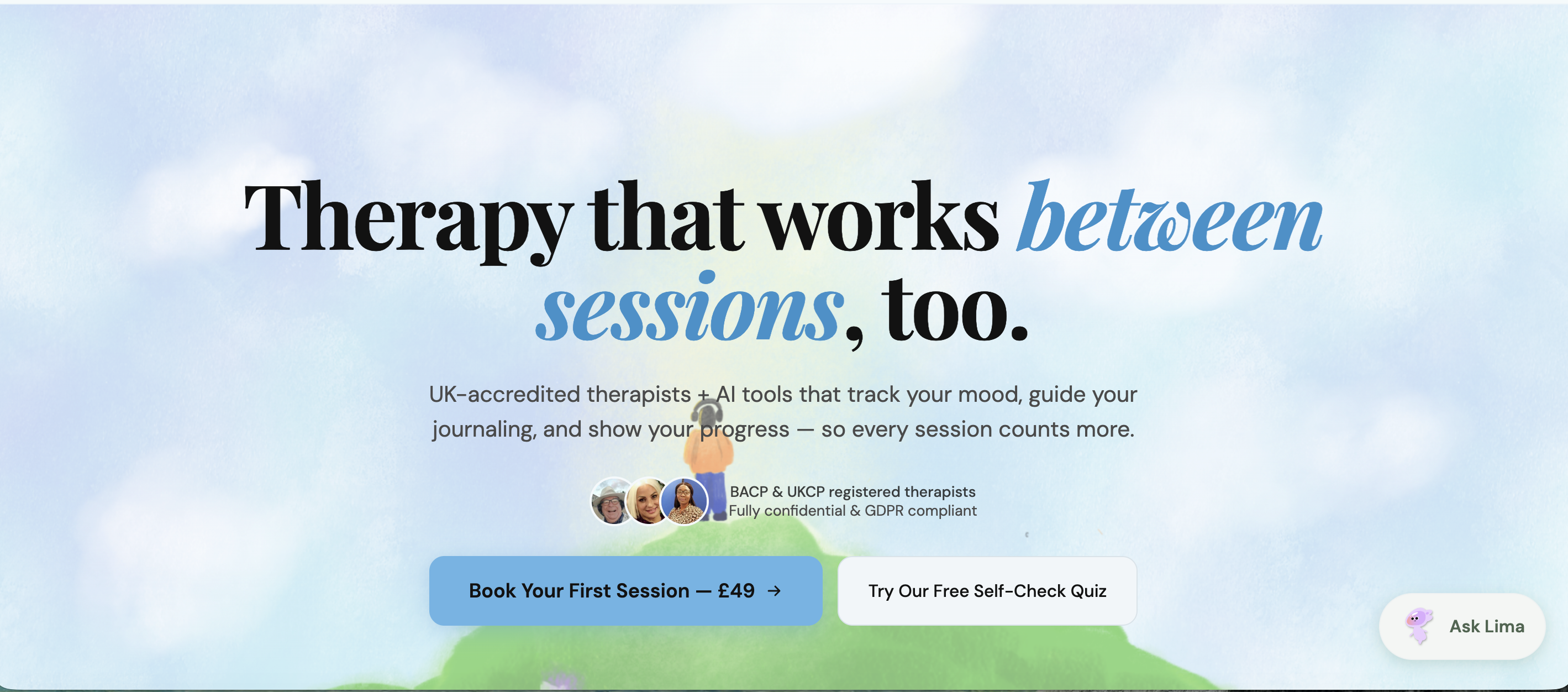
Sessions are available via video, live chat, telephone, or avatar format for those who prefer anonymity. Appointments run across evenings and weekends. All therapists on the platform are accredited, insured, and in active clinical supervision. If the first match does not feel right, switching is straightforward and does not require explanation.
Between sessions, Mysafetherapy's AI journalling, mood tracking, and self-help tools give you a way to continue the work on your own terms. The platform covers the full UK and operates with clear, transparent pricing and no long-term commitment required.
To begin, book an individual therapy session or start the matching process to find a person-centred therapist suited to your needs.
Sources
The following organisations and resources provide authoritative information for anyone researching or accessing non-directive therapy in the UK.
- Person‑Centered Therapy (Rogerian Therapy) — NCBI Bookshelf
- NON‑DIRECTIVE PSYCHOTHERAPY — PMC
- Treatment choice trial (Pragmatic controlled trial) — PubMed
- The non‑directive attitude — Stephen (Bloomsbury chapter)
When using any of these sources, cross-reference the date of publication against current BACP or UKCP guidance. Professional standards and accreditation requirements are reviewed periodically, and the most current version of any guidance takes precedence over older summaries.
This article is general information, not a substitute for advice from a qualified doctor. Consult a qualified healthcare professional about your own circumstances before acting on anything here.