

TL;DR:
- Empathy in therapy is an active, skillful process that significantly improves client outcomes and engagement.
- Research shows that genuine therapeutic empathy predicts symptom reduction, treatment adherence, and satisfaction across modalities.
Empathy is frequently dismissed as a soft skill, something therapists simply possess or lack. That framing underestimates what research consistently shows: the role of empathy in therapy is measurably tied to client outcomes, treatment adherence, and the quality of the therapeutic alliance. It is not passive listening or feeling sorry for someone. It is an active, skilled process that shapes how a client experiences their sessions, whether they stay in treatment, and whether they recover. This article explains what therapeutic empathy actually involves, what the evidence says, and why it should matter to anyone considering or currently in therapy.
Table of Contents
- Key takeaways
- The role of empathy in therapy: definitions and types
- What the research says about empathy and outcomes
- How empathy enhances the therapy process
- Challenges therapists face in sustaining empathy
- Our perspective: empathy is not optional in therapy
- Finding a therapist who prioritises empathic care
- FAQ
Key takeaways
| Point | Details |
|---|---|
| Empathy is an active clinical skill | Therapeutic empathy involves deliberate cognitive and emotional attunement, not passive sympathy. |
| Evidence links empathy to outcomes | A meta-analysis of 82 studies shows therapist empathy has a moderate-to-strong link with symptom reduction. |
| It strengthens the therapeutic alliance | Empathy builds trust and rapport, which directly predicts client engagement and progress. |
| Premature advice undermines empathy | Offering solutions before establishing empathic understanding causes clients to reject even sound guidance. |
| Therapists must sustain empathy actively | Supervision, mindfulness, and workload management are clinically recognised strategies to prevent empathy erosion. |
The role of empathy in therapy: definitions and types
Most people understand empathy as "putting yourself in someone else's shoes." In therapy, the concept is considerably more precise, and the distinctions matter.
Psychologists generally recognise three forms of empathy relevant to clinical practice:
- Cognitive empathy. The ability to understand what another person is thinking or feeling from their perspective. A therapist using cognitive empathy can accurately identify what a client means, even when the client struggles to articulate it.
- Affective empathy. The capacity to feel an emotional response that corresponds to another person's experience. This creates genuine emotional resonance between therapist and client, rather than a detached, analytical exchange.
- Compassionate empathy. This goes further. It combines understanding and feeling with an orientation toward helping. It is empathy that motivates a response, not simply recognition.
In contrast, sympathy involves feeling concern for someone from a distance. You feel for them, not with them. The distinction shapes the entire therapeutic relationship. A sympathetic therapist might say "That sounds terrible." An empathic therapist would reflect the client's internal world back to them in a way that makes the client feel genuinely understood.
Empathy in therapy is also, as Carl Rogers identified, a way of being rather than a technique to deploy. It is a pervasive stance, not a tool you pick up at the start of a session and set aside at the end. That distinction is significant. It means the importance of empathy in counselling cannot be separated from the therapist's fundamental orientation toward the client.
Empathic behaviours in a session might include reflecting emotions back accurately, asking clarifying questions that demonstrate genuine curiosity, adjusting tone and pacing to match a client's emotional state, and sitting with discomfort without rushing toward resolution.
What the research says about empathy and outcomes
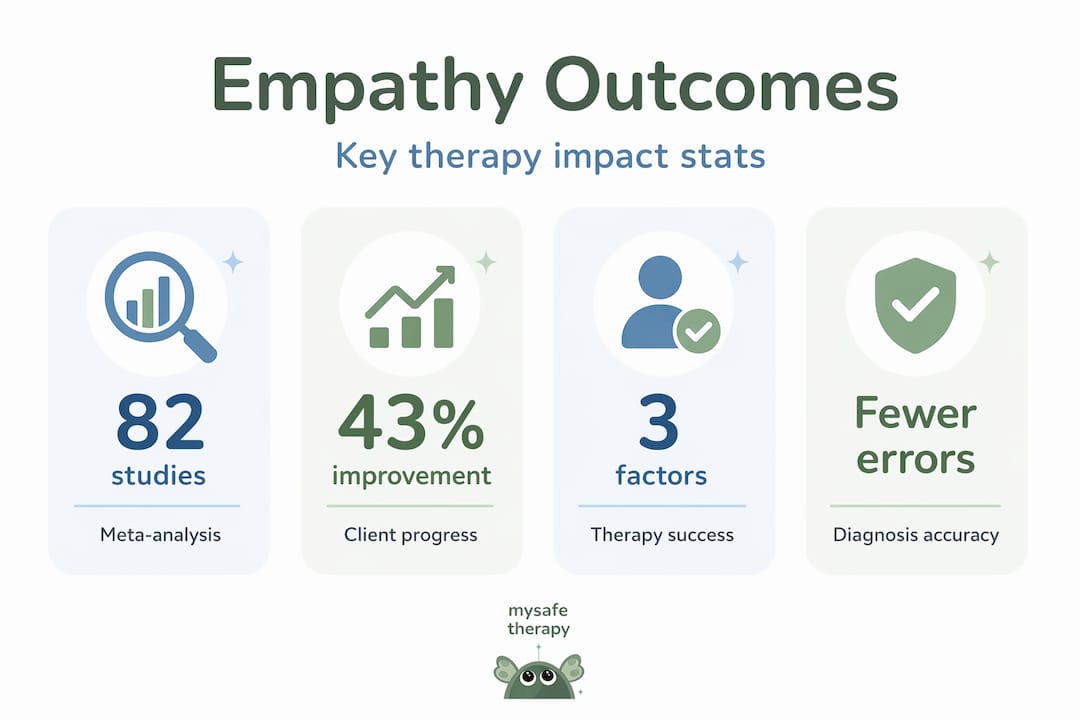
The evidence supporting empathy as a therapeutic necessity is substantial. A meta-analysis of 82 studies found a moderate-to-strong correlation between therapist empathy and improved mental health outcomes across different therapy types. This is not a marginal finding. Empathy predicts progress across cognitive-behavioural therapy, psychodynamic approaches, and person-centred counselling alike.
Carl Rogers placed empathy alongside genuineness and unconditional positive regard as the three necessary conditions for therapeutic change. His argument was that no technique, no matter how well executed, compensates for the absence of these relational conditions. Decades of subsequent research have largely confirmed this position.
The table below summarises key evidence on how empathy affects therapy and clinical outcomes.
| Area | Finding |
|---|---|
| Symptom reduction | Moderate-to-strong correlation across 82 studies between therapist empathy and client improvement |
| Treatment adherence | Empathy-focused care linked to higher adherence across 14 randomised controlled trials |
| Patient satisfaction | 100% of 14 RCTs showed higher satisfaction when empathic care was prioritised |
| Diagnostic accuracy | Empathy functions as a clinical diagnostic tool, improving understanding of client realities |
"Empathy is not just a skill but a foundational way of being therapists embody, essential for genuine therapeutic change." — Carl Rogers' framework on therapeutic conditions
Empathy in psychological treatment also reduces diagnostic errors. When therapists genuinely understand a client's internal world, they are better placed to interpret presenting symptoms accurately and tailor intervention accordingly. The benefits of empathy in therapy, then, are not solely relational. They are clinical and measurable.
It is also worth understanding that therapeutic empathy is collaborative. Clients actively help correct a therapist's understanding when something does not quite land. This back-and-forth is not a sign of failure; it strengthens the connection and prevents the therapeutic relationship from operating on assumptions.
How empathy enhances the therapy process
Understanding how empathy enhances therapy means looking at the session-level mechanisms through which it operates. It is not abstract. Empathy changes what happens in the room, and what clients experience as a result.
-
It creates a psychologically safe space. Clients who feel genuinely understood are more willing to disclose difficult material. Research shows that clients physiologically relax during empathic moments in therapy, displaying more relaxed body language and finding communication easier. Safety is not just emotional; it is measurable.
-
It facilitates emotional regulation. When a therapist accurately reflects a client's emotional state, the client gains a clearer sense of what they are experiencing. This process of being witnessed and understood helps reduce emotional overwhelm, which is a precondition for productive therapeutic work.
-
It improves treatment tailoring. Empathy gives a therapist access to the client's unique emotional reality. A standardised intervention applied without that understanding will often miss the mark. Understanding empathy in therapy means recognising that the same technique will land very differently depending on how attuned the therapist is to this individual person.
-
It strengthens engagement and collaboration. Clients who feel their therapist understands them are more likely to remain in treatment, complete tasks between sessions, and trust the process. The role of empathy in mental health is, in part, a retention mechanism for the therapeutic work itself.
-
It creates space to engage with positive emotions. Research shows that empathising with positive emotions is five times more beneficial for long-term relational satisfaction than focusing only on distress. In therapy, this means an empathic therapist does not only sit with pain. They also amplify and validate moments of growth, pride, and connection.
Pro Tip: Micro-practices matter. Small empathic actions such as maintaining eye contact, naming an emotion accurately, and validating a client's response take under a minute but significantly improve how clients perceive the quality of care they receive.
Challenges therapists face in sustaining empathy
Empathy, as a sustained clinical stance, is demanding work. Therapists who engage deeply with clients' distress, trauma, and suffering face real occupational risks that, if unmanaged, erode the very quality their clients depend upon.
The most significant challenges include:
- Compassion fatigue. Repeated exposure to others' pain without adequate recovery can deplete a therapist's capacity for empathic engagement. It is not indifference. It is exhaustion.
- Emotional labour. Sustaining empathy across multiple clients in a working day requires active emotional management. This is not incidental to the work; it is the work, and it carries a cost.
- Workload pressures. Research shows that reducing workload by 40% is cited as the most critical factor in sustaining clinician empathy. Overloaded therapists cannot be fully present, regardless of their intentions.
- Premature problem-solving. One of the most underappreciated barriers to empathic therapy is the therapist's own discomfort with sitting in uncertainty. Clients frequently reject advice offered before an empathic connection is established, even when that advice is technically sound.
- Peer isolation. Peer support is identified by 16% of clinicians as critical to sustaining empathy. Therapists who work without collegial connection are more vulnerable to emotional depletion.
Practical strategies therapists use to address these challenges include mindfulness-based rituals to transition into and out of empathic states between sessions, regular clinical supervision, ongoing reflective practice, and deliberate boundary management that preserves emotional capacity without diminishing genuine connection.
Pro Tip: If you are in therapy and feel your therapist seems rushed or is offering solutions before you feel heard, it is reasonable to name that experience. Good therapists welcome this feedback. It is part of how therapists support mental health effectively.

Understanding these challenges as a client also matters. Knowing your therapist is actively managing their empathic capacity, rather than simply being naturally warm, changes how you understand the professional relationship.
Our perspective: empathy is not optional in therapy
I have seen this pattern consistently. When someone questions whether a therapy experience is working, it almost always comes back to one thing: they do not feel understood. Not because their therapist lacks technical knowledge or is applying the wrong model. Because the empathic connection is absent or insufficient.
What I have learned from working in this space is that people frequently undervalue empathy when choosing a therapist. They focus on qualifications, approach, or availability, all of which matter. But if your therapist cannot demonstrate genuine understanding of your specific emotional reality, no technique will compensate for that absence. The research is unambiguous on this point.
There is also a misconception worth addressing directly. Empathic therapists are not simply "nice" therapists. Empathy is not pleasantness. It involves accuracy. A therapist can be warm and still consistently misread what you are experiencing. True empathic attunement requires both skill and genuine attention, and it should be something you actively look for.
My honest advice: when you begin therapy, pay attention to whether you feel accurately understood, not just listened to. There is a difference. Being heard is passive. Being understood means the therapist reflects your experience back in a way that feels true. That experience is the foundation of every other benefit therapy can provide.
Learning about burnout prevention and emotional resilience alongside therapy also supports better outcomes. Empathy in the room matters more when clients are also caring for themselves between sessions.
— MySafeTherapy
Finding a therapist who prioritises empathic care
Knowing that empathy is clinically significant changes how you should approach finding the right therapist. You are not looking for someone who ticks qualification boxes alone. You are looking for someone who will understand your specific emotional world accurately and consistently.
At Mysafetherapy, all therapists are UK-accredited and registered with professional bodies including BACP, UKCP, and NCPS. The platform is built around accessibility, confidentiality, and personalised care, with session formats including video, chat, and avatar-based options to suit different comfort levels. If you are ready to start therapy with a therapist selected for both their qualifications and their capacity for empathic, person-centred practice, Mysafetherapy makes that process straightforward. Sessions are available evenings and weekends, with transparent pricing and the flexibility to change therapists if the fit is not right. Your comfort and safety matter throughout.
FAQ
What is the role of empathy in therapy?
Empathy allows therapists to understand a client's internal world accurately, creating the psychological safety required for effective therapeutic work. Research links therapist empathy directly to symptom reduction, treatment adherence, and client satisfaction.
How does empathy differ from sympathy in a therapeutic context?
Sympathy involves feeling concern for someone from a distance, while empathy means understanding and sharing in the client's emotional experience. In therapy, empathy leads to accurate attunement; sympathy does not.
Can therapy work without empathy?
Research strongly suggests it cannot reach its potential without it. A meta-analysis of 82 studies found that therapist empathy has a moderate-to-strong correlation with improved outcomes, independent of the therapeutic model used.
How can I tell if my therapist is empathic?
A genuinely empathic therapist reflects your experience back in ways that feel accurate, asks questions that demonstrate real curiosity about your specific situation, and does not rush toward solutions before you feel understood.
What happens when empathy is absent in therapy?
Without empathic attunement, clients are less likely to disclose difficult material, less likely to adhere to treatment, and more likely to reject advice, even when that advice is clinically sound.