

For adults in the UK managing anxiety, Mysafetherapy is the recommended starting point: UK-accredited therapists registered with BACP, UKCP, or NCPS, multiple session formats, transparent pricing, and a clear policy for switching therapists if the first match is not right.
To act now:
- Check accreditation. Confirm your therapist holds a current registration with a PSA-recognised body such as BACP or UKCP before booking.
- Choose your format. Mysafetherapy offers video, phone, live chat, and avatar-based sessions. Pick what suits your anxiety and your schedule.
- Book an assessment. Your first session is a structured clinical assessment. Prepare a short list of your main symptoms and goals beforehand.
- Review pricing. Mysafetherapy publishes its pricing clearly. If cost is a barrier, check whether NHS Talking Therapies or a charity such as Anxiety UK offers a faster or lower-cost route for your situation.
Table of Contents
- How do UK online therapy platforms for anxiety actually work?
- Which therapy types help anxiety, and does online delivery work?
- How to choose a trustworthy UK online therapy platform
- What does online anxiety therapy cost in the UK, and how long will you wait?
- Are your therapist and your data safe on UK platforms?
- What progress can you realistically expect from online therapy for anxiety?
- Why Mysafetherapy suits UK adults managing anxiety
- Key takeaways
- Therapist fit matters more than platform features
- Start online therapy for anxiety with Mysafetherapy today
- Useful UK sources and evidence
How do UK online therapy platforms for anxiety actually work?
The process across most UK platforms follows a consistent sequence, though the quality of each step varies considerably.
- Sign-up and screening. You create an account and complete a questionnaire covering your symptoms, history, and preferences (session format, therapist gender, scheduling needs).
- Clinical triage or assessment. A trained clinician or the platform's matching algorithm reviews your responses. Better platforms conduct a live assessment call before assigning a therapist.
- Therapist matching. You are matched to a therapist whose specialism, availability, and approach fit your profile. Reputable platforms show you the therapist's qualifications, registration number, and areas of experience before you confirm.
- Sessions. Depending on the platform, sessions run via live video, phone, text-based live chat, asynchronous messaging (you write, the therapist responds within a set window), or avatar-based formats for those who prefer anonymity.
- Between-session tools. Many platforms supplement live sessions with guided self-help modules, mood tracking, AI-assisted journalling, and homework prompts. These tools matter: between-session practice is where much of the therapeutic work consolidates.
What to watch for in scheduling and cancellation terms:
- Cancellation windows vary from 24 to 48 hours; late cancellations often incur the full session fee.
- Therapist switching should be straightforward and free. If a platform makes it difficult or charges for a change, treat that as a warning sign.
- Refund policies differ significantly. Read the terms before subscribing, particularly for monthly plans.
Which therapy types help anxiety, and does online delivery work?
The evidence base for anxiety treatment is clear. Evidence-based approaches for anxiety include:
- Dialectical Behaviour Therapy (DBT) skills: — Particularly relevant where anxiety overlaps with emotional dysregulation; DBT distress-tolerance and mindfulness modules translate well to digital delivery.
On the question of whether online delivery is as effective as in-person care: peer-reviewed meta-analytic evidence supports that internet-delivered CBT and therapist-led online treatments produce outcomes comparable to face-to-face therapy for anxiety disorders, with many people experiencing meaningful improvement over a common period of a few weeks of weekly sessions.
Statistic to note: IAPT outcome data show that digitally enabled therapies are now a routine part of NHS Talking Therapies provision, reflecting both their accessibility and their clinical acceptability.
CBT and guided self-help translate particularly well to digital modules. Exposure work can be conducted remotely when the therapist is experienced in remote delivery and the client has a stable, private environment. Find the right therapy type for your anxiety before committing to a platform, since not every service offers every modality.
How to choose a trustworthy UK online therapy platform
Most people spend less time choosing a therapy platform than they would choosing a laptop. That imbalance has consequences.
Checklist: what to verify before signing up
- Therapist registration with a PSA-recognised body (BACP, UKCP, NCPS). The registration number should be visible on the therapist's profile and verifiable on the body's public register.
- Clear, published pricing with no hidden subscription fees.
- A stated therapist-switching policy that does not penalise you for changing.
- Session formats that match your preference and anxiety presentation.
- A privacy policy that references UK GDPR compliance and specifies how session data is stored, who can access it, and under what circumstances information might be shared with a GP.
- Evidence of clinical supervision and continuing professional development (CPD) for therapists on the platform.
Questions to ask before your first session:
- What is your experience working with [your specific anxiety type, e.g. social anxiety, health anxiety, panic disorder]?
- What happens if I need support between sessions or in a crisis?
- How do you handle confidentiality if you have safeguarding concerns?
- What is your cancellation and rescheduling policy?
- How will we measure progress, and what does a typical course of treatment look like?
Red flags that warrant caution:
- No therapist registration number on the profile.
- No option to switch therapists or a fee for doing so.
- Pricing that is only revealed after payment details are entered.
- No UK-based registration or data storage information.
- Vague or absent statements about clinical supervision.
Understanding therapist registration is the single most protective step you can take before starting online therapy.
What does online anxiety therapy cost in the UK, and how long will you wait?
Private platforms
Private therapy in the UK typically costs between £40 and over £100 per session, with sliding-scale fees commonly available for students and those on lower incomes. Online platforms generally sit in the lower-to-mid range of that band, partly because therapists save on room hire. Subscription models (paying monthly for a set number of sessions) often reduce the per-session cost compared with pay-as-you-go pricing.
Cost note: Peer-reviewed economic research links investment in psychological therapies to improved work-related outcomes and reduced downstream healthcare costs, which means the upfront cost of therapy is rarely the full picture of its value.
NHS Talking Therapies
NHS Talking Therapies are free to patients and can be self-referred without a GP referral. They offer both remote and in-person options and deliver NICE-recommended psychological treatments, including CBT and guided self-help. Waiting times vary by area but can extend to several weeks or longer, which makes NHS provision less suitable when anxiety is significantly affecting daily life right now.
Charities and low-cost options
- Anxiety UK provides reduced-cost therapy and specialist guidance for people with anxiety conditions. Membership gives access to discounted therapy rates.
- Mind and local mental health charities often offer counselling on a sliding scale or free of charge.
- University counselling services are available to students, typically free and with short waiting lists during term time.
If cost is the primary barrier, start with NHS self-referral or an Anxiety UK membership enquiry before committing to a private subscription.
Are your therapist and your data safe on UK platforms?
Therapist titles and what they mean
In the UK, the titles "psychotherapist" and "counsellor" are not legally protected. Anyone can use them without formal training or registration. This is a documented regulatory gap: a Parliamentary Office of Science and Technology briefing confirms that PSA-recognised bodies such as BACP and UKCP provide the primary consumer assurance in the absence of statutory regulation. Checking registration is not optional; it is the baseline.
How to verify a therapist's registration:
- Find the therapist's stated registration body and membership number on their profile.
- Go to the public register of that body (e.g. BACP's Therapist Directory, UKCP's Find a Therapist).
- Search by name or number to confirm current registration status.
- Check whether the profile mentions DBS (Disclosure and Barring Service) checks and CPD commitments.
Data protection on UK platforms
UK GDPR requires that any platform processing your personal health data does so lawfully, transparently, and securely. In practice, this means:
- Session data should be stored on encrypted servers, ideally UK-based.
- Video sessions should use end-to-end encrypted platforms (not standard consumer video tools).
- The privacy policy should specify data retention periods and the conditions under which information might be shared (e.g. safeguarding obligations, GP communication with your consent).
- You have the right to request access to your data and to have it deleted, subject to legal retention requirements.
A platform that cannot answer these questions clearly is not ready to handle sensitive health information. UK therapy regulations and what they mean for your safety covers the registration landscape in detail.
What progress can you realistically expect from online therapy for anxiety?
Many people receiving CBT-based online therapy for anxiety see meaningful change within 8–12 weekly sessions. That is not a guarantee; it is a frequently observed pattern in the clinical literature, and it depends on the severity of the anxiety, the consistency of attendance, and the quality of between-session practice.
How progress is typically measured:
- Validated self-report scales (such as the GAD-7 for generalised anxiety or the PHQ-9 where depression co-occurs) administered at regular intervals.
- Session-by-session outcome measures that allow both client and therapist to track change over time.
- Client journals and mood tracking tools, which provide a continuous record between sessions.
- Goal reviews at agreed intervals, usually every four to six sessions.
If progress stalls:
- Raise it with your therapist directly. A good therapist will welcome the conversation and adjust the approach.
- Consider whether the modality is the right fit. Some people respond better to ACT than CBT, or benefit from adding structured exposure work.
- If anxiety has a significant physical component, a GP review is worth considering to rule out contributing medical factors or to discuss whether medication alongside therapy is appropriate.
Between-session practice is where gains consolidate. Platforms that integrate homework prompts, mood logs, and guided journeys into the app experience tend to support better adherence than those that treat sessions as standalone events.
Why Mysafetherapy suits UK adults managing anxiety
Mysafetherapy is built around the criteria that matter most when choosing online therapy for anxiety: verified therapist registration, format flexibility, transparent pricing, and tools that support progress between sessions.
What the platform offers:
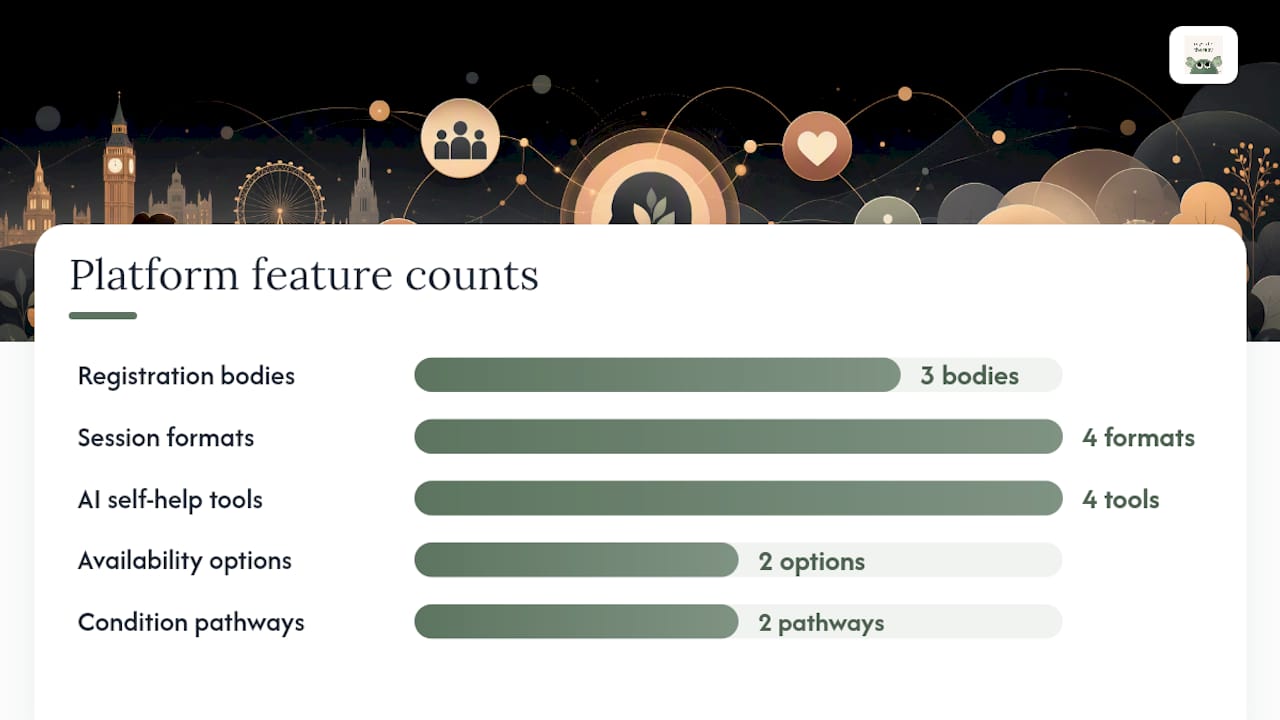
- Therapists registered with BACP, UKCP, or NCPS, with registration details visible on each therapist profile.
- Session formats covering video, phone, live chat, and avatar-based anonymous sessions, which are particularly useful for people whose anxiety makes face-to-face or video contact difficult.
- AI-assisted self-help tools including journalling, mood tracking, guided journeys, and progress reports, designed to support between-session practice.
- Evening and weekend availability, which removes the need to take time off work for appointments.
- A clear therapist-switching policy with no penalty for changing if the initial match is not the right fit.
- Condition-specific pathways for presentations including social anxiety and health anxiety.
In practice: after completing the onboarding questionnaire, you are matched to a therapist whose specialism aligns with your anxiety presentation. The first session is a structured assessment. From session two onwards, the therapist introduces evidence-based techniques (CBT, ACT, or another approach suited to your goals), and the platform's between-session tools keep you engaged with the work in the days between appointments.
Pro Tip: Before your first session, write down your three main anxiety symptoms and one concrete goal. This makes the assessment more focused and gives your therapist a clear starting point.
Key takeaways
Choosing the right UK online therapy platform for anxiety comes down to three non-negotiable checks: therapist accreditation with a PSA-recognised body, transparent pricing, and a clear policy for switching therapists if the match is not right.
| Point | Details |
|---|---|
| Verify accreditation first | Check your therapist's BACP, UKCP, or NCPS registration number on the body's public register before booking. |
| Online CBT is clinically supported | Meta-analytic evidence confirms online therapy produces outcomes comparable to in-person care, often within 8–12 weekly sessions. |
| Private costs vary widely | Private sessions typically range from £40 to over £100 per session; NHS Talking Therapies are free and self-referrable if waiting times are acceptable. |
| NHS and charities are real options | Anxiety UK offers reduced-cost therapy; NHS Talking Therapies can be accessed without a GP referral. |
| Mysafetherapy covers the key criteria | UK-accredited therapists, multiple formats including avatar sessions, AI self-help tools, and a clear switching policy make it a practical first choice. |
Therapist fit matters more than platform features
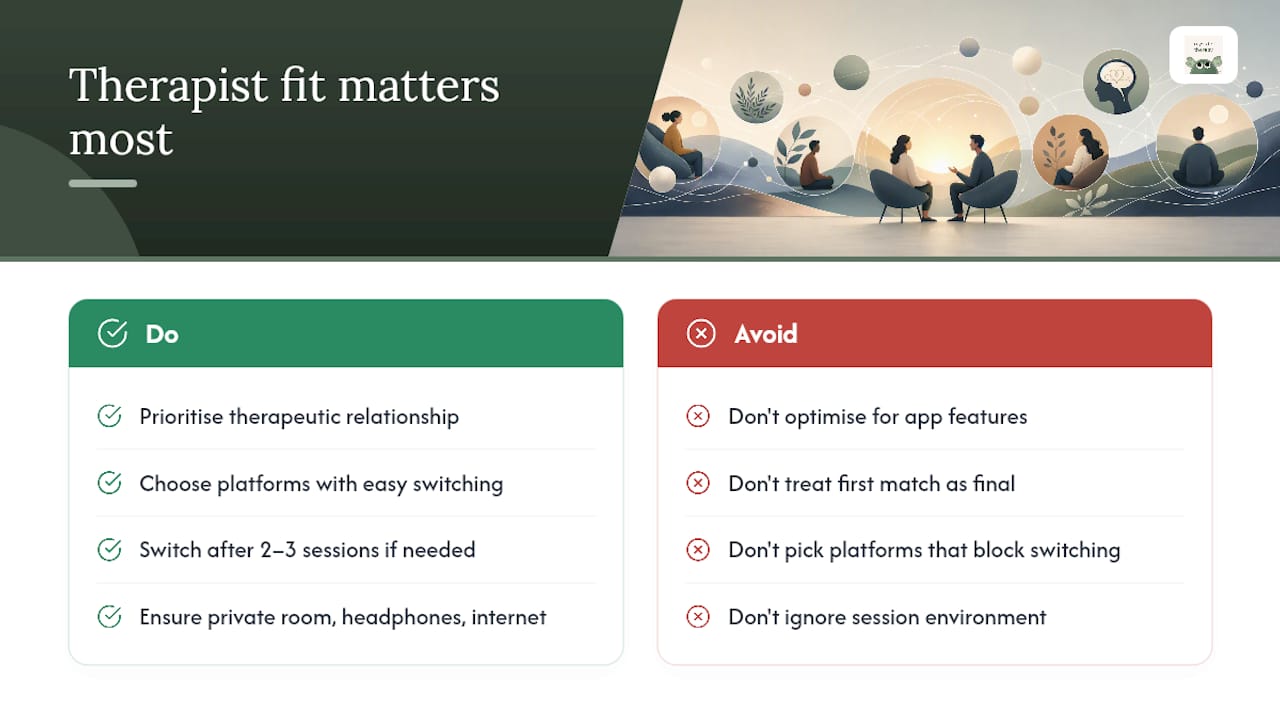
The most common mistake people make when choosing an online therapy platform is optimising for the wrong variable. They compare app interfaces, subscription prices, and session counts, then overlook the single factor that the research consistently identifies as the strongest predictor of outcomes: the quality of the therapeutic relationship.
A platform can offer every format imaginable and still deliver poor results if the therapist match is wrong. Accreditation matters because it sets a floor, not a ceiling. A BACP-registered therapist has met a defined standard of training and ethical practice. What it does not guarantee is that this particular therapist is the right fit for this particular person's anxiety.
The practical implication: choose a platform that makes switching easy and treats the first match as a starting point, not a commitment. Mysafetherapy's switching policy reflects this understanding. If the first therapist is not working for you after two or three sessions, changing should be frictionless. Platforms that make switching difficult are, in effect, prioritising retention over outcomes.
One practical point that rarely appears in platform comparisons: the physical environment for your sessions matters. A stable internet connection, headphones, and a genuinely private room reduce the technical and psychological friction that can undermine the therapeutic alliance in remote sessions. Sort the logistics before your first appointment, not during it.
Start online therapy for anxiety with Mysafetherapy today
Adults in the UK who need accredited, affordable online therapy for anxiety do not have to navigate a lengthy waiting list or an opaque matching process. Mysafetherapy connects you directly with UK-registered therapists, with sessions available in the evenings and at weekends, in the format that suits you.
Getting started takes three steps. First, complete the short onboarding questionnaire at mysafetherapy.com to describe your anxiety, your preferences, and your availability. Second, review your matched therapist's profile, including their registration body, specialism, and session formats. Third, book your first assessment session and use the platform's AI self-help tools in the days before it to begin tracking your mood and clarifying your goals.
Pricing is published clearly on the platform. Subscription options reduce the per-session cost for those committing to a regular course of therapy. If you have questions about which plan fits your situation, the platform's support team can advise before you commit.
Useful UK sources and evidence
The following sources underpin the claims in this article and are worth consulting directly for further detail.
- Find NHS talking therapies for anxiety and depression — NHS
- Improving Access to Psychological Therapies data set reports — digital.nhs.uk
- Cost–benefit and outcomes research related to psychological therapies (Cambridge Core)
- Anxiety UK information and services (Choice and Medication)
This article provides general information about online therapy options in the UK. It is not a substitute for professional clinical advice. Confirm current service details and your eligibility directly with the provider or a qualified mental health professional.