

TL;DR:
- Relationship counselling helps couples improve communication, resolve conflicts, and rebuild trust effectively. Different approaches like EFT, the Gottman Method, IBCT, and ACT target specific relational issues with proven results. Therapy benefits can occur even when only one partner participates, especially with early intervention.
Relationship counselling is a specialised form of psychotherapy where a trained therapist helps couples or individuals improve their interpersonal dynamics and emotional wellbeing. Known formally as couples therapy or relationship therapy, it treats the relationship itself as the primary client, not either person in isolation. Sessions typically last 60 minutes on a weekly basis, with total duration varying according to the couple's needs. The process is structured, neutral, and goal-directed. Therapists registered with bodies such as the BACP (British Association for Counselling and Psychotherapy), UKCP, or NCPS provide a confidential space where both partners can speak honestly and work towards genuine change.
What is relationship counselling and what types of therapy does it use?
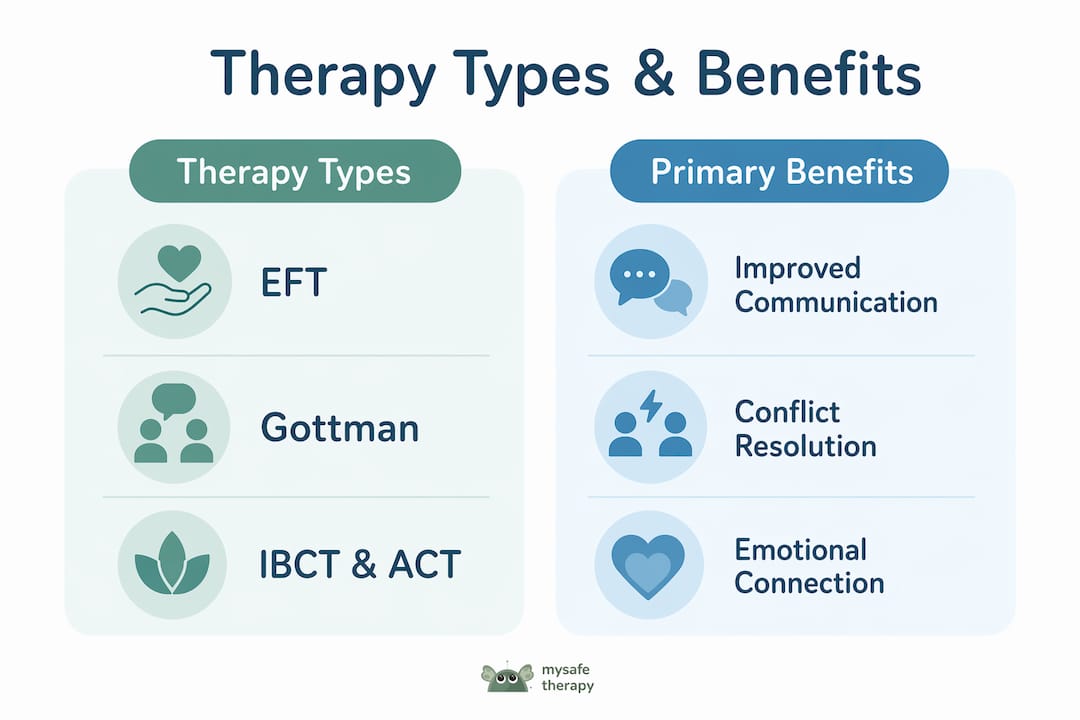
Four approaches carry the strongest empirical support in relationship counselling: Emotionally Focused Therapy (EFT), the Gottman Method, Integrative Behavioural Couple Therapy (IBCT), and Acceptance and Commitment Therapy (ACT). Each targets different aspects of relational difficulty, and no single method is universally superior. A skilled therapist selects and blends approaches based on the couple's specific patterns, history, and goals. You can read a fuller breakdown of these models in this guide to relationship therapy.

Emotionally Focused Therapy (EFT)
EFT focuses on healing attachment wounds. It helps partners identify the emotional needs driving their behaviour and express those needs more clearly. Developed by Dr Sue Johnson, EFT is particularly effective where one or both partners feel emotionally disconnected or chronically misunderstood.
The Gottman Method
The Gottman Method builds communication skills and positive interactions. It uses structured exercises to reduce contempt, criticism, defensiveness, and stonewalling, which research identifies as the four most damaging patterns in long-term relationships. Couples learn to repair conflict faster and build a stronger friendship base.
IBCT and ACT
IBCT promotes acceptance of differences alongside behaviour change. Rather than pushing both partners to become someone they are not, it works with personality and temperament as fixed variables. ACT applies mindfulness and values-based commitment to help couples act in line with what they genuinely want from the relationship, even during difficult periods.
| Approach | Primary focus | Typical outcomes | Best suited for |
|---|---|---|---|
| EFT | Attachment and emotional bonding | Deeper emotional connection | Emotional distance, recurring conflict |
| Gottman Method | Communication and friendship | Reduced conflict, stronger bond | Communication breakdown |
| IBCT | Acceptance and behaviour change | Greater tolerance, less reactivity | Personality clashes |
| ACT | Values and mindfulness | Clearer commitment, reduced avoidance | Ambivalence, life transitions |
Pro Tip: Ask a prospective therapist which approach they use and why. A therapist who can explain their method clearly is more likely to apply it with consistency and skill.
How does relationship counselling work in practice?
The first session focuses on assessment. The therapist gathers background on the relationship, identifies the main concerns, and agrees on goals with both partners. This stage sets the direction for all subsequent work and gives both people a chance to feel heard before any deeper exploration begins.
The therapist's role is that of a neutral facilitator. Maintaining therapist neutrality is essential, and a skilled counsellor builds roughly equal alliances with both partners rather than siding with either. This is a critical distinction from mediation or arbitration. The therapist does not decide who is right. The focus stays on the interaction patterns between partners, not on assigning blame.
Common activities across sessions include:
- Communication skills practice. Partners learn to express needs without criticism and to listen without immediately defending themselves.
- Conflict cycle identification. The therapist maps the repeating sequence of triggers, reactions, and withdrawals that keep arguments unresolved.
- Emotional exploration. Partners examine the feelings beneath their surface reactions, often uncovering fear, shame, or grief that drives difficult behaviour.
- Homework tasks. Many approaches assign structured exercises between sessions to practise new skills in real situations.
Confidentiality applies throughout. What is discussed in the room stays there, with narrow legal exceptions. Individual sessions may be used selectively but usually with full consent from both partners and only when it benefits the couple's shared progress.
Pro Tip: Finding a therapist you both feel comfortable with matters as much as the method they use. Therapist matching significantly affects outcomes, and it is entirely normal to try more than one counsellor before settling on the right fit.
What are the benefits and goals of relationship counselling?
The primary goals of relationship counselling include improved communication, conflict resolution, trust rebuilding, and a deeper understanding of each partner's emotional needs. These goals go beyond surface-level skills training. Therapy addresses the emotional roots of recurring problems, including past injuries that one or both partners carry into the relationship.
Improved communication is the most commonly cited benefit, but the change runs deeper than learning to "use 'I' statements." Partners develop the capacity to stay present during difficult conversations rather than shutting down or escalating. That shift in emotional regulation changes the entire quality of daily interaction.
Trust rebuilding is another significant outcome, particularly after infidelity or a period of sustained conflict. Therapy provides a structured process for accountability, repair, and gradual re-engagement. Without that structure, many couples attempt reconciliation without ever addressing the underlying rupture.
Therapy shifts focus away from who is right or wrong and toward identifying the negative interaction cycles that keep conflict alive. Being 'right' is often the barrier to connection, not the path to it.
Preventative counselling is one of the most underused benefits. Couples who attend therapy before a crisis arises build emotional safety and resilience that helps them navigate future life changes, such as having children, bereavement, or career disruption. Waiting for a breaking point is not a requirement.
The evidence on therapy supporting wellbeing confirms that relational health and individual mental health are closely linked. Improving one consistently improves the other.
Who can benefit from relationship counselling and when should you seek it?
Relationship counselling serves couples at every stage and of every type. Married couples, cohabiting partners, those in long-distance arrangements, LGBTQ+ couples, and people navigating cultural or religious differences all access therapy successfully. Therapists adapt their approaches to respect each couple's cultural background, values, and individual history rather than applying a single model to everyone.
Common reasons people seek counselling include:
- Persistent communication breakdown or recurring arguments with no resolution
- Infidelity or a significant breach of trust
- Parenting disagreements or conflict around family roles
- Emotional or physical distance that has grown over time
- A desire to deepen connection before problems become entrenched
- Life transitions such as relocation, job loss, or bereavement
Mutual willingness helps, but it is not always a prerequisite. Individual therapy can benefit one partner even when the other does not participate. One person gaining new tools and perspectives can shift the dynamic of the whole relationship.
Counselling is not appropriate in every situation. Where domestic violence or coercive control is present, couples therapy is not the right intervention. Safety planning must come first, and specialist services exist for that purpose. A responsible therapist will screen for these factors at assessment and refer accordingly.
Stigma remains a barrier for many people in the UK. Seeking therapy is still sometimes framed as a sign of failure. The reality is the opposite. Attending counselling before a relationship reaches crisis point is a proactive decision, not a last resort. For LGBTQ+ couples or those from communities where therapy carries additional stigma, inclusive therapy options are available from therapists with specific training in diverse relationship contexts.
Pro Tip: If you are unsure whether counselling is right for your situation, a single initial session with a BACP-registered therapist can clarify whether the process suits your needs without any long-term commitment.
Key takeaways
Relationship counselling is most effective when both partners engage with the process, but individual therapy also produces meaningful change when only one partner attends.
| Point | Details |
|---|---|
| Therapy treats the relationship | The relationship itself is the primary client, not either individual in isolation. |
| Four methods have strong evidence | EFT, the Gottman Method, IBCT, and ACT each address different relational problems. |
| Neutrality is the therapist's role | A good counsellor builds equal alliances with both partners and avoids assigning blame. |
| Prevention is a valid reason to attend | Counselling before a crisis builds resilience and emotional safety for future challenges. |
| Safety comes before therapy | Domestic violence or coercive control requires specialist intervention, not couples counselling. |
Relationship counselling: the Mysafetherapy view
The most persistent myth about relationship counselling is that attending means the relationship has already failed. From our experience working with adults across the UK, the opposite is consistently true. The couples who benefit most are often those who come in early, before resentment has calcified into contempt.
There is also a tendency to treat therapy as a short course with a fixed endpoint. Relational growth does not work that way. The skills built in counselling, such as recognising your own emotional triggers, staying regulated during conflict, and expressing vulnerability without defensiveness, require ongoing practice. Viewing therapy as a one-time fix sets unrealistic expectations and often leads to disappointment when old patterns resurface under stress.
The therapist-client fit matters more than most people realise before they start. A technically skilled therapist who does not feel safe to both partners will produce limited results. If the connection is not there, changing therapists is not a failure. It is good clinical judgement.
The UK's cultural diversity also shapes what effective relationship counselling looks like in practice. A therapist who understands the specific pressures facing couples from different cultural, religious, or community backgrounds brings a different quality of insight to the work. That cultural awareness is not a bonus feature. It is a clinical necessity for many of the people we see.
— Mysafetherapy
Relationship counselling with Mysafetherapy
Mysafetherapy connects adults across the UK with BACP, UKCP, and NCPS-registered therapists who specialise in relationship and couples counselling.
Sessions are available via video, text chat, and avatar therapy for those who prefer greater anonymity. Evening and weekend appointments are available to fit around work and family commitments. Therapists are matched to your specific situation, and switching counsellors is straightforward if the initial match does not feel right. Pricing starts from £49, with no hidden fees and no long-term contracts. Whether you are navigating a specific crisis or want to strengthen a relationship that is already functioning well, start therapy with a qualified counsellor at a time that suits you.
FAQ
What is the difference between relationship counselling and couples therapy?
Relationship counselling and couples therapy refer to the same process. Both terms describe a structured therapeutic intervention where a trained professional helps partners improve communication, resolve conflict, and strengthen emotional connection.
How many sessions does relationship counselling typically take?
Session duration varies based on the couple's needs, from a handful of sessions for a specific issue to longer-term work for deeply entrenched patterns. Most couples attend weekly 60-minute sessions.
Is relationship counselling effective?
Relationship counselling produces measurable improvements in communication, emotional connection, and conflict resolution. Approaches such as EFT and the Gottman Method carry strong empirical support from decades of clinical research.
Can one partner attend relationship counselling alone?
Yes. Individual therapy benefits one partner even without the other's participation. Gaining new tools and self-awareness can shift relational dynamics meaningfully, even when only one person attends.
Is relationship counselling available online in the UK?
Online relationship counselling is widely available in the UK through accredited platforms. Mysafetherapy offers video, chat, and avatar-based sessions with BACP-registered therapists, including online access for couples who prefer to attend from home.