

For most UK adults dealing with common mental health conditions, video therapy is an effective, evidence-based option that compares directly with in-person care. A systematic review and meta-analysis of video call-based CBT found no statistically significant difference in symptom reduction between video and face-to-face delivery (SMD=0.044; CI = –0.086 to 0.174). UK NHS service data reinforces this: a retrospective study of over 5,000 IAPT clients in London found that remote delivery during the COVID-19 period produced recovery rates that often met or exceeded pre-pandemic in-person cohorts.
The evidence summary: Video-delivered CBT performs similarly to face-to-face therapy on symptom reduction, client satisfaction, and therapeutic alliance.
- Effective: Peer-reviewed meta-analyses confirm non-inferiority for common adult conditions.
- Accessible: Removes geographic and logistical barriers, particularly for rural and disabled adults.
- Convenient: No travel required; sessions fit around work and caring responsibilities.
Key takeaways
Video therapy is clinically non-inferior to in-person care for common adult mental health conditions, and UK service data confirms its effectiveness at scale.
| Point | Details |
|---|---|
| Non-inferiority confirmed | Meta-analysis SMD=0.044 (CI = –0.086 to 0.174) shows no significant difference vs in-person CBT. |
| UK NHS evidence | A retrospective study of over 5,000 IAPT clients found remote delivery met or exceeded pre-pandemic in-person recovery rates. |
| Suitability matters | Video therapy suits mild to moderate presentations; acute crisis, severe psychosis, or no private space are red flags for in-person referral. |
| Accreditation is non-optional | Check BACP, UKCP, or HCPC registration and confirm the platform meets UK GDPR before booking. |
| Mysafetherapy | Connects UK adults with BACP/UKCP/NCPS-accredited therapists via secure video, chat, or avatar sessions, with no waiting list. |
Table of Contents
- 1. The main video therapy benefits for UK adults
- 2. What does the research say about video therapy effectiveness?
- 3. What are the potential downsides of video therapy?
- 4. Is video therapy right for you?
- 5. How do you access video therapy in the UK, and what does it cost?
- 6. How to prepare for your first video therapy session
- 7. What should a high-quality video therapy provider offer?
- Flexible, accredited video therapy with Mysafetherapy
- Sources
1. The main video therapy benefits for UK adults
Video therapy offers a set of practical advantages that make it a genuinely different proposition from traditional face-to-face care, not simply a substitute for it.
Convenience and schedule flexibility are the most immediate gains. Without travel, a 50-minute session does not consume two or three hours of the day. Adults with demanding work schedules, caring responsibilities, or limited transport options can book sessions during a lunch break or after the children are in bed. Implementation studies report that service users save an average of approximately 145 miles and 142 minutes per session compared with attending in person. That is not a marginal saving.
Geographic access is a significant factor for people in rural areas, where waiting lists for local therapists can be long and specialist services may simply not exist nearby. Video therapy removes the postcode barrier. Adults in remote parts of Scotland, Wales, or Northern England can access the same range of accredited therapists as someone in central London. For those with physical disabilities or mobility difficulties, the removal of travel is not just convenient but clinically meaningful.
Privacy and comfort operate differently in video therapy. Attending a clinic carries visible social risk for some people, particularly those in small communities or professional roles where stigma remains a concern. Being at home, in a familiar environment, can lower the threshold for disclosure. Some clients report finding it easier to discuss sensitive topics when they are not physically in a therapist's room.

Continuity is an underappreciated benefit. Life changes, including relocation, extended travel, or illness, typically interrupt face-to-face therapy. Video sessions remove that disruption. A therapeutic relationship built over months does not have to end because someone moves city.
Inclusivity extends to people with certain sensory or communication needs. Captioning tools, adjustable screen sizes, and the option to use familiar devices all reduce barriers that a standard clinic environment may not address.
A literature review of synchronous video consultations confirms that many users value access and convenience highly, though it also notes that technical barriers can exclude some people without adequate devices or connectivity.
2. What does the research say about video therapy effectiveness?
The evidence base for video therapy has grown substantially, and the direction of findings is consistent: for common adult mental health conditions, video delivery is largely non-inferior to in-person care.
The most precise pooled estimate comes from a systematic review and meta-analysis of video call-based CBT, which found an SMD of 0.044 (CI = –0.086 to 0.174) on pooled symptom outcomes. The confidence interval crosses zero, meaning the difference between video and in-person CBT is not statistically significant. The British Psychological Society's research digest summarises this body of work plainly: video-delivered therapy performs similarly to face-to-face sessions on symptom reduction, client satisfaction, and therapeutic alliance.
UK-specific service data adds a real-world layer. The London IAPT retrospective study of over 5,000 clients found that remote delivery remained effective throughout the pandemic period, with recovery and improvement rates often meeting or exceeding pre-pandemic in-person benchmarks. This is service-level data, not a controlled trial, but the scale and the UK context make it directly relevant.
A NES digital delivery guidance report reviewing evidence for anxiety and depression reached a similar conclusion: video and telephone interventions can offer comparable benefits to face-to-face treatment, though the report flags quality gaps in the evidence base and a shortage of cost-effectiveness studies.
Limitations worth noting:
- Study populations vary considerably, with a concentration of PTSD and veteran cohorts in some reviews.
- Most trials measure short-term symptom change; long-term follow-up data remain limited.
- Study quality is heterogeneous, and not all reviews use the same outcome measures.
- Cost-effectiveness data for video therapy in UK NHS settings are sparse.
The evidence is not without caveats, but the overall picture is coherent: for mild to moderate anxiety, depression, and related conditions, video therapy is a clinically credible option. For more complex presentations, the evidence thins and clinical judgement becomes more important.
| Evidence source | Key finding | Population |
|---|---|---|
| London IAPT retrospective (>5,000 clients) | Recovery rates met or exceeded pre-pandemic in-person cohorts | NHS IAPT clients, London |
| NES digital delivery review | Comparable outcomes for anxiety and depression; evidence quality gaps noted | UK/Scottish NHS context |
| BPS research digest summary | Non-inferiority on symptoms, satisfaction, and therapeutic alliance | Multiple study populations |
For further reading on video therapy for anxiety and depression, the evidence base is discussed in more detail.
3. What are the potential downsides of video therapy?
A balanced assessment of virtual therapy benefits requires an honest account of where video delivery falls short.
Technical problems are the most common practical obstacle. Connection drops, audio lag, frozen screens, and software login failures all interrupt the therapeutic process. These are not trivial disruptions in a session that may involve distressing material. Poor lighting or a low-quality microphone can also reduce the therapist's ability to read non-verbal cues accurately.
Confidentiality and data security require active management. Using a shared device, a thin-walled room, or an unsecured Wi-Fi network all create real privacy risks. Platforms vary significantly in their data protection standards. UK-based providers are subject to UK GDPR, but not all platforms used for therapy are purpose-built for clinical work. A consumer video-calling app is not the same as a secure video counselling platform with end-to-end encryption and a published data processing agreement.
Clinical suitability limits are the most important consideration. Video therapy is not appropriate for everyone. People in acute crisis, those with severe psychosis or significant reality-testing difficulties, and those who require physical assessment or close clinical monitoring generally need face-to-face or inpatient care. BACP guidance is explicit that therapists must assess whether remote work is clinically appropriate before proceeding, and that some presentations require in-person care.
Red flags to watch for when choosing a provider:
- No visible UK accreditation (BACP, UKCP, or HCPC registration)
- No published privacy policy or data processing agreement
- No documented remote risk management or safety protocol
- No clear process for escalating to emergency services if needed
- Use of a non-clinical, consumer-grade video platform
Pro Tip: Ask any prospective provider two direct questions before booking: "What platform do you use for video sessions, and is it end-to-end encrypted?" and "What is your safety protocol if I am in crisis during a session?" A competent, accredited provider will answer both without hesitation.
4. Is video therapy right for you?
Video therapy suits most adults with mild to moderate mental health needs and a stable home environment. The following checklist helps clarify whether it is the right fit.
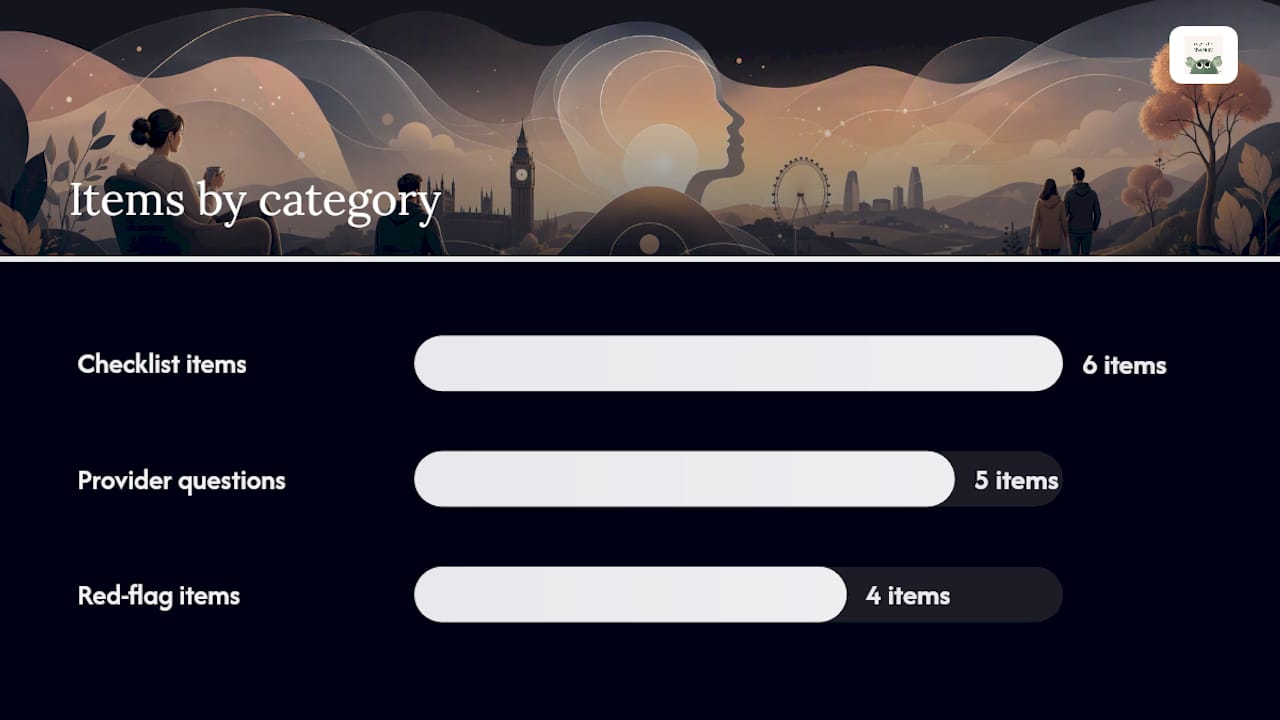
Self-assessment checklist:
- Can you access a private space where you will not be overheard for the duration of a session?
- Do you have a reliable internet connection and a device with a working camera and microphone?
- Are you comfortable with video calls as a communication format?
- Is your presenting concern mild to moderate in severity (anxiety, low mood, stress, relationship difficulties, burnout)?
- Are you not currently in acute crisis or requiring immediate clinical intervention?
- Do you have access to local emergency contacts and services if needed between sessions?
If you answered yes to all six, video therapy is likely a practical and appropriate option.
Red flags that suggest in-person care is more appropriate:
- Active suicidal ideation with a plan, or recent self-harm requiring clinical monitoring
- Severe dissociation or psychosis where grounding in a physical space with a clinician matters
- A presenting issue requiring physical examination or proximity-based therapeutic techniques
- No access to a private, stable environment for sessions
- Significant digital literacy barriers that cannot be resolved with preparatory support
Questions to ask a prospective provider before booking:
- Are you registered with BACP, UKCP, or HCPC?
- What is your remote risk management protocol?
- How do you handle a clinical emergency during a video session?
- What platform do you use, and how does it comply with UK GDPR?
- What is your process if I need to change therapist?
Pro Tip: If you are uncertain whether your presenting issue is suitable for video therapy, request an initial assessment call rather than committing to a full session. A competent therapist will use that call to assess suitability and advise accordingly.
For a detailed comparison of video versus chat therapy, including which format suits different needs, that resource covers the practical distinctions clearly.
5. How do you access video therapy in the UK, and what does it cost?
NHS routes remain the primary publicly funded option. Adults can access video therapy through NHS Talking Therapies (formerly IAPT) via GP referral or self-referral in most areas. Remote delivery, including video and telephone, has been embedded in NHS Talking Therapies services since the pandemic and is now a standard delivery option rather than an exception. Waiting times vary by area and can be significant; NHS Talking Therapies is generally most appropriate for mild to moderate anxiety and depression.
Private access removes the waiting list but introduces cost. Private video therapy sessions in the UK typically range from approximately £50 to £120 per session, depending on the therapist's qualifications, location, and specialism. Subscription-based platforms may offer lower per-session costs for those committing to regular sessions. These figures are illustrative; check individual provider pages for current pricing.
Accreditation and trust signals are the primary quality filter for private providers. The key bodies to check are:
- BACP (British Association for Counselling and Psychotherapy): the largest UK professional body for counsellors and psychotherapists; membership requires adherence to an ethical framework.
- UKCP (UK Council for Psychotherapy): registers psychotherapists and psychotherapeutic counsellors; sets training and practice standards.
- HCPC (Health and Care Professions Council): statutory regulator for practitioner psychologists and other regulated health professions.
- NICE (National Institute for Health and Care Excellence): publishes clinical guidelines that inform which therapeutic approaches are recommended for specific conditions.
A provider registered with one of these bodies is accountable to a professional standard and a complaints process. One that is not registered carries no such accountability.
Data protection is a specific consideration for online therapy. UK GDPR applies to all personal data processed by UK-based providers. A reputable provider will publish a clear privacy policy, name the platform used for video sessions, confirm whether data is stored and where, and provide a data processing agreement on request. Confidential online therapy requires both clinical governance and technical data security.
| Trust signal | What to check |
|---|---|
| BACP membership | Therapist listed on BACP's public register |
| UKCP registration | Therapist listed on UKCP's public register |
| HCPC registration | Required for practitioner psychologists |
| Privacy policy | Published, names the video platform, addresses UK GDPR |
| Complaints procedure | Clearly documented and accessible |
| Clinical governance | Supervision arrangements stated; risk protocol available |
6. How to prepare for your first video therapy session
Preparation reduces avoidable disruptions and lowers pre-session anxiety. A session that starts with a frozen screen or an echo-heavy microphone loses momentum before it begins.
Technical checklist:
- Test your internet connection speed; a stable broadband or 4G connection is sufficient for most platforms.
- Check that your device's camera and microphone are functioning correctly.
- Download or log in to the required platform at least 24 hours before your first session.
- Use headphones to improve audio quality and reduce the risk of being overheard.
- Position your device so your face is well-lit from the front, not backlit by a window.
- Have a contingency plan: agree with your therapist in advance what happens if the connection drops (typically a phone call to resume or reschedule).
Environment checklist:
- Choose a room where you can close the door and will not be interrupted.
- Inform anyone else in the property that you are unavailable for the session duration.
- Keep a notebook nearby if you find writing useful during or after sessions.
- Have water to hand; sessions can be emotionally demanding.
- Know where your local emergency contacts are, including your GP's out-of-hours number and the Samaritans (116 123), in case distress arises after the session ends.
A step-by-step guide to accessible online therapy covers the preparation process in detail for those new to the format.
Pro Tip: Request a brief trial call with your therapist or the platform's support team before your first full session. Even five minutes of technical testing removes the uncertainty that can make the start of a first session feel unsettled.
Research on synchronous video consultations confirms that preparatory support, including test calls and technical guidance, meaningfully improves uptake and reduces dropout.
7. What should a high-quality video therapy provider offer?
A trustworthy UK provider follows a clear service flow and makes its quality markers visible before you commit.
Typical service flow: Initial assessment → therapist matching → first session → ongoing review → discharge or aftercare planning. Each stage should be documented and communicated clearly.
Quality markers to look for:
- Therapist biographies that state qualifications, registration body, and areas of specialism
- Visible clinical governance arrangements, including supervision
- A documented remote risk management protocol
- A secure, purpose-built video platform (not a consumer app)
- A clear complaints and escalation procedure
- Explicit GDPR compliance and a published privacy policy
BACP's online and telephone working framework sets out the specific competences required for remote therapeutic work, including how therapists should assess the client's environment, manage technical contingencies, and adapt their clinical approach for the video medium. BACP states clearly that the medium does not change the purpose of therapy; safety, confidentiality, and therapeutic alliance remain the governing principles.
Therapists working remotely adapt their technique in specific ways: attending more deliberately to facial expressions and vocal tone, using screen-sharing to deliver psychoeducation materials, and building explicit check-ins about the client's physical environment and safety into each session.
Pro Tip: Ask to see the therapist's registration number before your first session. You can verify BACP membership at bacp.co.uk/therapist-directory and UKCP registration at psychotherapy.org.uk. Verification takes under two minutes and confirms accountability.
Mysafetherapy connects clients with UK-accredited therapists registered with BACP, UKCP, and NCPS, and operates on a secure platform with published clinical governance and GDPR-compliant data handling. One-to-one video therapy is explained in detail for those wanting to understand the session format before booking.
Mysafetherapy's perspective on video therapy for UK adults
The evidence for video therapy is now substantial enough that the question is no longer whether it works, but whether it is the right fit for a specific person at a specific point in their life. For most UK adults with mild to moderate mental health needs, it is. The clinical literature is consistent, the UK service data is encouraging, and the practical barriers to access are lower than they have ever been.
What the evidence does not resolve is the quality gap between providers. Accreditation, clinical governance, and data security are not optional features. They are the minimum standard for responsible remote mental health care. Mysafetherapy was built on that premise: connecting clients with UK-accredited therapists, on a secure platform, with transparent clinical governance and clear privacy standards.
The shift to remote therapy is not a temporary accommodation. It is a permanent expansion of how evidence-based psychological care reaches people. The obligation for providers is to meet that expansion with the same clinical rigour that in-person care demands.
Flexible, accredited video therapy with Mysafetherapy
Mysafetherapy offers UK adults direct access to accredited therapists registered with BACP, UKCP, and NCPS, without a waiting list and without the need to travel. Sessions are delivered via secure video, chat, or avatar format, with evening and weekend availability to fit around work and family commitments.
The platform matches you with a therapist based on your presenting concern, preferences, and schedule. All therapists hold UK accreditation, and the platform operates under a published privacy policy with full UK GDPR compliance. If a therapist is not the right fit, switching is straightforward.
Mysafetherapy also provides AI-guided self-help tools including mood tracking, journaling, and guided programmes, which supplement live sessions and support mental health management between appointments.
To begin, visit the individual therapy page for session formats and pricing, or go directly to start therapy to begin the matching process.
Sources
- Virtual therapy: video performs similarly to face-to-face sessions
- Digital delivery guidance report (NES)
- tCBT systematic review (UEA eprints, Ebrahimjee et al.)
This article is general information, not a substitute for advice from a qualified doctor. Consult a qualified healthcare professional about your own circumstances before acting on anything here.