

TL;DR:
- Therapists in the UK provide evidence-based talking therapy across various settings, with duties including assessment, intervention, and record-keeping. They must hold proper registration with bodies like BACP, UKCP, or HCPC, depending on their role, and adhere to safeguarding and data protection standards. Clear job descriptions and credential verification ensure client safety and help attract qualified professionals.
A therapist or psychotherapist in the UK provides structured, evidence-based talking therapy alongside clinical risk assessment and care planning, with the goal of helping clients change unhelpful thoughts, feelings or behaviours. The role spans individual, couples, family and group work, delivered across NHS services, private practice, charities and online platforms.
Core responsibilities covered in any complete therapist job description include:
- Clinical assessment of mental health needs and risk factors
- Therapeutic intervention using evidence-based modalities (CBT, psychodynamic, integrative, systemic and others)
- Care planning and outcome monitoring, including discharge planning
- Record-keeping in line with UK data-protection law and professional guidance
- Clinical supervision and CPD as required by professional bodies
- Safeguarding duties and mandatory reporting procedures
Professional registration matters here. HCPC registration is required for practitioner psychologists (clinical, counselling, forensic), where the title is legally protected. For therapists and psychotherapists more broadly, voluntary registration with BACP or UKCP is the recognised standard, though the title "therapist" itself carries no statutory protection. Platforms such as Mysafetherapy work exclusively with UK-accredited therapists registered with bodies including BACP and UKCP, which sets a clear benchmark for employers specifying registration requirements in job adverts.
Table of Contents
- What does a therapist actually do day to day?
- Job description templates for NHS and private practice roles
- What skills and qualities do employers look for in therapists?
- What qualifications and registration do therapists need in the UK?
- What do therapists earn in the UK?
- Record-keeping, confidentiality and GDPR obligations
- How to write a therapist job description that attracts the right candidates
- How to verify UK therapist credentials before hiring
- Key takeaways
- Why precise job descriptions protect clients and therapists alike
- Find a therapist or list your practice with Mysafetherapy
- Useful sources
What does a therapist actually do day to day?
The day-to-day reality of a therapist role depends heavily on setting, but certain duties appear across virtually every context.

Core clinical tasks include conducting initial assessments to identify presenting problems and risk, formulating a working understanding of the client's difficulties, agreeing a therapeutic contract, delivering sessions (typically 50 minutes), monitoring progress using validated outcome measures, and managing discharge or onward referral. BACP guidance confirms that therapists work with individuals, couples, families or groups and maintain ongoing caseloads with regular clinical supervision.
Setting shapes the administrative load considerably. In NHS community mental health teams, therapists carry structured caseloads, attend multidisciplinary team meetings, complete electronic patient records and work to referral-to-treatment targets. Inpatient settings add ward rounds and risk-management documentation. Private practice reduces the MDT element but increases responsibility for scheduling, invoicing, marketing and client acquisition. Charity and online platforms sit somewhere between the two: therapists often work autonomously but within a platform's administrative framework, including session-booking systems, client handover policies and platform-specific record-keeping.
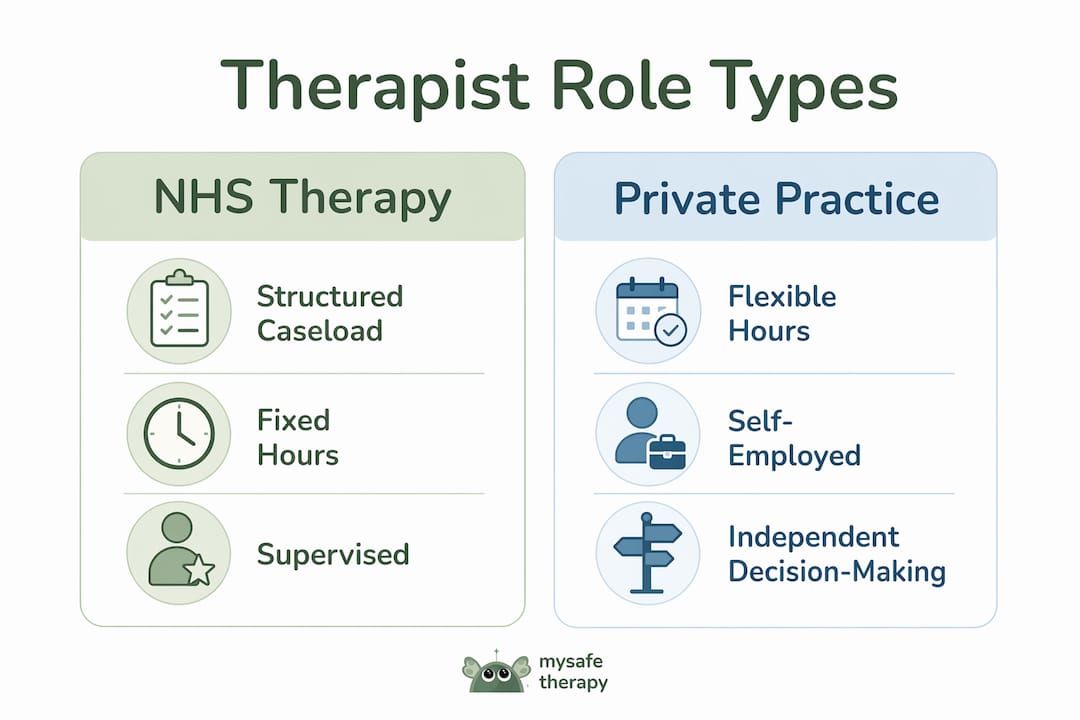
Administrative and professional tasks that appear in most roles include: writing clinical notes contemporaneously after each session, managing referrals and waiting lists, attending and preparing for supervision, completing CPD activities, and maintaining registration with the relevant professional body. Skills England's occupational framework lists these duties formally as knowledge, skills and behaviours required of counsellors across all sectors.
Session volume varies. NHS therapists in a high-intensity IAPT (now NHS Talking Therapies) role may see eight to ten clients per day in brief CBT-based work. A private psychotherapist offering longer-term relational therapy might see five to eight clients per week alongside supervision and CPD commitments. The balance between direct contact hours and administration is a practical detail worth specifying in any job description.
Pro Tip: When writing a job description, state the expected ratio of clinical to administrative hours explicitly. Candidates who underestimate the admin load are more likely to experience burnout in the first year.
Job description templates for NHS and private practice roles
The two templates below are designed to be adapted directly into job adverts or internal role profiles. Adjust titles, banding and specific modalities to match your organisation's requirements.
NHS / secondary-care psychological therapist
Job purpose: To deliver evidence-based psychological therapy to adults referred to [service name], conducting clinical assessments, formulating care plans and providing structured therapeutic interventions within a multidisciplinary team.
Core responsibilities:
- Conduct clinical and risk assessments for referred clients
- Formulate and deliver individual and/or group therapy using [specify modality, e.g. CBT, DBT, EMDR]
- Maintain accurate, contemporaneous records on [system, e.g. SystmOne, RiO]
- Participate in MDT meetings and contribute to care planning
- Attend regular clinical supervision (minimum one hour per fortnight)
- Complete mandatory safeguarding training and follow local procedures
- Contribute to service audit and outcome monitoring
Required qualifications and checks: Accredited postgraduate qualification in [modality]; registration with BACP, UKCP or HCPC (as applicable); enhanced DBS check; evidence of current CPD.
Hours and banding: Typically 37.5 hours per week, NHS Agenda for Change Band 6 or 7 depending on experience and autonomy.
Reporting line: Clinical lead or service manager; professional supervision provided separately.
Private practice / online therapy platform
Job purpose: To provide high-quality, client-centred therapy to individuals [and/or couples/families] on a self-employed or employed basis, managing your own caseload and maintaining professional standards independently.
Core responsibilities:
- Conduct initial consultations and agree therapeutic contracts, including confidentiality limits and data-retention terms
- Deliver sessions via [video/chat/phone/in-person] using [modality]
- Maintain secure, GDPR-compliant client records
- Manage scheduling, session notes and client communications
- Attend external clinical supervision (minimum one hour per month for every eight client hours)
- Maintain registration and annual CPD requirements with BACP/UKCP
- Follow platform or practice safeguarding protocols and escalation procedures
Required qualifications and checks: Accredited counselling or psychotherapy qualification; current BACP or UKCP registration; enhanced DBS check; professional indemnity insurance.
Hours and contract: Flexible; self-employed contractor or employed part-time. Session fees or salary to be agreed.
| Element | NHS / secondary care | Private / online platform |
|---|---|---|
| Caseload management | Structured, MDT-supported | Autonomous, self-managed |
| Record system | NHS electronic patient record | Secure practice software or platform system |
| Supervision | Provided by employer | Arranged independently |
| DBS requirement | Enhanced DBS | Enhanced DBS |
| Registration | BACP, UKCP or HCPC | BACP or UKCP |
| Contract type | Employed, AfC banded | Self-employed or part-time employed |
| CPD responsibility | Supported by employer | Self-directed |
Pro Tip: For adverts, lead with the client group and modality before listing requirements. Candidates self-select more accurately when they understand who they will be working with before they read the person specification.
What skills and qualities do employers look for in therapists?
The working alliance — the collaborative, trusting relationship between therapist and client — is consistently a stronger predictor of positive outcomes than any single therapy model. That finding has a direct implication for hiring: relational competencies belong at the top of any person specification, not buried below qualification requirements.

Interpersonal skills employers should specify include: empathy and active listening, the ability to build and maintain trust, appropriate challenge (not simply validation), genuineness, and cultural humility. Psychology Today's summary identifies seven qualities consistently valued by clients: empathy, non-judgement, curiosity, reliability, accountability, the ability to challenge appropriately, and self-awareness. These qualities are consistently cited as key interpersonal skills by both clients and employers.
Clinical skills to specify include: psychological formulation, competence in at least one evidence-based modality, risk assessment and management, outcome monitoring using validated tools (such as PHQ-9, GAD-7 or CORE-10), and accurate record-keeping. For evidence-based practice, competence in a named modality is a minimum; the ability to adapt that modality to the individual client is what separates adequate from excellent practice.
Professional behaviours include: maintaining clear professional boundaries, engaging actively with supervision, reflective practice, and commitment to ongoing CPD. Research summarised by the BPS shows that the best therapists use client self-report data, supervision and session review to identify and repair relationship ruptures — a practice that explains major outcome differences between therapists, regardless of years of experience.
For employers assessing these qualities at interview, structured scenarios work better than open questions. Ask candidates to describe a time the therapeutic relationship became difficult and how they managed it. Their answer reveals formulation ability, self-awareness and supervision engagement simultaneously.
Pro Tip: Include "emotional safety" as an explicit competency in your person specification. Candidates who can articulate what emotional safety means in a clinical context demonstrate both relational awareness and professional maturity.
What qualifications and registration do therapists need in the UK?
Training routes vary by modality and level of practice, but the broad structure is consistent across the sector.
Common training pathways:
- An undergraduate degree in psychology, nursing, social work, education or a related field, followed by an accredited postgraduate diploma or master's in counselling or psychotherapy
- Direct entry to a UKCP-accredited psychotherapy training programme (typically four years part-time), which includes personal therapy, supervised clinical hours and theoretical study
- NHS-funded training routes such as the Improving Access to Psychological Therapies (IAPT) high-intensity therapist programme for CBT practitioners
UKCP-accredited programmes at Level 7 typically require approximately 450 hours of supervised practice before registration is granted, often taking a further period beyond the taught course to complete. The British Psychotherapy Foundation notes that reputable trainings also require personal therapy throughout, treating the trainee's own development as a clinical requirement, not an optional extra.
Registration and protected titles:
| Body | Type | Title protection | Who it covers |
|---|---|---|---|
| HCPC | Statutory register | Yes (e.g. "Clinical Psychologist") | Practitioner psychologists |
| BACP | Voluntary register (PSA-accredited) | No | Counsellors and psychotherapists |
| UKCP | Voluntary register (PSA-accredited) | No | Psychotherapists |
| BPC | Voluntary register | No | Psychoanalytic practitioners |
The practical difference for employers: if a role requires an HCPC-registered clinical or counselling psychologist, that title is legally protected and verifiable on the HCPC register. For therapist and psychotherapist roles, BACP or UKCP registration is the recognised professional standard, but the title itself is not protected by statute.
Experience expectations by level:
- Entry-level: Accredited qualification, placement experience, minimum supervised client hours as required by training body, current registration
- Intermediate: Two or more years post-qualification experience, evidence of CPD, established supervision arrangements
- Senior/specialist: Significant post-qualification experience, specialist modality training, supervision or clinical leadership experience, contribution to service development
Required checks for all roles: Enhanced DBS (with barred list check where working with children or vulnerable adults), right-to-work documentation, safeguarding training (level appropriate to role), evidence of current registration and professional indemnity insurance.
What do therapists earn in the UK?
Pay varies significantly by sector, contract type and session volume. The figures below are directional guides rather than definitive payroll data.
- NHS employed roles typically fall within Agenda for Change Band 6 Salary bands typically fall within the NHS Agenda for Change Band 6 range for qualified therapists working within defined protocols; Band 7 usually applies to those with greater autonomy, specialist skills or supervisory responsibilities. Band 8a applies to consultant-level or highly specialist posts.
- Private practice session fees for self-employed therapists in the UK commonly range from £50 to £120 per session, with higher rates in London and for specialist modalities. Therapists working via online platforms may receive a proportion of the platform fee after the platform's administrative costs are deducted.
- Charity sector roles are generally employed positions, often banded similarly to NHS roles or slightly below, depending on the organisation's funding model.
- Zero-hours and sessional contracts are common in both NHS and third-sector settings for therapists covering additional capacity. Income under these arrangements depends entirely on session volume and is not guaranteed.
- Annual income in private practice depends on the number of sessions delivered per week, the fee charged, and the proportion of time spent on non-billable administration. Annual income in private practice depends on the number of sessions delivered per week, the fee charged, and the proportion of time spent on non-billable administration.
Working hours vary equally. NHS therapists typically work 37.5 hours per week on a standard contract. Private practitioners often work part-time clinical hours supplemented by administration, supervision and CPD, with many choosing to work evenings and weekends to accommodate client availability.
Record-keeping, confidentiality and GDPR obligations
Therapists in the UK operate under clear legal and professional obligations regarding records and data. These obligations belong in every job description and every induction programme.
What good records look like:
- Written contemporaneously (or as soon as practicable after each session)
- Factual, objective and free from unnecessary personal opinion
- Stored securely, with access restricted to authorised personnel
- Retained for the period specified by professional guidance (BACP recommends a minimum of seven years for adult client records, longer where children are involved)
- Accessible to the client on request under UK data-protection law
UK data-protection law governs how client information is collected, stored, processed and shared. Therapists must obtain informed consent for data processing, explain who can access records, state the retention period, and describe what happens to records at the end of therapy. BACP's good-practice guidance recommends that this information is covered explicitly in the initial therapeutic contract, both to meet data-protection requirements and to strengthen the working alliance. For online practice, confidentiality procedures include platform security standards, encrypted storage and clear policies on data access.
Safeguarding and mandatory reporting:
- Therapists must follow local and national safeguarding procedures when a disclosure raises concern about risk to a child or vulnerable adult
- Confidentiality has defined limits: risk of serious harm to the client or others, court orders, and certain public-interest disclosures can override the duty of confidentiality
- All therapists working with children or vulnerable adults require an enhanced DBS check with barred list check
- Safeguarding training must be kept current, at a level appropriate to the role and client group
Wording for job descriptions: Include a clause specifying that the post-holder will maintain records in accordance with professional body guidance and UK data-protection law, attend safeguarding training as required, and follow the organisation's confidentiality policy including its stated limits.
Statistic to note: Research from the London Centre for Applied Psychology found that therapist effects account for approximately 8–10% of client outcomes, and that the top 13% of therapists achieved recovery rates twice those of below-average practitioners. Supervision and deliberate practice, not years of experience alone, explain that gap.
How to write a therapist job description that attracts the right candidates
A well-constructed job description does two things: it sets accurate expectations for candidates and it protects the organisation by specifying the minimum professional standards required.
Core sections to include:
- Job purpose: One or two sentences stating the client group, setting and primary therapeutic function
- Key duties: A numbered or bulleted list of eight to twelve specific responsibilities (not a generic list of "general duties as required")
- Person specification: Separated into essential and desirable criteria, covering qualifications, registration, experience, skills and personal qualities
- Professional requirements: Registration body, DBS level, safeguarding training, supervision arrangements and CPD expectations
- Reporting lines: Who the post-holder is clinically supervised by and who they are managerially accountable to
- Terms and benefits: Hours, contract type, salary or fee, leave entitlement and any employer-funded CPD or supervision
Getting the registration language right: Write "current registration with BACP, UKCP or equivalent PSA-accredited body" rather than naming only one body, unless the role genuinely requires a specific register. For HCPC-protected titles, state the exact protected title required. Avoid vague phrases such as "relevant professional membership" — they invite applications from candidates with unaccredited training.
Inclusive language and reasonable adjustments: State that the organisation welcomes applications from candidates with lived experience of mental health difficulties, and include a standard reasonable-adjustments line. Avoid language that inadvertently excludes candidates from non-traditional training backgrounds where the role does not require a specific route.
Pro Tip: Specify supervision arrangements in the job description itself, not just in the contract. Candidates who prioritise their professional development treat the quality of supervision on offer as a deciding factor when choosing between roles.
How to verify UK therapist credentials before hiring
Credential verification is a non-negotiable step, not an administrative courtesy. These checks protect clients and protect the organisation.
Step-by-step verification process:
- BACP register: Search the BACP therapist directory by name. The register confirms current membership status and accreditation level. Complaints and fitness-to-practise outcomes are published on the BACP website.
- UKCP register: Search the UKCP online directory to confirm registration, modality and any conditions on practice. UKCP also publishes fitness-to-practise decisions.
- HCPC register: For roles requiring a protected title (clinical psychologist, counselling psychologist, etc.), verify on the HCPC online register. This is a statutory check and should be treated as mandatory.
- DBS check: Request an enhanced DBS certificate, with barred list check where the role involves regulated activity with children or vulnerable adults. Do not rely on a certificate more than three months old for a new appointment.
- Training documentation: Request the original certificate of qualification, the name of the awarding body, and confirmation that the course was accredited by BACP, UKCP, HCPC or another PSA-accredited body at the time of completion.
- Supervision records: Ask for evidence of current supervision arrangements, including the supervisor's name and registration. A candidate without active supervision is not meeting professional standards.
- References: At least one reference should come from a clinical supervisor or line manager with direct knowledge of the candidate's clinical work, not only their character.
Spotting misleading claims: Be cautious of qualifications from unaccredited providers, vague descriptions such as "trained in CBT" without a named course or awarding body, and membership of bodies that are not PSA-accredited. The UK therapy regulations overview provides a useful summary of the registration landscape and what each body confirms.
Pro Tip: Always check the register on the day of appointment, not just at shortlisting. Registration can lapse between application and start date.
Key takeaways
A therapist job description that specifies registration, supervision and safeguarding requirements explicitly is the single most effective tool for protecting clients and attracting qualified candidates.
| Point | Details |
|---|---|
| Registration is not optional | Require current BACP, UKCP or HCPC registration in every job description and verify it on the day of appointment. |
| Working alliance predicts outcomes | Relational competencies (empathy, genuineness, appropriate challenge) belong at the top of every person specification. |
| Supervision must be specified | State supervision arrangements in the job description; candidates treat this as a quality signal when choosing roles. |
| Pay varies significantly by sector | NHS Band 6–7 roles and private practice fees differ substantially; state the contract type and pay model clearly in adverts. |
| Records and GDPR are non-negotiable | Every role must include contemporaneous record-keeping, data-protection compliance and current safeguarding training as explicit requirements. |
Why precise job descriptions protect clients and therapists alike
There is a tendency in the sector to treat job descriptions as administrative paperwork — something produced quickly to fill a vacancy and filed away once the post is filled. That approach carries real risk.
When a job description fails to specify registration requirements clearly, it opens the door to applications from practitioners with unaccredited training. When it omits supervision arrangements, it signals to candidates that professional development is not a priority. When it says nothing about safeguarding or data-protection duties, it creates ambiguity about accountability that can surface at exactly the wrong moment.
The evidence is clear: therapist effects account for a measurable portion of client outcomes, and the gap between the best and least effective practitioners is substantial. Supervision, deliberate practice and clear role expectations are what close that gap. A well-written job description is where that process begins. Employers who invest in precise role definitions, rigorous credential checks and structured supervision are not simply meeting a compliance requirement. They are making a direct contribution to client safety and therapeutic quality.
For applicants, the same logic applies in reverse. A job description that specifies supervision, CPD support and clear reporting lines is a reliable indicator of an organisation that takes clinical governance seriously. It is worth reading carefully before accepting any offer.
Find a therapist or list your practice with Mysafetherapy

Mysafetherapy connects adults across the UK with accredited therapists registered with BACP, UKCP and NCPS, offering sessions by video, phone, chat and avatar-based therapy from £49. All therapists on the platform are verified against professional registers before they work with clients, and supervision and CPD requirements are built into the platform's standards.
Whether you are an employer looking to understand what a qualified therapist role looks like, or an individual ready to start therapy, Mysafetherapy provides a transparent, safe and accessible route to professional mental health support.
Useful sources
The following authoritative UK sources were used in preparing this article and are recommended for further reference.
- BACP (British Association for Counselling and Psychotherapy) — Professional register lookup, ethical framework, good-practice guidance documents and CPD resources for counsellors and psychotherapists.
- UKCP (United Kingdom Council for Psychotherapy) — Register of accredited psychotherapists, training accreditation standards and fitness-to-practise decisions.
- HCPC (Health and Care Professions Council) — Statutory register for practitioner psychologists; confirms protected-title registration and publishes fitness-to-practise outcomes.
- BPS (British Psychological Society) — Guidance on psychological therapy principles, therapist effects research and good-practice standards.
- NHS Health Careers — psychological therapies — Overview of therapy roles within the NHS, including distinctions between psychology, psychiatry and psychotherapy.
- National Careers Service — psychotherapist profile — Skills, qualifications and day-to-day tasks for psychotherapist roles in the UK.
- Prospects.ac.uk — psychotherapist profile — Detailed responsibilities, training routes and career progression guidance.
- Skills England — counsellor occupation profile — Formal occupational framework listing knowledge, skills and behaviours for counsellor roles across sectors.
- Mysafetherapy — UK therapy regulations overview — Summary of the UK registration landscape and what each professional body confirms.
This article provides general information about therapist roles and job descriptions in the UK. It does not constitute legal, HR or professional advice. Employers and candidates should confirm current registration requirements and employment law obligations with the relevant professional body or a qualified adviser.