

TL;DR:
- Psychotherapy is a structured talking treatment where a trained practitioner helps improve psychological wellbeing through a therapeutic relationship. It addresses a wide range of issues, including anxiety, depression, trauma, and relationship challenges, often for self-improvement and prevention.
Psychotherapy, often called talking therapy, is a professional treatment in which a trained practitioner helps a person explore thoughts, feelings, and behaviours to improve psychological wellbeing through a structured therapeutic relationship. According to the UKCP, it focuses on understanding personal history and relational patterns rather than simply managing immediate symptoms.
Three things to know before reading further:
- Goals: Reduce psychological distress, improve relationships, process trauma, and build self-awareness.
- Who provides it: Qualified psychotherapists, psychologists, and psychiatrists accredited by bodies such as UKCP, BACP, or HCPC, or working within NHS services.
- Formats: In-person, phone, video, group, and online platforms.
Table of Contents
- What can psychotherapy help with?
- How does psychotherapy actually produce change?
- What are the main types of psychotherapy?
- What happens during a psychotherapy session?
- How long does psychotherapy usually take?
- How do you find a psychotherapist in the UK?
- How does psychotherapy differ from counselling, psychology, and psychiatry?
- Key takeaways
- Why trustworthy psychotherapy matters
- Useful sources and further reading
What can psychotherapy help with?
Psychotherapy covers a wider range of difficulties than most people expect. The NHS and Mind both recognise talking therapies as appropriate for a broad set of presenting problems, including:
- Anxiety disorders: Persistent worry, panic attacks, phobias, or social anxiety that interfere with daily life.
- Depression: Low mood, loss of motivation, or persistent feelings of hopelessness.
- Grief and loss: Bereavement, relationship breakdown, or major life transitions.
- Relationship difficulties: Communication problems, conflict, or patterns that repeat across relationships.
- Trauma and PTSD: Distressing memories, flashbacks, or emotional numbness following difficult experiences.
- Obsessive thoughts and compulsive behaviours: Intrusive thoughts or rituals that feel difficult to control.
- Workplace stress and burnout: Exhaustion, disengagement, or difficulty maintaining boundaries at work. Professionals dealing with confidential work-related stress often find structured therapy particularly useful here.
- Caregiver strain: Those supporting ill or elderly relatives frequently carry significant emotional weight; caregiver wellbeing support is an area where therapy can make a meaningful difference.
Psychotherapy is not only for people in crisis. As the UKCP emphasises, many people use it to increase self-awareness, improve relationships, and prevent future difficulties.
"Therapy can provide a safe, confidential space to talk, understand yourself better, resolve complicated feelings, and learn new coping strategies." — Mind
How does psychotherapy actually produce change?
Talking to a trained professional works through several distinct mechanisms, not simply through venting or receiving advice.
Therapeutic alliance. The relationship between client and therapist is itself a vehicle for change. Studies consistently show that the quality of the therapeutic relationship is one of the strongest predictors of a good outcome, across all modalities. This matters more than which specific technique a therapist uses.
New perspectives. Therapy helps people identify thought patterns and assumptions they have never examined. Naming a pattern is often the first step to changing it.
Behavioural experiments. Many approaches ask clients to try new behaviours between sessions and reflect on what happens. This builds evidence against unhelpful beliefs.
Trauma processing. Specific techniques help clients revisit and reprocess distressing memories in a safe, contained environment, reducing their emotional charge over time.
The evidence base supports psychotherapy as an effective treatment for depression, anxiety disorders, OCD, and trauma-related conditions. NICE and NHS pathways recommend talking therapies as first-line treatments for many common mental health disorders. For a detailed review of what the research actually shows, the Mysafetherapy guide on therapy's real impact is worth reading.
The practical implication: when choosing a therapist, prioritise verified accreditation and a good personal fit over the specific modality label. The role of empathy in that relationship is a key part of why therapy works.
What are the main types of psychotherapy?
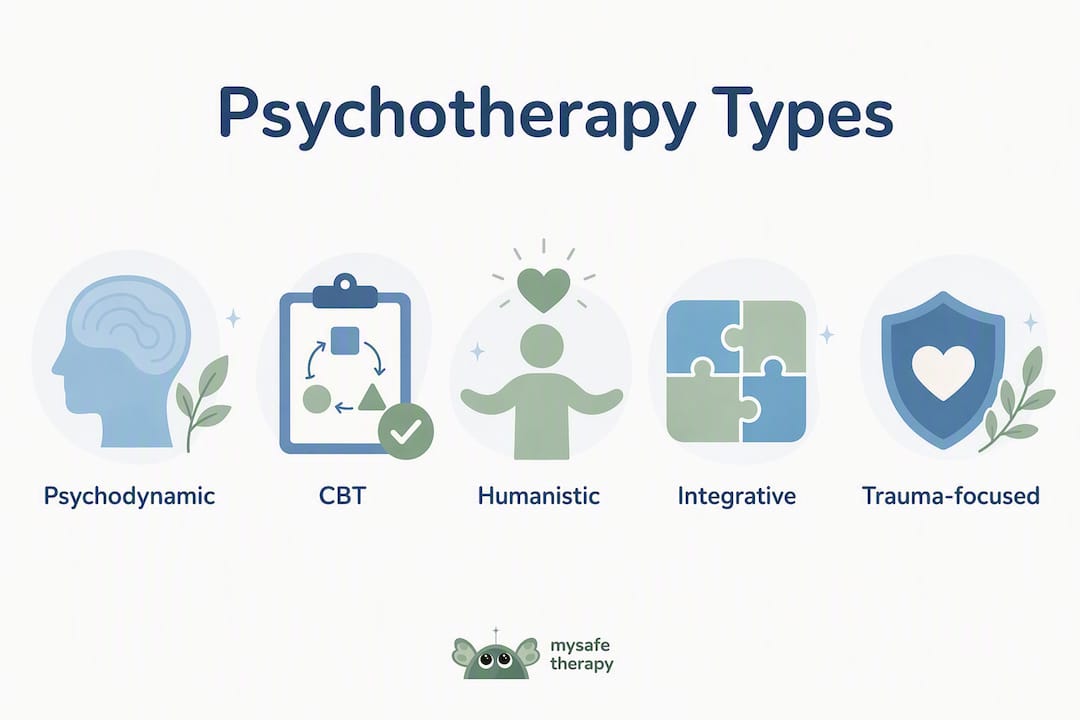
Most UK therapists work within one or more of the following approaches. Many are integrative, drawing on several traditions.
-
Cognitive Behavioural Therapy (CBT): Structured and time-limited, CBT focuses on the links between thoughts, feelings, and behaviours. It is widely available on the NHS and has a strong evidence base for anxiety and depression. Sessions typically involve homework tasks between appointments.
-
Psychodynamic therapy: Rooted in psychoanalytic traditions, this approach explores how past experiences and unconscious patterns shape present difficulties. Sessions are more exploratory and less structured than CBT. Often recommended for longer-standing relational or personality difficulties.
-
Humanistic and person-centred therapy: Focuses on the client's own capacity for growth. The therapist offers unconditional positive regard and empathy rather than directing the process. Useful for self-esteem issues, identity questions, and personal development.
-
EMDR (Eye Movement Desensitisation and Reprocessing): A structured approach for trauma and PTSD, using bilateral stimulation (typically eye movements) to help the brain reprocess distressing memories. NICE recommends it for PTSD.
-
Couples and family therapy: Addresses relational dynamics between two or more people in the room. Useful for communication breakdown, conflict, or shared trauma. A detailed overview of relationship therapy methods covers what to expect.
-
Group therapy: A therapist facilitates a small group of clients who share similar difficulties. The group dynamic itself becomes a therapeutic tool, offering peer support and real-time relational feedback.
-
Integrative approaches: Many practitioners combine elements from several traditions, tailoring the work to the individual. This is increasingly common and does not indicate a lack of rigour, provided the therapist holds recognised training. For a broader look at effective therapy techniques, Mysafetherapy's guide covers the main options clearly.
The Royal College of Psychiatrists notes that the relationship between client and practitioner is central to all these approaches, regardless of the specific technique used.
What happens during a psychotherapy session?
The assessment phase. The first one to three sessions are typically exploratory. The therapist gathers information about your history, current difficulties, and goals. You are also assessing them. This is a two-way process.
Session structure. Most sessions last 50–60 minutes and take place weekly, though frequency varies. The therapist will usually open by checking in, then follow the client's lead or return to themes from previous sessions. There is no script.
Confidentiality. What you discuss stays between you and your therapist, with clearly defined exceptions: risk of serious harm to yourself or others, or a legal requirement to disclose. Your therapist should explain these limits at the outset.
Remote versus in-person. Online and hybrid formats are now standard practice among accredited therapists. Video and phone sessions offer equivalent therapeutic value for most presentations, with the added benefit of accessibility.
Emotional intensity. Sessions can leave you feeling tired or emotionally raw, particularly after deep work. Mind advises planning calm activities after sessions and monitoring your wellbeing between appointments. This reaction is normal, not a sign that therapy is going wrong.
Pro Tip: Use the first two or three sessions as a deliberate assessment period. Ask your therapist directly about their training, accreditation, and approach. If the relationship does not feel right after three sessions, it is entirely reasonable to try someone else. The UKCP explicitly supports this.
How long does psychotherapy usually take?
Duration depends on the goals, the complexity of the presenting difficulties, and the approach used.
| Type of work | Typical duration | Common approaches |
|---|---|---|
| Short-term focused therapy | 6–20 sessions | CBT, solution-focused, EMDR |
| Medium-term work | 3–12 months | Integrative, psychodynamic |
| Longer-term therapy | 1 year or more | Psychodynamic, relational, complex trauma |
| NHS talking therapies | Usually 8–16 sessions | CBT-based (IAPT/NICE-recommended) |
Short-term therapy suits specific, well-defined problems. Longer-term work is more appropriate for complex trauma, personality difficulties, or deeply ingrained relational patterns.
Signs that therapy is making progress include: greater clarity about your own patterns, reduced intensity of distressing symptoms, improved relationships, and a growing sense of agency. If progress stalls, it is worth discussing this with your therapist rather than simply continuing.
A brief historical note: the major schools of psychotherapy emerged across the twentieth century. Psychodynamic approaches grew from Freud's psychoanalytic work; behavioural and cognitive approaches developed mid-century as evidence-based alternatives; humanistic therapies emerged in the 1950s and 1960s as a response to both. This history explains why multiple modalities co-exist today, each with a distinct theoretical basis and evidence base.
How do you find a psychotherapist in the UK?
Finding a therapist involves more than a Google search. Accreditation and fit both matter.
Accreditation bodies to know:
- UKCP (UK Council for Psychotherapy): Accredits psychotherapists and psychotherapeutic counsellors; typically expects postgraduate-level (level 7) training.
- BACP (British Association for Counselling and Psychotherapy): Accredits counsellors and psychotherapists; a widely recognised standard for ethical practice.
- HCPC (Health and Care Professions Council): Regulates protected titles including clinical psychologist and counselling psychologist.
- RCPsych (Royal College of Psychiatrists): The professional body for psychiatrists, who are medically qualified and can prescribe.
- NICE: Sets clinical guidelines that inform NHS talking therapy pathways; a useful benchmark for evidence-based practice.
You can verify any therapist's registration directly on the UKCP, BACP, or HCPC online registers. Mysafetherapy publishes its own therapist standards so you can see exactly how practitioners on the platform are vetted.
NHS versus private access:
| Route | How to access | Typical wait | Approximate cost |
|---|---|---|---|
| NHS IAPT/Talking Therapies | Self-refer or GP referral | Weeks to months | Free at point of use |
| NHS secondary care | GP referral | Longer | Free at point of use |
| Private therapist | Direct booking | Usually within days | £50–£120 per session |
| Online platform (e.g. Mysafetherapy) | Direct booking online | Often within days | Varies by plan |
Practical questions to ask at first contact:
- What is your accreditation and with which body?
- What training have you completed and at what level?
- What is your experience with my specific difficulty?
- What approach do you use and why?
- What are your fees, cancellation policy, and session format options?
Red flags to watch for: guarantees of a cure or specific outcome; unwillingness to discuss training or registration; no clear confidentiality policy; pressure to commit to a long block of sessions upfront; contact outside agreed boundaries.
For a step-by-step walkthrough of starting online therapy, Mysafetherapy's guide covers the process clearly. The therapist matching process is also worth understanding before you book.
How does psychotherapy differ from counselling, psychology, and psychiatry?
These titles are often used interchangeably in everyday conversation, but they describe distinct training backgrounds, regulatory frameworks, and scopes of practice.
| Role | Training | Regulated by | Can prescribe? | Typical focus |
|---|---|---|---|---|
| Psychotherapist | Postgraduate diploma or degree (often level 7); multi-year training | UKCP or BACP (accreditation, not statutory) | No | Relational and developmental patterns; longer-term work |
| Counsellor | Diploma level; shorter training than psychotherapist | BACP or NCPS (accreditation) | No | Specific life difficulties; shorter-term support |
| Clinical/counselling psychologist | Doctoral level (DClinPsy or equivalent) | HCPC (statutory) | No (in most cases) | Assessment, formulation, evidence-based therapy |
| Psychiatrist | Medical degree plus specialist psychiatric training | GMC (statutory) | Yes | Diagnosis, medication management, complex mental illness |
The clearest practical distinction: psychiatrists link medical diagnosis and medication with therapeutic care; psychotherapists focus on relational and developmental patterns through talking. Health Careers NHS notes that a psychotherapist may also hold a background in psychology or psychiatry, with additional specialist training.
When to see a psychiatrist: if you need a formal diagnosis, medication assessment, or have a complex presentation involving psychosis or severe mood disorder.
When to see a psychotherapist: if you want to explore patterns, process difficult experiences, or work on psychological wellbeing through talking, without a primary need for medication.
The title "psychologist" is protected by law; only those registered with the HCPC may use it. "Psychotherapist" and "counsellor" are not currently protected titles in the UK, which is precisely why checking UKCP or BACP accreditation matters.
Key takeaways
Psychotherapy is a structured, evidence-based talking treatment delivered by accredited practitioners, effective for a wide range of psychological difficulties, and available in the UK through NHS and private routes.
| Point | Details |
|---|---|
| Clear definition | Psychotherapy uses a professional therapeutic relationship to improve psychological wellbeing through structured talking. |
| Evidence base | NICE and NHS pathways recommend talking therapies as first-line treatments for depression, anxiety, and PTSD. |
| Alliance over modality | The quality of the therapeutic relationship predicts outcomes more reliably than the specific approach used. |
| Check accreditation | Verify any therapist's registration with UKCP, BACP, or HCPC before committing to sessions. |
| Practical next step | Mysafetherapy connects UK adults with accredited therapists via video, chat, and avatar formats, often within days. |
Why trustworthy psychotherapy matters
The gap between good therapy and poor therapy is not always visible from the outside. A practitioner can sound credible, use the right terminology, and still lack the training or ethical grounding that protects clients. At Mysafetherapy, the platform's position is straightforward: accreditation is not a box-ticking exercise. Every therapist on the platform holds registration with a recognised UK body, whether BACP, UKCP, or NCPS, and that registration is verifiable.
The formats available, video, chat, phone, and avatar-based sessions, exist because accessibility matters as much as quality. Someone who cannot attend in-person sessions, whether due to geography, work schedules, or anxiety about face-to-face contact, should not have to choose between convenience and clinical standards. Supplementary tools including AI journaling, mood tracking, and guided self-help resources sit alongside live sessions, not as replacements for them, but as a way to maintain momentum between appointments.
The therapeutic relationship remains the central mechanism of change. Mysafetherapy's matching process is designed with that in mind: finding the right therapist is the first and most important step.
Useful sources and further reading
The following resources are authoritative starting points for anyone researching psychotherapy in the UK.
- NHS Counselling and Talking Therapies: Explains NHS access routes, session formats, and what to expect from talking therapy on the NHS.
- UKCP: What is psychotherapy?: The professional body's own definition and guidance on finding an accredited practitioner.
- UKCP: How psychotherapy works: Covers mechanisms of change and what the therapeutic process involves.
- Mind: Understanding therapy and counselling: Accessible overview of therapy types, what to expect, and how to access support.
- Mind: What to expect from therapy: Practical preparation for sessions, including emotional intensity and self-care.
- RCPsych: About psychotherapy: The Royal College of Psychiatrists' overview of psychotherapeutic treatments.
- Health Careers NHS: Differences between psychology, psychiatry and psychotherapy: Clear explanation of professional roles and training pathways.
- NIMH: Psychotherapies: US-based review of the evidence base for psychotherapy across common conditions.
- Mysafetherapy: Start therapy: Platform landing page explaining accreditation, formats, and how to begin.
- Mysafetherapy: Therapist standards: Details the accreditation and vetting criteria applied to therapists on the platform.
- Mysafetherapy: Why seek mental health support: Practical guidance on deciding whether therapy is right for you and how to take the first step.
Before booking, verify your therapist's registration directly on the UKCP, BACP, or HCPC register. If you are unsure where to start, a short trial session, typically one to three appointments, is a low-commitment way to assess the fit before committing to a longer course of work.
Ready to take the next step? Book a session with a UK-accredited therapist on Mysafetherapy, with flexible formats and no long-term commitment required.
This article provides general information about psychotherapy and is not a substitute for professional clinical advice. For guidance specific to your situation, consult a qualified mental health professional or your GP.